
Malaysia vs Global Markets
HR Operations Analysts are the engine behind smooth HR processes. They ensure payroll runs correctly, compliance is met, and HR systems stay updated. From managing employee data to coordinating cross-border payroll, they help businesses stay compliant and efficient. As companies expand globally, demand for HR operations talent with payroll and compliance expertise continues to grow.
This guide compares 2026 HR Operations Analyst salary benchmarks across Malaysia, the US, Singapore, Hong Kong, and Australia to support smarter hiring decisions.
Content Outline
Key Summary
Cost-Effective Talent in Malaysia
HR Operations Analysts in Malaysia earn MYR 75k–105k (USD 17k–24k), offering strong payroll efficiency compared to Western markets.
High Salaries in the U.S.
Senior analysts in the US typically earn USD 70k–85k due to complex compliance and enterprise HR systems.
Competitive Pay in Singapore
Analysts earn SGD 60k–95k (USD 44k–70k), especially in financial services and multinational firms.
Moderate Salaries in Hong Kong
Analysts earn HKD 300k–450k (USD 38k–58k), reflecting demand in finance, logistics, and compliance-heavy industries.
Experienced Talent in Australia
Salaries range AUD 75k–105k+ (USD 50k–70k+) for analysts skilled in payroll, compliance, and HRIS systems.
Outsourcing Maximizes ROI
Hiring in Malaysia provides access to English-speaking analysts with payroll expertise, delivering 55–60% payroll efficiency.
Simplified Hiring via EOR
FastLaneRecruit’s EOR solution manages contracts, payroll, and compliance while companies retain operational control.
HR Operations Analyst Salary Breakdown by Country (2026)
Malaysia
| Level | Salary (MYR) | Salary (USD) |
| Entry (0–2 yrs) | 75,000–85,000 | 17,000–19,000 |
| Mid (3–5 yrs) | 90,000–100,000 | 20,500–22,500 |
| Senior (6+ yrs) | 100,000–105,000 | 23,000–24,000 |
Market Insight: Malaysia offers cost-efficient analysts with strong payroll compliance expertise.
United States
| Level | Salary (USD) |
| Entry (0–2 yrs) | 50,000–60,000 |
| Mid (3–5 yrs) | 60,000–70,000 |
| Senior (6+ yrs) | 70,000–85,000 |
Market Insight: High salaries reflect demand for compliance-heavy HR operations in large enterprises.
Singapore
| Level | Salary (SGD) | Salary (USD) |
| Entry (0–2 yrs) | 60,000–70,000 | 44,000–52,000 |
| Mid (3–5 yrs) | 75,000–85,000 | 55,000–63,000 |
| Senior (6+ yrs) | 95,000+ | 70,000+ |
Market Insight: Analysts in multinational firms and financial services command premium pay.
Also Read: Building a High-Performing Offshore HR and Payroll Management Team in Malaysia (Singapore Edition)
Hong Kong
| Level | Salary (HKD) | Salary (USD) |
| Entry (0–2 yrs) | 300,000–350,000 | 38,000–45,000 |
| Mid (3–5 yrs) | 370,000–400,000 | 47,000–51,000 |
| Senior (6+ yrs) | 420,000–450,000 | 54,000–58,000 |
Market Insight: Strong demand in finance and logistics drives salaries upward.
Australia
| Level | Salary (AUD) | Salary (USD) |
| Entry (0–2 yrs) | 75,000–80,000 | 50,000–53,000 |
| Mid (3–5 yrs) | 90,000–100,000 | 60,000–67,000 |
| Senior (6+ yrs) | 105,000+ | 70,000+ |
Market Insight: Analysts with HRIS and compliance expertise are highly sought after.
Comparing HR Operations Analyst Salaries Across Countries
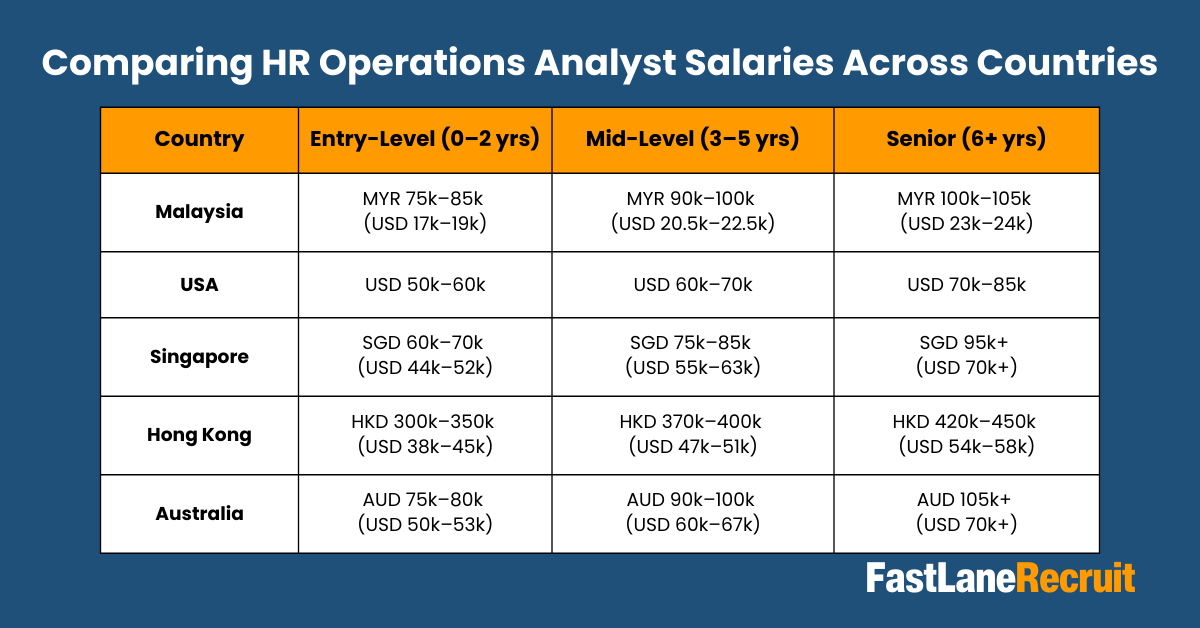
| Country | Entry-Level (0–2 yrs) | Mid-Level (3–5 yrs) | Senior (6+ yrs) |
| Malaysia | MYR 75k–85k (USD 17k–19k) | MYR 90k–100k (USD 20.5k–22.5k) | MYR 100k–105k (USD 23k–24k) |
| USA | USD 50k–60k | USD 60k–70k | USD 70k–85k |
| Singapore | SGD 60k–70k (USD 44k–52k) | SGD 75k–85k (USD 55k–63k) | SGD 95k+ (USD 70k+) |
| Hong Kong | HKD 300k–350k (USD 38k–45k) | HKD 370k–400k (USD 47k–51k) | HKD 420k–450k (USD 54k–58k) |
| Australia | AUD 75k–80k (USD 50k–53k) | AUD 90k–100k (USD 60k–67k) | AUD 105k+ (USD 70k+) |
Key Insight: Malaysia remains the most cost-efficient option, while the US and Singapore command higher salaries due to compliance-heavy HR demands.
Why These Salaries Differ
HR Operations and payroll roles look similar on paper across countries, but salary levels can vary significantly. These differences are shaped by living costs, market demand, skill requirements, and how global companies structure their regional operations.
1. Cost of Living and Local Expenses
The cost of everyday living has a direct impact on salary expectations. Countries such as the United States, Singapore, Hong Kong, and Australia have much higher housing, transportation, and healthcare costs compared to Malaysia. To help employees maintain a reasonable standard of living, employers in these markets must offer higher base salaries.
Example: An HR Operations Analyst working in Singapore may need a higher salary simply to cover rental costs and daily expenses, which can be several times higher than in Kuala Lumpur. In contrast, a similar role in Malaysia can be paid at a competitive local rate while still offering a comfortable lifestyle.
Also Read: Building a High-Performing Offshore HR and Payroll Management Team in Malaysia (Hong Kong Edition)
2. Industry Concentration and Regulatory Complexity
Financial centres like New York, Singapore, and Hong Kong host a large number of multinational corporations, banks, and regulated industries. These companies face strict labour, tax, and data protection regulations, increasing the risk and responsibility tied to payroll and HR compliance roles.
Because mistakes can lead to significant penalties, companies in these markets are willing to pay more to secure experienced professionals who can manage complex reporting and compliance requirements.
Example: A payroll analyst supporting a multinational bank in Hong Kong may manage multiple benefit schemes and regional tax rules, which requires advanced expertise and therefore attracts higher pay compared to a similar role in Malaysia supporting a regional team.
3. Skill Specialisation and Professional Credentials
Across all countries, professionals with specialised HR technology skills and recognised certifications are more highly paid. Experience in systems such as SAP, Workday, and Oracle HCM, as well as certifications like CIPD and SHRM, signals strong technical knowledge and compliance expertise.
These skills reduce operational risk for employers and improve reporting accuracy, making such professionals more valuable in any market.
Example: An HR Operations Analyst in Australia with Workday implementation experience and CIPD certification can earn a higher salary than a generalist HR administrator, even within the same company, because of their ability to manage system integrations and compliance workflows.
4. Remote Work and Global Hiring Strategies
The rise of remote and hybrid work has changed how companies build HR operations teams. Instead of hiring exclusively in high-cost markets, many global employers now outsource payroll and HR operations to Malaysia to balance cost efficiency and compliance quality.
Malaysia offers a strong pool of English-speaking HR professionals with experience supporting regional teams across Asia-Pacific, making it an attractive location for shared service centres.
Example: A US-based SaaS company may choose to build a regional HR operations team in Malaysia instead of Singapore. By doing so, the company can still receive accurate payroll processing and compliance support while significantly reducing operational costs and improving scalability.
Also Read: Building a High-Performing Offshore HR and Payroll Management Team in Malaysia (Australia Edition)
Why Outsource HR Operations to Malaysia
Malaysia has become a preferred hub for global companies building regional HR operations teams. It offers a rare balance of quality talent, strong compliance knowledge, and operational efficiency, making it ideal for payroll and HR outsourcing.
1. Lower Payroll Costs Without Sacrificing Quality
Compared to markets like Singapore, Hong Kong, Australia, and the United States, Malaysia offers more manageable salary levels while maintaining a highly skilled workforce. This allows companies to build full HR operations teams without stretching budgets.
Example: A company that might only afford one HR Operations Analyst in Singapore can often build a small regional support team in Malaysia, covering payroll processing, reporting, and employee queries across multiple countries.
2. Certified Talent with Global HR Tools
Malaysia has a growing pool of HR professionals trained in global HR systems such as SAP, Workday, and Oracle HCM, as well as internationally recognised certifications like CIPD and SHRM. These skills enable Malaysian HR teams to support multinational payroll structures and compliance reporting.
Example: A European company can rely on a Malaysia-based HR operations team to manage payroll reports, benefits administration, and HR system updates across several APAC countries.
3. Time Zone Overlap for APAC and Europe
Malaysia’s time zone offers overlapping working hours with both Asia-Pacific and parts of Europe. This makes it easier for HR operations teams to collaborate in real time, respond to employee queries, and manage payroll cycles without long delays.
Example: A UK-based company can communicate with its Malaysia HR team during overlapping business hours to resolve payroll queries before the end of the same working day.
Also Read: 2026 Hong Kong Salary Guide
4. Strong English Proficiency
English is widely used in Malaysia’s business environment, enabling smooth communication with global teams, employees, and external partners. This reduces miscommunication risks and improves payroll accuracy and reporting clarity.
Example: A US company can assign payroll reporting and employee support to a Malaysia-based team without language barriers, ensuring smooth operations across time zones.
5. Simplified Payroll and Compliance with an EOR
For companies without a local entity, partnering with an Employer of Record (EOR) simplifies payroll, tax, and compliance management. An EOR handles statutory registrations, payroll submissions, and compliant employment contracts.
Example: By using FastLaneRecruit’s EOR service, a growing tech startup can hire HR operations staff in Malaysia quickly while ensuring all EPF, SOCSO, EIS, and PCB obligations are met, without setting up a local company.
Use Case: Scaling HR Operations Teams
A U.S.-based SaaS company was preparing for rapid expansion across Asia-Pacific and Europe. As their workforce grew, their internal HR team struggled to keep up with payroll processing, statutory reporting, employee queries, and compliance tracking across multiple countries.
Hiring additional HR operations staff in the U.S. or Singapore proved expensive and would significantly increase overhead costs. The company needed a way to scale its HR support without compromising accuracy, compliance, or service quality.
The Challenge
- Rising payroll and HR administration costs in high-cost markets
- Increasing complexity of multi-country payroll and compliance
- Delayed response times to employee payroll and benefits queries
- Lack of local expertise in Malaysia for compliant hiring
The Solution
The company partnered with FastLaneRecruit’s Employer of Record (EOR) service to build a regional HR operations team in Malaysia.
FastLaneRecruit acted as the legal employer on the ground, managing:
- Compliant employment contracts
- Monthly payroll processing
- EPF, SOCSO, EIS, and PCB submissions
- Ongoing statutory reporting and record-keeping
Meanwhile, the SaaS company retained full control over daily operations, performance management, and workload planning.
Also Read: 2026 Singapore Salary Guide
The Results
- 60% reduction in payroll and HR administration costs compared to hiring in the U.S.
- Faster payroll processing and fewer compliance risks
- Improved employee satisfaction due to quicker responses to payroll and benefits queries
- The ability to provide near round-the-clock HR support across multiple time zones
Business Impact
With a stable and compliant HR operations team in Malaysia, the company could focus on growth initiatives, product development, and customer expansion while FastLaneRecruit ensured payroll accuracy and compliance were managed locally and reliably.
How to Hire HR Operations Analysts in Malaysia
Hiring HR Operations Analysts in Malaysia can be fast, compliant, and cost-effective when done with the right structure. For global employers, especially those without a local entity, using FastLaneRecruit’s Employer of Record (EOR) service simplifies every step.
Step 1: Define Role Requirements Clearly
Start by identifying the level of experience your business needs.
| Level | Typical Responsibilities |
| Entry-Level | Support payroll data entry, update HR systems, prepare basic payroll reports, manage employee documentation, and assist with statutory filings under supervision. |
| Mid-Level | Run monthly payroll cycles, prepare payslips, calculate EPF, SOCSO, EIS and PCB, respond to payroll queries, and maintain compliance records. |
| Senior-Level | Lead payroll operations, manage audits, oversee multi-country payroll, manage HRIS platforms (SAP, Workday, Oracle HCM), and guide junior team members. |
Defining responsibilities clearly helps attract the right candidates and ensures accurate salary benchmarking.
Step 2: Choose the Right Hiring Model
Decide how you want to employ your team:
| Hiring Model | Best For | How FastLaneRecruit Helps |
| Direct Hire | Companies with a Malaysian entity | FastLaneRecruit can still manage payroll, statutory filings, and compliance as your local payroll partner. |
| Contract Hire | Short-term or project-based hiring | FastLaneRecruit supports compliant contract payroll and reporting. |
| Employer of Record (EOR) | Companies without a Malaysian entity | FastLaneRecruit becomes the legal employer, managing contracts, payroll, tax, and statutory contributions on your behalf. |
For most global companies, FastLaneRecruit’s Employer of Record (EOR) model provides the fastest and lowest-risk pathway to hiring in Malaysia.
Instead of spending months setting up a local legal entity, opening bank accounts, registering with statutory bodies, and learning complex labour regulations, companies can begin hiring within days. FastLaneRecruit acts as the legal employer on the ground, taking full responsibility for employment contracts, payroll processing, statutory contributions, and ongoing compliance with Malaysian labour and tax laws.
This model significantly reduces administrative burden and regulatory risk. Your company maintains full control over daily operations, performance management, and team structure, while FastLaneRecruit manages all local employment obligations. It allows you to test new markets, scale teams quickly, and maintain full payroll compliance without long-term commitments or setup delays.
In practical terms, this means you can focus on growing your business in Malaysia with confidence, knowing that your payroll, tax, and employment responsibilities are handled correctly and on time by local compliance experts.
Also Read: 2026 Australia Salary Guide
Step 3: Set Competitive Salary Benchmarks
FastLaneRecruit provides local salary benchmarks based on:
- Experience level
- City (Kuala Lumpur, Selangor, Penang, Johor, etc.)
- HRIS expertise (SAP, Workday, Oracle HCM)
- Professional certifications (CIPD, SHRM)
This ensures your offers are attractive while remaining cost-efficient.
Step 4: Ensure Payroll Compliance from Day One
FastLaneRecruit’s EOR ensures full compliance by handling:
- Registration with EPF, SOCSO, EIS, and LHDN
- Monthly payroll processing and payslip issuance
- Statutory contribution calculations and submissions
- PCB tax deductions and electronic reporting
- Record-keeping and audit support
You avoid administrative complexity and compliance risks while maintaining full operational control.
Step 5: Onboard and Scale Confidently
With FastLaneRecruit, you can:
- Issue compliant employment contracts
- Onboard new hires quickly
- Scale your HR operations team flexibly
- Receive ongoing local compliance support
This allows you to focus on business growth while FastLaneRecruit manages payroll and employment compliance locally.
Also Read: 2026 Malaysia Salary Guide
Conclusion
Malaysia continues to gain recognition as a dependable base for regional HR operations teams. Its workforce offers solid experience in payroll processing, statutory compliance, and HR information systems, enabling consistent HR service delivery across borders. For many organisations, Malaysia also represents a market where HR operations investment delivers strong operational value and predictable ongoing costs.
HR Operations Analysts in Malaysia are well-versed in multinational HR environments and commonly work with SAP SuccessFactors, Workday, and Oracle HCM. With clear English communication and convenient time zone alignment, Malaysian teams provide reliable HR support to global organisations.
FastLaneRecruit’s Employer of Record (EOR) service further simplifies hiring by managing employment compliance locally, allowing businesses to grow their teams smoothly and securely.
Ready to Hire HR Operations Analysts in Malaysia?
FastLaneRecruit makes it easy to build a compliant and strategically optimized HR operations team in Malaysia. With our Employer of Record (EOR) solution, we handle the local complexities so you can focus on growing your business.
Our EOR service covers:
- Employment Contracts: Drafted in full compliance with Malaysian labour laws, protecting both your business and employees.
- Payroll & Statutory Contributions: Accurate, timely salary payments and contributions for EPF, SOCSO, EIS, and PCB, ensuring regulatory compliance.
- Onboarding & HR Support: Seamless employee onboarding, orientation, and ongoing HR assistance to integrate your team effectively.
By partnering with FastLaneRecruit, you gain access to certified HR professionals, streamline payroll and compliance, and scale your HR operations efficiently. Companies leveraging our EOR solution benefit from optimized employment structures and faster market entry while maintaining full adherence to local regulations.
Start building your Malaysian HR operations team today with FastLaneRecruit’s EOR, empowering your global workforce with confidence, compliance, and operational excellence. Book a free call with FastLaneReruit!
