
Payroll, Tax, and Compliance Explained
Hiring top-tier web developers in Malaysia can unlock cost-effective, highly skilled talent for your global tech projects. However, navigating payroll, taxes, and compliance in a foreign country can be daunting. This guide walks you through everything you need to know when hiring web developers in Malaysia, with practical tips and solutions to simplify your operations, like using an Employer of Record (EOR) service from FastLaneRecruit.
Content Outline
Key Summary
Malaysia Offers Skilled, Cost-Effective Web Developers
Malaysia provides a large pool of multilingual developers with expertise in frontend, backend, and full-stack roles, often at 30–60% lower costs than Western markets.
Statutory Payroll Contributions Are Mandatory
Employers must comply with EPF, SOCSO, EIS, HRDF, and income tax (MTD/PCB) requirements for local and foreign employees.
Tax Compliance is Crucial
All employees are subject to personal income tax, and employers must register with the Inland Revenue Board (LHDN) to submit monthly deductions. Foreign employees also contribute to EPF and SOCSO at 2% each.
Employment Contracts Protect Both Parties
Written contracts detailing job scope, salary, working hours, leave, and termination procedures prevent disputes and ensure compliance with the Employment Act 1955 (Amendment 2022).
Termination and Severance Must Follow Legal Guidelines
Notice periods, just cause for dismissal, and severance pay depend on tenure and circumstances, protecting employees and reducing legal risk.
Tips for Smooth Hiring and Retention
Maintain accurate records, offer competitive benefits, use clear contracts, and stay updated on payroll, tax, and statutory contribution changes.
Employer of Record (EOR) Simplifies Hiring
FastLaneRecruit’s EOR service manages payroll, taxes, statutory contributions, and work passes, enabling fast, compliant onboarding of local and foreign web developers while you retain full operational control.
Why Malaysia is an Attractive Destination for Web Developers
Malaysia is fast becoming one of the most popular destinations for companies looking to hire skilled web developers. If you’re considering expanding your tech team here, here’s what makes Malaysia stand out:
Highly Skilled Workforce
Malaysia has a large and growing pool of talented web developers, covering frontend, backend, and full-stack development. Many developers are not only technically proficient but also fluent in English, making communication easy for international teams. In addition, a lot of developers speak Malay and Mandarin, which is helpful if your company serves clients across Asia. Whether you need someone to build complex web applications, maintain an existing platform, or innovate on new digital products, Malaysia has the talent to meet those needs.
Cost-Effective Talent
Hiring developers in Malaysia is much more affordable compared to Western countries. On average, a mid-level web developer can cost 30–60% less than a similar role in the US or Europe, without compromising on skills or quality. This cost advantage allows companies to scale their teams quickly and efficiently while staying within budget.
Also Read: Best Countries to Outsource Web Development Services
Strategic Time Zone
Malaysia operates on GMT+8, which creates a convenient overlap with multiple global regions. This means your Malaysian web development team can work with other Asian offices, European teams during their morning hours, and even US teams during their early mornings. The time zone alignment makes real-time collaboration and project management smoother, reducing delays and improving productivity.
Business-Friendly Environment
The Malaysian government actively supports tech growth and foreign investment. They offer streamlined business regulations, digital infrastructure, and tax incentives for companies setting up tech operations. This pro-business environment makes it easier for foreign companies to hire, onboard, and retain skilled developers while staying compliant with local laws.
Payroll in Malaysia for Web Developers
When hiring web developers in Malaysia, you must comply with statutory payroll obligations. This includes mandatory contributions and deductions for retirement, social security, and income tax.
1. Monthly Salary Guidelines
Salaries vary by experience and skillset:
| Developer Level | Monthly Salary (RM) | Approx. USD Equivalent |
| Junior Developer | 3,000 – 5,000 | 650 – 1,100 |
| Mid-Level Developer | 5,000 – 8,000 | 1,100 – 1,700 |
| Senior Developer | 8,000 – 15,000 | 1,700 – 3,200 |
(Note: Salaries can fluctuate depending on tech stack, certifications, and location.)
Also Read: How To Choose Between In-House or Outsourced Website Development
2. Statutory Payroll Contributions
Employers must make monthly contributions to several funds:
| Contribution | Employer Rate | Employee Rate |
| EPF (retirement) | 12–13% | 11% |
| SOCSO (social security) | 1.75% | 0.5% |
| EIS (unemployment insurance) | 0.2% | 0.2% |
| HRDF (training levy) | 1% | N/A |
| Income Tax (MTD/PCB) | Withholding by the employer | N/A |
Tip: Keep payroll records for at least six years to comply with Malaysian law.
Example Salary Calculation for a Web Developer
If you hire a mid-level Web Developer earning RM7,000 per month, here’s how the statutory contributions may look:
- EPF (Employer + Employee): ~23% combined
- Employer: 12% of salary → RM840
- Employee: 11% of salary → RM770
- SOCSO (Employer + Employee): 2.25% combined
- Employer: 1.75% → RM122.50
- Employee: 0.5% → RM35
- EIS (Employer + Employee): 0.4% combined
- Employer: 0.2% → RM14
- Employee: 0.2% → RM14
Total Approximate Statutory Contribution: ~25.65% of the employee’s monthly salary, shared between the employer and employee.
Tip: For foreign web developers, the EPF and SOCSO contribution rates are 2% each (employer + employee), effective October 2025, which simplifies payroll for expatriates.
Taxation for Web Developers in Malaysia
When hiring web developers in Malaysia, understanding personal income tax and employer obligations is crucial. Both local and foreign employees have specific tax and contribution requirements that companies must comply with.
Personal Income Tax for Employees
All Malaysian residents are subject to personal income tax on their earnings. The tax system is progressive, which means the rate increases as an employee’s income rises. Rates currently range from 0% for low-income earners up to 30% for the highest earners.
Employers are responsible for withholding the correct amount of tax from employees’ salaries and remitting it to the government. This system is called the Monthly Tax Deduction (MTD) or Potongan Cukai Bulanan (PCB). It ensures employees do not face a large tax bill at the end of the year.
Example: A web developer earning RM6,000 per month will have part of their salary deducted each month according to the progressive tax rates set by the Inland Revenue Board of Malaysia (LHDN).
Employer Registration and Compliance
Before making deductions, employers must register with LHDN as a withholding agent. This allows the company to submit monthly MTD payments for their employees. Failure to register or submit deductions on time can result in penalties and interest charges, so timely compliance is critical.
Tax and Contributions for Foreign Employees
Foreign web developers working in Malaysia on valid work passes (such as the Employment Pass (EP) or Professional Visit Pass (PVP)) are also subject to contributions for statutory funds:
- EPF (Employees Provident Fund): 2% contribution from both employer and employee
- SOCSO (Social Security Organization): 2% contribution from both employer and employee
These rates became effective October 2025 and apply to most foreign employees, excluding domestic workers.
Tip: Many companies find managing foreign payroll and statutory contributions complex. Using an Employer of Record (EOR) service, like FastLaneRecruit, simplifies the process. The EOR ensures all taxes and contributions are handled correctly, letting you focus on managing your developers instead of paperwork.
Also Read: How to Effectively Manage Offshore Software Development Teams in Malaysia
Compliance and Employment Law
Malaysia’s Employment Act 1955 (Amendment 2022) sets the legal framework for hiring web developers:
1. Employment Contracts
- Mandatory written contracts for employees engaged over one month.
- Must include job title, salary, working hours, leave entitlements, and termination procedures.
- Clear contracts protect you from legal disputes over wages, overtime, or termination.
2. Working Hours & Overtime
- Maximum 45 hours per week (5–6 days workweek).
- Overtime pay is mandatory for employees earning RM4,000 or less:
| Work Type | Overtime Rate |
| Regular day | 1.5× hourly rate |
| Rest day | 2× hourly rate |
| Public holiday | 3× hourly rate |
Tip: Consider offering flexible arrangements or fixed overtime allowances for senior developers above RM4,000 to stay competitive.
3. Leave Entitlements
| Leave Type | Entitlement |
| Annual | 8–16 days depending on tenure |
| Sick | 14–22 days, plus 60 days hospitalization |
| Maternity | 98 days paid, with conditions |
| Paternity | 7 days paid per child, with conditions |
4. Hiring Foreign Developers
Steps to legally employ non-Malaysians:
- Obtain Director General of Labour approval
- Apply for foreign quota
- Secure expatriate post authorisation
- Issue a valid work pass (EP or PVP)
FastLaneRecruit’s EOR service can handle this entire process, letting you onboard foreign web developers without setting up a local entity.
Termination and Severance for Web Developers in Malaysia
When hiring web developers in Malaysia, it’s important to understand the rules around termination and severance, as these are strictly regulated under the Employment Act 1955 (Amendment 2022). Following proper procedures protects your company from legal disputes and ensures fair treatment of employees.
Notice Periods
The law requires that employers provide advance notice before terminating an employee, and the length of notice depends on how long the employee has worked with the company:
| Length of Service | Minimum Notice Period |
| Less than 2 years | 4 weeks |
| 2–5 years | 6 weeks |
| More than 5 years | 8 weeks |
Instead of giving notice, employers can also choose to pay salary in lieu of notice, which means the employee receives their wages for the notice period but is asked to leave immediately.
Tip: Always check the employee’s contract as it may specify a longer notice period than the statutory minimum.
Also Read: How to Hire Full-Stack Developers in Malaysia
Just Cause and Excuse for Dismissal
Employers cannot terminate employees arbitrarily. A dismissal must have “just cause and excuse”, which typically includes:
- Misconduct: Theft, harassment, insubordination, or other serious violations of company rules.
- Poor Performance: Failure to meet agreed-upon performance targets, after proper warnings and performance reviews.
- Redundancy or Restructuring: When a role is no longer required due to organizational changes or downsizing.
Before dismissing an employee for misconduct, companies should conduct a Domestic Inquiry (DI). This is a formal internal hearing that allows the employee to respond to allegations and ensures that the termination process is legally defensible.
Severance Pay
Severance, also called termination benefits, is payable to employees who are retrenched or laid off for reasons beyond their control. The amount depends on the employee’s length of continuous service:
| Length of Service | Severance Pay (Days’ Wages per Year of Service) |
| Less than 2 years | 10 days |
| 2–5 years | 15 days |
| More than 5 years | 20 days |
Important: Severance does not apply if the employee resigns voluntarily, is terminated for misconduct, or refuses a suitable re-employment offer within the company.
Tip: To avoid disputes, document all termination and retrenchment processes carefully, including notice letters, reasons for dismissal, and calculations for severance pay. This ensures compliance with the Department of Labour (JTKSM) requirements and reduces the risk of claims in the Industrial Court.
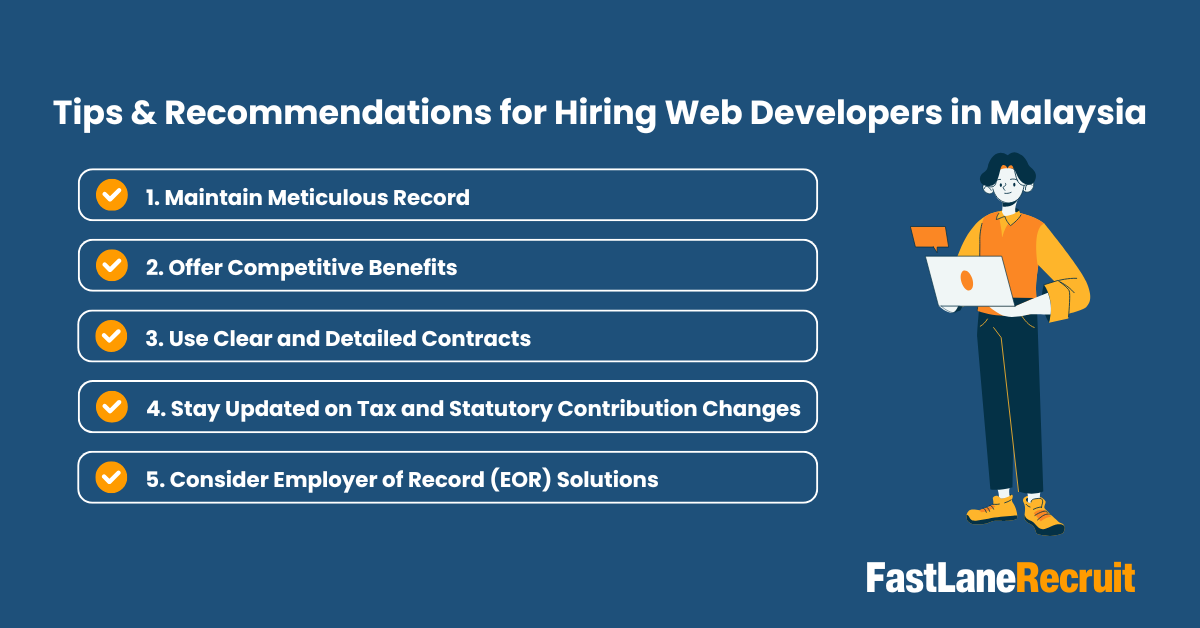
Tips & Recommendations for Hiring Web Developers in Malaysia
Hiring in a foreign country comes with unique challenges. To make the process smoother and ensure compliance with Malaysian laws, here are some actionable tips and best practices:
1. Maintain Meticulous Records
Keeping accurate records is critical for compliance and smooth operations. This includes:
- Payroll: Track salary payments, overtime, and statutory contributions (EPF, SOCSO, EIS, HRDF).
- Attendance: Maintain logs of working hours, rest days, and leave taken.
- Contracts: Store signed employment agreements, amendments, and probation details.
- Leave Records: Keep track of annual, sick, maternity, and paternity leave entitlements.
Example: For a mid-level web developer, ensure payroll records clearly show monthly salary, EPF/SOCSO contributions, and any overtime payments. Proper documentation can protect your company in case of audits or disputes.
2. Offer Competitive Benefits
While Malaysian law sets minimum statutory requirements, offering additional benefits can help attract and retain top web development talent:
- Health insurance or medical coverage
- Flexible working arrangements (remote work or flexible hours)
- Performance bonuses or stock options
- Training and development programs
Tip: Developers in tech are highly sought-after. Even modest perks beyond the legal minimum can make your company a more attractive employer.
Also Read: Hiring Front-End Developer Teams in Malaysia
3. Use Clear and Detailed Contracts
Vague or incomplete contracts can lead to misunderstandings or legal disputes. Ensure your contracts clearly outline:
- Job title and responsibilities
- Salary, allowances, and payment frequency
- Working hours and overtime policy
- Leave entitlements and probationary terms
- Termination procedures and notice periods
- Confidentiality and non-compete clauses
Tip: A well-structured contract protects both your company and the employee, reducing the risk of disputes over pay, benefits, or termination.
4. Stay Updated on Tax and Statutory Contribution Changes
Malaysian laws around payroll, taxation, EPF, and SOCSO contributions can change frequently. Non-compliance can result in fines or penalties:
- EPF contributions may differ for foreign vs. local employees.
- SOCSO and EIS rates are mandatory and must be deducted monthly.
- MTD (Monthly Tax Deduction) for personal income tax must be correctly withheld.
Tip: Assign someone in your HR or payroll team to regularly review updates from LHDN, SOCSO, and EPF.
5. Consider Employer of Record (EOR) Solutions
An EOR service like FastLaneRecruit can simplify hiring and ensure full compliance with Malaysian laws:
- The EOR becomes the legal employer, handling payroll, statutory contributions, and employment contracts.
- They can onboard foreign web developers without the need to establish a local entity.
- You retain full operational control over your team while the EOR handles administrative compliance.
Example: If you’re hiring a remote web developer from Europe, FastLaneRecruit can process their payroll, EPF/SOCSO contributions, and work pass requirements while you focus on managing their projects.
Also Read: Hiring App Developers in Malaysia
Example: Outsourcing vs Employer of Record (EOR)
When expanding your tech team in Malaysia, you have two main options: traditional outsourcing or using an Employer of Record (EOR). Understanding the differences can help you choose the most efficient and compliant solution for your business.
| Feature | Traditional Outsourcing | EOR via FastLaneRecruit |
| Legal Employer | Your company is the legal employer | FastLaneRecruit becomes the legal employer of record |
| Payroll & Statutory Compliance | You manage payroll, EPF/SOCSO contributions, and taxes | Fully handled by FastLaneRecruit, ensuring compliance with all Malaysian laws |
| Work Pass for Foreign Employees | Your company applies for work permits and visas | FastLaneRecruit manages work pass applications, renewals, and documentation |
| Onboarding Speed | Slower due to legal, payroll, and administrative setup | Faster onboarding because FastLaneRecruit handles all administrative and compliance processes |
| Control over Team | Limited, especially if outsourced through third-party agencies | Full operational control; you directly manage your team’s work and projects |
Why Choose FastLaneRecruit’s EOR Service?
Using an Employer of Record (EOR) is a modern, hassle-free approach to hiring in Malaysia, especially for web developers. Here’s how FastLaneRecruit makes it easier:
- Full Compliance: FastLaneRecruit handles employment contracts, payroll, EPF/SOCSO contributions, taxes, and statutory reporting, reducing your risk of non-compliance.
- Faster Onboarding: With all administrative processes managed by FastLaneRecruit, you can get your web developers working on projects quickly, without waiting for company registration or local approvals.
- Focus on Core Business: You retain full operational control over your developers, so you can focus on project management, innovation, and team growth, instead of administrative tasks.
- Cost-Effective: Avoid hidden costs associated with payroll mistakes, delayed work pass approvals, or non-compliance fines. FastLaneRecruit ensures all obligations are met efficiently.
Example: Instead of spending weeks managing paperwork and approvals to hire a foreign web developer, you can partner with FastLaneRecruit’s EOR. They handle all compliance requirements while you focus on integrating the developer into your team and accelerating product development.
Conclusion
Hiring web developers in Malaysia offers access to a skilled, multilingual, and cost-effective workforce. By understanding payroll, taxation, and employment compliance, you can minimize risks while maximizing productivity.
For a smooth, fully compliant hiring experience, especially for foreign employees, consider partnering with FastLaneRecruit’s EOR service. They manage payroll, taxes, work passes, and compliance, letting you scale your Malaysian team quickly and confidently.
Ready to Hire Web Developers in Malaysia?
Take the stress out of onboarding and managing web developers in Malaysia. With FastLaneRecruit’s Employer of Record (EOR) service, you can:
- Hire local and foreign web developers quickly and compliantly
- Manage payroll, EPF/SOCSO contributions, and income tax effortlessly without setting up a local entity
- Retain full operational control over your team while leaving administrative compliance to experts
Start scaling your Malaysian tech team today. Contact FastLaneRecruit for a free consultation and see how our EOR solutions can streamline your hiring process.
