
A Practical Guide for Global Employers
Malaysia attracts global companies building regional and remote teams in Asia. With a strong employment framework, skilled multilingual professionals, and a mature HR ecosystem, it offers a stable environment for long-term workforce growth.
However, hiring employees in Malaysia involves more than recruitment. HR operations teams must manage payroll accurately, meet statutory contribution requirements, and stay compliant with local employment laws. For global employers, especially those without a local entity, understanding how payroll and compliance work is essential to avoid delays, penalties, and employee dissatisfaction.
In this guide, we will explain how payroll works in Malaysia, what HR teams are responsible for, and how companies can stay compliant while scaling efficiently. We also explore how Employer of Record (EOR) solutions can simplify hiring without setting up a local entity.
Content Outline
Key Summary
Understanding Payroll in Malaysia
Payroll involves accurate salary calculation, statutory deductions (EPF, SOCSO, EIS, PCB), payslip issuance, and record-keeping to ensure compliance.
Know the Key Authorities
Employers must register with EPF, SOCSO, EIS, LHDN, and SSM to comply with Malaysian employment, tax, and payroll regulations.
Payroll Cycle and Payslip Rules
Salaries must be paid monthly, within 7 days after the wage period ends, with itemised payslips showing salary, allowances, deductions, and net pay.
Mandatory Statutory Contributions
Employers must correctly calculate and remit EPF, SOCSO, EIS, and PCB contributions each month to avoid penalties and ensure employee protection.
Avoid Common Payroll Mistakes
HR teams should prevent late payments, miscalculations, missing payslips, employee misclassification, incorrect foreign tax treatment, and poor documentation.
Tips for Staying Compliant
Use payroll calendars, automated systems, periodic audits, legal updates, organised records, and expert support (like FastLaneRecruit’s EOR) for seamless compliance.
Employer of Record (EOR) Solutions
FastLaneRecruit’s EOR allows global companies to hire Malaysian employees without a local entity, managing payroll, taxes, and statutory contributions fully compliant.
Understanding Payroll in Malaysia
Payroll in Malaysia is the structured and regulated process of paying employees accurately, on time, and in full compliance with Malaysian employment laws. It goes beyond simply transferring salaries into bank accounts. Payroll ensures that every payment meets legal requirements for taxes, statutory contributions, reporting, and documentation.
For HR operations teams, payroll is a critical monthly responsibility because it directly affects employee trust, government compliance, and company reputation.
Payroll in Malaysia typically includes:
| Payroll Element | What It Means in Practice |
| Salary calculation & payment timelines | Calculating monthly wages, allowances, overtime, and ensuring salaries are paid within the legally allowed timeframe |
| Mandatory deductions & employer contributions | Deducting employee contributions and adding employer contributions for EPF, SOCSO, EIS, and income tax |
| Monthly and annual reporting | Submitting contribution payments and tax filings to government bodies on a regular basis |
| Payslip issuance & record-keeping | Providing itemised payslips and maintaining payroll records for audits and inspections |
Because payroll directly impacts employee income and government revenue, Malaysian authorities closely monitor payroll compliance. Even small errors can lead to penalties, making accuracy, timeliness, and proper documentation essential for HR operations analysts and HR operations teams.
Also Read: Building a High-Performing Offshore HR and Payroll Management Team in Malaysia (Singapore Edition)
Key Payroll Authorities Every Employer Must Know
When a company hires its first employee in Malaysia, it must register with and report to several government bodies that oversee payroll, tax, and employment compliance. These authorities work together to ensure that employees are protected and employers meet their legal obligations.
| Authority | What They Do | Why They Matter |
| Employees Provident Fund (EPF / KWSP) | Manages Malaysia’s national retirement savings scheme | Ensures employees build long-term retirement savings through monthly contributions |
| Social Security Organisation (SOCSO / PERKESO) | Provides protection for workplace injuries and invalidity | Covers employees in case of work-related accidents or health issues |
| Employment Insurance System (EIS) | Supports employees during job loss and retraining | Provides financial assistance and re-employment support |
| Inland Revenue Board (LHDN) | Oversees income tax collection and monthly tax deductions | Ensures correct tax withholding and annual tax reporting |
| Companies Commission of Malaysia (SSM) | Regulates business registration and corporate compliance | Confirms that companies are legally registered to operate in Malaysia |
These bodies form the backbone of Malaysia’s payroll and employment compliance system. Every employer must engage with them from the very first hire, whether hiring directly through a local entity or via an Employer of Record (EOR).
Payroll Cycle and Salary Payment Rules
Most Malaysian companies follow a monthly payroll cycle, meaning employees are paid once a month for the work completed during that month.
Under the Employment Act 1955, employers must pay salaries:
- No later than 7 days after the wage period ends
- Together with a clear and itemised payslip for every employee
What This Means in Practice
If an employee’s salary period runs from 1 June to 30 June, their salary must be paid on or before 7 July. Paying later than this is considered a violation of labour law and may lead to employee complaints, inspections, or penalties.
Payslip Requirements
Every employee must receive a payslip each month. Payslips are mandatory in Malaysia and must clearly show:
| Payslip Item | What It Covers |
| Basic salary and allowances | Monthly base pay and any fixed allowances (transport, phone, housing, etc.) |
| Overtime or bonuses | Additional earnings if applicable |
| Statutory deductions | EPF, SOCSO, and EIS contributions |
| Monthly tax deduction (PCB) | Income tax withheld by the employer |
| Net pay | Final amount paid into the employee’s bank account |
Payslips help employees understand how their salary is calculated and ensure transparency. They also serve as legal proof of payment if any dispute arises.
Mandatory Statutory Contributions Explained
In Malaysia, employers must contribute to several government schemes designed to protect employees and support long-term financial security. These contributions must be calculated accurately and submitted every month.
Employer & Employee Contribution Overview
| Contribution | Employer Share | Employee Share | Purpose |
| EPF (KWSP) | 12%–13% | 11% | Retirement savings |
| SOCSO | ~1.75% | ~0.5% | Workplace injury & disability protection |
| EIS | 0.2% | 0.2% | Job loss and re-employment support |
| PCB (Tax) | Deduct & remit | N/A | Monthly income tax withholding |
Contribution rates vary based on the employee’s salary and category.
Example: How Monthly Contributions Work
If an employee earns RM4,000 per month, the employer must:
- Deduct 11% EPF (RM440) from the employee’s salary
- Add 12%–13% EPF (RM480–RM520) as the employer’s contribution
- Deduct and contribute SOCSO and EIS based on current tables
- Calculate and deduct monthly tax (PCB)
- Submit all contributions to the relevant authorities by the 15th of the following month
These monthly submissions ensure employees remain covered by national protection schemes and that employers stay compliant with Malaysian labour and tax laws.
Also Read: Building a High-Performing Offshore HR and Payroll Management Team in Malaysia (Hong Kong Edition)
Income Tax and Monthly Tax Deduction (PCB)
In Malaysia, income tax is collected using a pay-as-you-earn system called Potongan Cukai Bulanan (PCB). This means employers act as the agent for the Inland Revenue Board (LHDN), withholding tax from employees’ salaries every month and remitting it directly to the government.
What HR Teams Need to Do
HR teams are responsible for:
- Calculating monthly tax deductions
Tax is based on each employee’s gross monthly salary, statutory contributions (like EPF), and eligible tax reliefs (such as spouse or child relief). - Using approved PCB tables or LHDN tools
LHDN provides official PCB tables and calculators to ensure accurate deductions. Employers can also integrate these tools into payroll software for automated calculations. - Submitting deductions electronically to LHDN
Monthly PCB filings must be made by the 15th of the following month. Accurate, timely submission helps avoid penalties or interest charges.
Important Notes for Global Employers
- Short-term employees: Foreign employees staying less than 182 days in Malaysia during a calendar year may be subject to a flat withholding tax rate rather than progressive resident tax rates.
- Residency tracking: HR teams must track the number of days foreign employees spend in Malaysia to apply the correct tax treatment.
- Official guidance: Employers can refer to LHDN for the latest regulations and tools: LHDN Official Website
Example: Calculating PCB
If a Malaysian employee earns RM5,000 per month and contributes 11% to EPF (RM550):
- Deduct EPF from gross salary → RM5,000 – RM550 = RM4,450
- Use LHDN PCB table to determine monthly tax based on RM4,450
- Deduct the calculated PCB from employee’s salary → remitting the tax directly to LHDN by the 15th of the next month
This ensures the employee’s tax obligations are met accurately and on time.
Payroll Compliance: Ongoing HR Responsibilities
Payroll compliance is not a one-time task. HR operations analysts in Malaysia must actively manage payroll every month and year to remain compliant.
Monthly Tasks
- Salary payments: Ensure employees are paid on time.
- Statutory submissions: Remit contributions for EPF, SOCSO, EIS, and PCB.
- Payslip issuance: Provide itemised payslips every month.
Annual Requirements
- Form E: Employer’s declaration summarizing total remuneration paid to employees for the tax year. Must be submitted to LHDN by 31 March.
- Form EA: Issued to employees, detailing their annual income and deductions for personal tax filing.
Record Keeping
Employers must retain payroll records for at least six years, including:
- Payslips
- Statutory contribution receipts
- Tax filings
- Employment contracts
These records may be reviewed during labour or tax audits, so maintaining accurate and accessible documentation is critical for compliance.
Example: Annual Compliance
A medium-sized company with 50 employees needs to:
- Ensure monthly payroll contributions (EPF, SOCSO, EIS, PCB) are submitted on time
- Issue 12 payslips per employee
- File Form E by 31 March summarizing all payroll for the previous year
- Provide Form EA to all employees for personal tax filings
By systematically following these steps, the company avoids fines, interest penalties, and reputational risks.
Also Read: Building a High-Performing Offshore HR and Payroll Management Team in Malaysia (Australia Edition)
Common Payroll Mistakes HR Teams Should Avoid
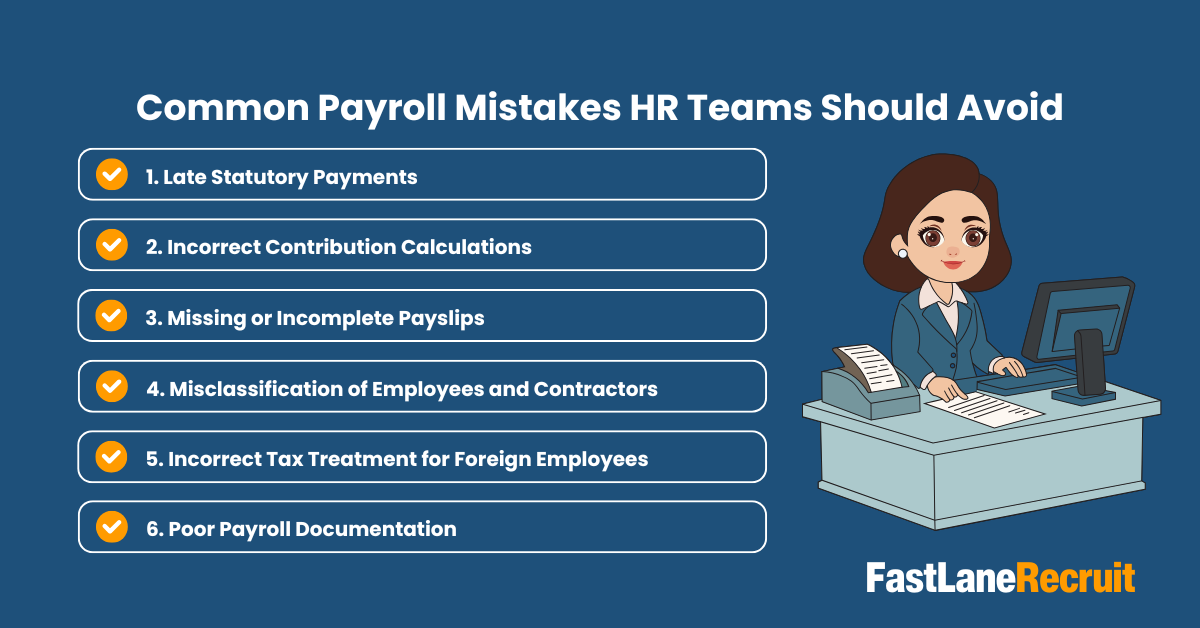
Even experienced HR teams can make mistakes in payroll management. While some errors may seem minor, they can quickly escalate into serious compliance risks, fines, and employee dissatisfaction. Here are the most common pitfalls and how to avoid them:
1. Late Statutory Payments
What Happens: Employers sometimes miss the deadlines for submitting EPF, SOCSO, EIS contributions, or PCB tax deductions.
Impact: Late payments can result in penalties, interest charges, or even legal action. For example, SOCSO fines can reach RM5,000, while EPF delays may incur interest and scrutiny from authorities.
Tip: Set internal reminders and use automated payroll software to ensure timely submission by the 15th of the following month.
2. Incorrect Contribution Calculations
What Happens: Miscalculating statutory contributions is a frequent issue, often caused by manual calculations or misunderstanding contribution rates.
Impact: Incorrect contributions can trigger fines and require backdated adjustments, causing extra administrative work.
Tip: Use official contribution tables from EPF, SOCSO, and EIS, or integrate local payroll systems to automate calculations.
Example: An employee earning RM4,000 should have EPF deducted at 11% (RM440) and employer contribution at 12%–13% (RM480–RM520). Miscalculating even a few percent can add up over time across multiple employees.
3. Missing or Incomplete Payslips
What Happens: Failing to provide itemised payslips or leaving out key details (allowances, deductions, net pay) is a common compliance error.
Impact: This violates the Employment Act 1955 and damages transparency and trust with employees. Payslips are also essential during audits or disputes.
Tip: Issue digital or printed payslips consistently every month. Ensure they include all earnings, statutory deductions, tax, and net pay.
Also Read: 2026 Hong Kong Salary Guide
4. Misclassification of Employees and Contractors
What Happens: Incorrectly labeling contractors as full-time employees (or vice versa) can lead to wrong statutory contributions and tax treatments.
Impact: Misclassification can result in penalties, back-payments, and compliance issues.
Tip: Clearly define employment status in contracts and consult local experts if unsure.
Example: Hiring a remote consultant as a full-time employee could unnecessarily trigger EPF and SOCSO obligations.
5. Incorrect Tax Treatment for Foreign Employees
What Happens: Foreign employees may be taxed incorrectly if HR teams fail to track residency status or apply the wrong PCB rates.
Impact: Misapplied tax can result in back taxes, penalties, and potential audits by LHDN.
Tip: Monitor the number of days foreign employees spend in Malaysia and apply correct tax rates (resident vs. non-resident). Refer to LHDN official guidance for updates.
6. Poor Payroll Documentation
What Happens: Inadequate record-keeping, such as missing payslips, contribution receipts, or tax filings, can create compliance headaches.
Impact: During audits, incomplete documentation may lead to fines and legal scrutiny. It also complicates employee queries and dispute resolution.
Tip: Maintain digital records for at least six years, including payslips, contribution receipts, tax filings, and employment contracts. Use cloud-based payroll systems for secure storage and easy retrieval.
Key Takeaway
Even small payroll errors can snowball into serious compliance problems. By automating processes, maintaining accurate records, and training HR teams, businesses can reduce risk, save time, and build trust with employees.
Tips for Staying Payroll-Compliant in Malaysia
Payroll compliance in Malaysia is essential for both local and global businesses. Staying on top of statutory requirements, tax obligations, and employment laws protects your company from fines, audits, and reputational damage. Here are practical strategies HR operations teams can implement:
1. Maintain a Payroll Compliance Calendar
Why it matters: Many payroll obligations in Malaysia, including EPF, SOCSO, EIS contributions, and PCB tax deductions, have strict monthly deadlines. Missing them can trigger penalties.
Tip: Create a compliance calendar highlighting all recurring tasks, including monthly contributions, payslip issuance, and annual reporting (e.g., Form E by 31 March).
Example: Setting reminders in your calendar or HR system ensures that payroll submissions are done before the 15th of the following month, avoiding late payment fines.
Also Read: 2026 Singapore Salary Guide
2. Use Locally Compliant Payroll Systems or Trusted Partners
Why it matters: Manual payroll processes are prone to errors, especially with changing contribution rates, tax tables, and exemptions.
Tip: Invest in Malaysian payroll software or partner with a trusted provider like FastLaneRecruit. These solutions automatically calculate contributions, generate payslips, and submit statutory filings accurately.
Example: A fast-growing global company using FastLaneRecruit’s EOR service ensures all EPF, SOCSO, EIS, and PCB filings are handled correctly, even for foreign employees.
3. Conduct Periodic Payroll Reviews
Why it matters: Payroll errors can go unnoticed if not regularly audited. Small mistakes in contributions or tax deductions can accumulate into significant compliance risks.
Tip: Schedule quarterly audits to verify salary calculations, statutory deductions, payslips, and submissions. Identify and correct discrepancies before they escalate.
Example: During an internal review, a company discovered that overtime allowances were not included in SOCSO calculations. Correcting this promptly avoided penalties and employee dissatisfaction.
4. Stay Informed About Employment Law Updates
Why it matters: Employment laws in Malaysia, including minimum wage updates, statutory contribution changes, and taxation rules, are periodically revised.
Tip: Subscribe to updates from LHDN, EPF, SOCSO, and government portals, or consult legal experts. Keeping your payroll system updated prevents non-compliance.
Example: When SOCSO updated its contribution rates in 2024, companies using automated payroll systems adjusted contributions instantly, avoiding penalties.
Also Read: 2026 Australia Salary Guide
5. Keep Documentation Organised and Accessible
Why it matters: Employers must retain payroll records for at least six years, including payslips, contribution receipts, tax filings, and employment contracts.
Tip: Use digital storage solutions or HR platforms to securely archive records for easy retrieval during audits or employee queries.
Example: A multinational company faced a labour audit and could immediately produce all payroll records thanks to organised digital filing, resulting in a smooth inspection.
6. Seek Expert Support When Expanding or Hiring Remotely
Why it matters: Expanding into Malaysia without a local legal entity or hiring foreign talent introduces complex payroll compliance requirements.
Tip: Partner with an Employer of Record (EOR) or local payroll specialists like FastLaneRecruit to manage compliance, payroll, and employment contracts accurately.
Example: A tech startup hired three Malaysian employees through FastLaneRecruit’s EOR service. Payroll, tax, and statutory contributions were fully managed locally, allowing the startup to focus on growth rather than administrative hurdles.
Why Payroll Compliance Matters for Global Businesses
Strong payroll compliance is more than a legal obligation, it is a strategic advantage for global companies:
- Builds employee trust and retention: Accurate and timely pay shows professionalism and respect, improving morale.
- Reduces regulatory risk: Prevents fines, audits, and legal disputes.
- Protects brand reputation: Demonstrates reliability and credibility in new markets.
- Enables smooth scaling across borders: A compliant payroll system supports rapid expansion without administrative bottlenecks.
For HR operations analysts, payroll compliance is not just an administrative task; it is a foundation for business growth, employee satisfaction, and sustainable international expansion.
Practical Example: Hiring in Malaysia Without a Local Entity
Scenario:
A global SaaS company wants to hire two Malaysian HR Operations Analysts quickly to support regional operations, but it does not have a local legal entity in Malaysia.
Challenge:
Setting up a local company involves multiple steps, incorporation, appointing local directors, opening bank accounts, registering for taxes and statutory contributions, which can take several months. Delays in hiring can slow market entry and affect business operations.
Solution: Partnering with an Employer of Record (EOR)
By engaging an EOR, the global company can:
- Hire employees legally under the EOR’s registered entity
- Ensure payroll, tax, and statutory contributions are handled correctly and on time
- Issue employment contracts fully compliant with Malaysian law
- Focus on managing day-to-day work without administrative burdens
This approach allows the company to enter the Malaysian market quickly, maintain full compliance, and avoid costly setup delays.
Example in Practice:
The SaaS company onboarded two HR Operations Analysts within two weeks using an EOR. Payroll, EPF, SOCSO, EIS, and PCB submissions were fully managed by the EOR, and the company could start projects immediately without worrying about local compliance.
Also Read: 2026 Malaysia Salary Guide
Employer of Record (EOR): A Smarter Way to Hire in Malaysia
Establishing a local legal entity in Malaysia involves:
- Corporate registration with SSM
- Appointment of local directors
- Tax and statutory registrations (EPF, SOCSO, EIS, PCB)
- Ongoing regulatory compliance and reporting
For many global companies, these requirements slow down hiring and expansion. This is where an EOR service becomes a practical solution.
How FastLaneRecruit’s EOR Service Helps
With FastLaneRecruit’s Employer of Record (EOR) service, global companies can:
- Hire Malaysian employees without incorporating locally
- Stay fully compliant with payroll, tax, and labour laws
- Issue legally compliant employment contracts
- Run payroll and statutory contributions accurately
- Scale teams flexibly and quickly without long-term commitments
FastLaneRecruit acts as the legal employer on the ground, managing all local compliance requirements, while your company retains full control over employee performance and daily operations.
Key Benefits:
| Benefit | How It Helps |
| Speed to hire | Onboard employees in days, not months |
| Compliance assurance | Payroll, taxes, and statutory contributions are handled correctly |
| Risk reduction | Avoid fines, audits, and administrative errors |
| Flexible scaling | Easily expand or reduce teams based on business needs |
By leveraging FastLaneRecruit’s EOR, companies can focus on growth and performance, while local employment obligations are taken care of seamlessly.
Conclusion
Malaysia offers strong opportunities for global companies building high-performing teams. But payroll and compliance must be handled carefully to avoid unnecessary risk.
By understanding statutory requirements, maintaining accurate payroll processes, and leveraging expert support when needed, HR operations teams can hire confidently and scale sustainably.
If you’re exploring hiring in Malaysia and want a compliant, efficient alternative to entity setup, FastLaneRecruit’s EOR service can help you get started quickly without compromising on compliance.
Talk to FastLaneRecruit today to explore EOR solutions for hiring in Malaysia.
