
A Practical Guide for Global Employers Hiring Corporate Services Officers
For global companies expanding into Southeast Asia, Malaysia is the best choice for building regional corporate services functions. From payroll and accounting to statutory reporting and compliance support, Corporate Services Officers play a critical role in keeping international operations running smoothly.
That said, hiring Corporate Services Officers in Malaysia requires a solid understanding of local labour laws, payroll obligations, and compliance standards. For employers unfamiliar with the Malaysian regulatory environment, even routine employment matters can feel complex.
This practical guide is designed for global employers. It explains Malaysia’s employment framework in clear, business-friendly terms, helping you hire Corporate Services Officers confidently while staying fully compliant.
Content Outline
Key Summary
Malaysia’s Employment Framework
Global employers must understand core laws, including the Employment Act, Industrial Relations Act, and EPF/SOCSO requirements, to hire Corporate Services Officers legally and effectively.
Written Employment Contracts Are Essential
Clearly outline role scope, working hours, compensation, leave, confidentiality, probation, and termination terms to protect both employer and employee.
Payroll & Statutory Compliance
Employers are responsible for EPF, SOCSO, EIS contributions, and monthly tax deductions. Accurate payroll ensures compliance and maintains employee trust.
Salary Deduction Example
Example: For a RM6,000 monthly salary, statutory deductions (EPF, SOCSO, EIS, PCB) total ~RM882, resulting in a net take-home pay of RM5,118. Employer contributions are additional.
Recruitment & Onboarding Best Practices
Structured hiring flows, role definition, non-discriminatory ads, structured interviews, written contracts, and statutory registration, improve compliance and productivity.
Hiring Without a Local Entity
Global companies can legally hire Corporate Services Officers via compliant cross-border or Employer of Record solutions, reducing administrative burden while ensuring compliance.
Strategic Advantage for Global Expansion
Compliant hiring and payroll practices empower Corporate Services Officers to support regional operations, enabling smooth growth while minimizing legal and operational risks.
Understanding Malaysia’s Employment Framework
Malaysia has a structured and well-regulated employment system designed to protect both employers and employees. For global companies hiring Corporate Services Officers, such as payroll, accounting, finance, or compliance professionals, understanding this framework is essential before making any hiring decisions.
Malaysia’s employment laws clearly define employee rights, employer responsibilities, payroll obligations, and dispute processes. When these rules are followed correctly, employers can operate smoothly and with confidence. When misunderstood, however, they can lead to delays, compliance risks, or unexpected costs.
Below is a simplified overview of the key employment laws global employers should be familiar with when hiring in Malaysia.
Also Read: Payroll and Statutory Compliance for Hiring Payroll Specialists in Malaysia
Key Employment Laws Global Employers Should Know
| Legislation | What It Means for Employers |
| Employment Act 1955 (Amended 2022) | This is Malaysia’s primary employment law. It sets out minimum standards for working hours, rest days, overtime, leave entitlements, notice periods, and termination procedures. Most Corporate Services Officers fall under this Act, regardless of salary level. |
| Industrial Relations Act 1967 | Governs employer–employee relationships and how workplace disputes are resolved. It outlines procedures for handling dismissals, grievances, and claims of unfair treatment, helping ensure industrial harmony. |
| Income Tax Act 1967 | Regulates how employee salaries are taxed. Employers must calculate monthly tax deductions, submit payments to the Inland Revenue Board, and issue annual tax forms to employees. |
| Employees Provident Fund Act 1991 (EPF) | Requires employers and employees to make monthly retirement contributions. Employers are responsible for registration, accurate calculations, and timely submissions. |
| Employees’ Social Security Act 1969 (SOCSO) | Provides social protection for employees in case of workplace injury, illness, or disability. Employers must contribute and ensure employees are properly registered. |
| Occupational Safety and Health Act 1994 (OSHA) | Places a duty on employers to provide a safe working environment, including office-based roles. This applies even to corporate and administrative positions. |
| Personal Data Protection Act 2010 (PDPA) | Regulates how employee personal data is collected, stored, and used. This is especially important for Corporate Services Officers who handle payroll, financial, and employee records. |
Why These Laws Matter for Corporate Services Roles
Corporate Services Officers often manage:
- Payroll processing
- Statutory filings
- Employee records
- Financial and tax documentation
Because these roles sit at the center of compliance, any misunderstanding of employment law can have wider operational impact. Global employers must ensure that employment terms, payroll processes, and data handling practices align with Malaysian regulations from day one.
Trusted Government and Regulatory References
To maintain accuracy and compliance, global employers should rely on official government sources:
- Ministry of Human Resources (MOHR)
https://www.mohr.gov.my
Oversees employment policy, labour standards, and workforce regulation. - Department of Labour Peninsular Malaysia (JTKSM)
https://jtksm.mohr.gov.my
Provides guidance on the Employment Act, working hours, leave, and employee rights. - Inland Revenue Board of Malaysia (LHDN)
https://www.hasil.gov.my
Manages income tax, employer reporting obligations, and employee tax compliance.
Referencing these authorities helps ensure decisions are aligned with current regulations and best practices.
Important Regional Consideration: East Malaysia
Sabah and Sarawak operate under separate Labour Ordinances, which differ slightly from Peninsular Malaysia’s Employment Act.
Global employers hiring Corporate Services Officers in East Malaysia should:
- Apply the relevant regional labour laws
- Review local employment thresholds and entitlements
- Seek local compliance guidance when structuring contracts
This distinction is important for companies managing teams across multiple Malaysian regions.
Employment Contracts for Corporate Services Officers
When hiring Corporate Services Officers in Malaysia, a clear and well-structured written employment contract is not just best practice, it is a critical compliance safeguard.
These roles typically involve handling payroll, financial records, statutory filings, tax documentation, and employee data. Because of this level of responsibility, contracts must clearly define expectations, protect sensitive information, and align with Malaysian employment regulations.
While verbal agreements may be legally recognised in limited situations, written contracts are strongly recommended, particularly for global employers managing cross-border teams. They provide clarity, reduce misunderstandings, and help demonstrate compliance if disputes arise.
Also Read: Outsource Payroll Specialist Teams: A Guide for Global Employers
Contract Elements Global Employers Should Include
| Clause | Practical Considerations |
| Role Scope | Clearly outline responsibilities such as payroll administration, statutory reporting (EPF, SOCSO, tax filings), compliance support, and internal controls. This avoids role overlap and scope creep. |
| Working Hours | Specify standard working hours, rest days, and how overtime is handled. Malaysian law sets limits on weekly working hours, which employers must respect even for administrative roles. |
| Compensation | Detail the salary structure, payment frequency, allowances, and any performance-based incentives. Clarity here supports accurate payroll processing and tax reporting. |
| Leave Entitlements | State annual leave, sick leave, and parental leave entitlements in line with the Employment Act. Many employers also include public holiday treatment for transparency. |
| Confidentiality | Essential for Corporate Services roles. Include clauses covering protection of financial records, payroll data, employee information, and internal company documentation. |
| Probation Period | Commonly set at 3 to 6 months. This allows both employer and employee to assess fit while still complying with notice requirements. |
| Termination Terms | Define notice periods, resignation procedures, and exit obligations. This helps manage offboarding smoothly and reduces legal risk in the event of termination. |
Why Written Contracts Matter for Global Employers
For international companies, employment contracts do more than formalise a hire, they act as a compliance and risk-management tool. A well-drafted contract helps:
- Align expectations across borders and time zones
- Support consistent payroll and HR administration
- Protect sensitive corporate and employee data
- Reduce the likelihood of disputes or misinterpretation
- Demonstrate adherence to Malaysian employment laws
This is especially important when Corporate Services Officers support multiple markets or regional operations.
Practical Tip for Cross-Border Hiring
Global employers should ensure that:
- Contracts are aligned with Malaysian labour laws, not just headquarters policies
- Terms are clearly explained to employees, especially where regional practices differ
- Confidentiality and data protection clauses reflect PDPA requirements
For companies unfamiliar with local contract standards, working with a local employment specialist or compliant hiring solution can help streamline the process.
Working Hours, Leave & Statutory Entitlements
Malaysia’s employment standards are clearly defined and apply to most employees, including Corporate Services Officers.
Key Employment Standards
| Area | Standard Requirement |
| Working hours | Up to 45 hours per week |
| Rest days | Minimum one rest day per week |
| Overtime | Payable beyond standard hours |
| Annual leave | Based on length of service |
| Sick leave | Statutory paid sick leave |
| Public holidays | Federal and state-designated holidays |
Global employers should reflect these entitlements accurately in payroll systems and HR policies.
Payroll & Statutory Compliance in Malaysia
Payroll compliance is one of the most critical responsibilities when employing Corporate Services Officers in Malaysia. These professionals often support payroll, accounting, and statutory reporting themselves, which means employers must ensure payroll practices are accurate, transparent, and fully compliant from the start.
Malaysia operates a structured statutory contribution system, where employers are responsible for registering employees, calculating deductions, submitting payments on time, and maintaining proper records. Errors or delays can result in penalties and compliance exposure.
Mandatory Employer Contributions in Malaysia
| Contribution | Purpose | Authority |
| Employees Provident Fund (EPF) | Retirement savings for employees | https://www.kwsp.gov.my |
| Social Security Organisation (SOCSO) | Protection for workplace injury, disability, and medical benefits | https://www.perkeso.gov.my |
| Employment Insurance System (EIS) | Income support and re-employment assistance | https://www.perkeso.gov.my |
| Monthly Tax Deduction (PCB/MTD) | Advance income tax payment | https://www.hasil.gov.my |
These contributions apply to both local and foreign employees, subject to eligibility rules.
Also Read: Why Outsourcing HRIS Administration Is a Smart Move for Global Companies
Employer Payroll Responsibilities
When hiring Corporate Services Officers in Malaysia, employers must:
- Register employees with EPF, SOCSO, EIS, and LHDN
- Calculate statutory deductions accurately each month
- Submit employer and employee contributions within prescribed deadlines
- Issue monthly payslips detailing deductions
- Provide annual EA tax forms for employee tax filing
- Retain payroll and tax records for at least seven years
Consistency and accuracy are especially important for global employers managing payroll remotely.
Example: Monthly Salary Deduction for a Corporate Services Officer
Below is a simplified example to help global employers understand how payroll deductions typically work in Malaysia.
Assumptions:
- Gross monthly salary: RM6,000
- Employee is a Malaysian tax resident
- Standard statutory contribution rates apply
| Item | Calculation | Amount (RM) |
| Gross Salary | – | 6,000 |
| EPF (Employee portion) | Approx. 11% | 660 |
| SOCSO (Employee portion) | Based on salary band | 30 |
| EIS (Employee portion) | 0.2% | 12 |
| Monthly Tax Deduction (PCB) | Based on tax table | 180 |
| Total Deductions | – | 882 |
| Net Take-Home Pay | 6,000 – 882 | 5,118 |
Employer contributions (EPF, SOCSO, EIS) are calculated separately and do not reduce the employee’s take-home pay, but they must still be paid on time.
Note: Actual contribution amounts vary based on salary levels, employee status, and current statutory rates. Employers should always refer to official authorities for updated figures.
Why Payroll Compliance Matters for Global Employers
Payroll compliance is not just an administrative task, it directly affects:
- Employee trust and retention
- Tax and statutory reporting accuracy
- Audit readiness
- Business reputation in Malaysia
For Corporate Services Officers, who often manage payroll and compliance internally, errors can quickly compound across the organisation if systems are not set up correctly.
Practical Tip for Global Companies
Many international employers choose to work with local payroll specialists or Employer of Record (EOR) solutions to:
- Reduce administrative burden
- Ensure timely statutory submissions
- Maintain compliance without setting up a local entity
This approach allows Corporate Services Officers to focus on strategic and operational work rather than troubleshooting payroll issues.
Hiring Malaysian vs Foreign Corporate Services Officers
Hiring Malaysian Nationals
Hiring local Corporate Services Officers is straightforward when employers:
- Use fair, role-based recruitment criteria
- Comply with the Personal Data Protection Act
- Maintain proper onboarding and documentation
Hiring Foreign Professionals
Engaging non-Malaysian Corporate Services Officers involves immigration approvals.
Common Work Passes
| Pass Type | Typical Use |
| Employment Pass (EP) | Senior finance, compliance, or regional roles |
| Professional Visit Pass | Short-term assignments |
| Residence Pass–Talent | Highly skilled professionals |
All work passes are administered by the Immigration Department of Malaysia:
https://www.imi.gov.my
Also Read: How to Hire HRIS Administrators in Malaysia
Record-Keeping, Performance & Termination
Record Retention
Employers must retain employee and payroll records for at least seven years, including:
- Employment contracts
- Payslips and statutory filings
- Tax documentation
Termination Considerations
Termination must follow due process, with:
- Proper notice or payment in lieu
- Documented reasons
- Compliance with Industrial Relations Act requirements
Recruitment & Onboarding Best Practices for Global Employers
A structured recruitment and onboarding process is essential when hiring Corporate Services Officers in Malaysia. These roles support critical functions such as payroll, compliance, finance, and statutory reporting, so any gaps during hiring or onboarding can quickly lead to operational or regulatory risks.
For global employers, following a consistent and compliant hiring flow helps reduce misunderstandings, ensure legal alignment, and accelerate employee productivity from day one.
Recommended Hiring Flow for Malaysia
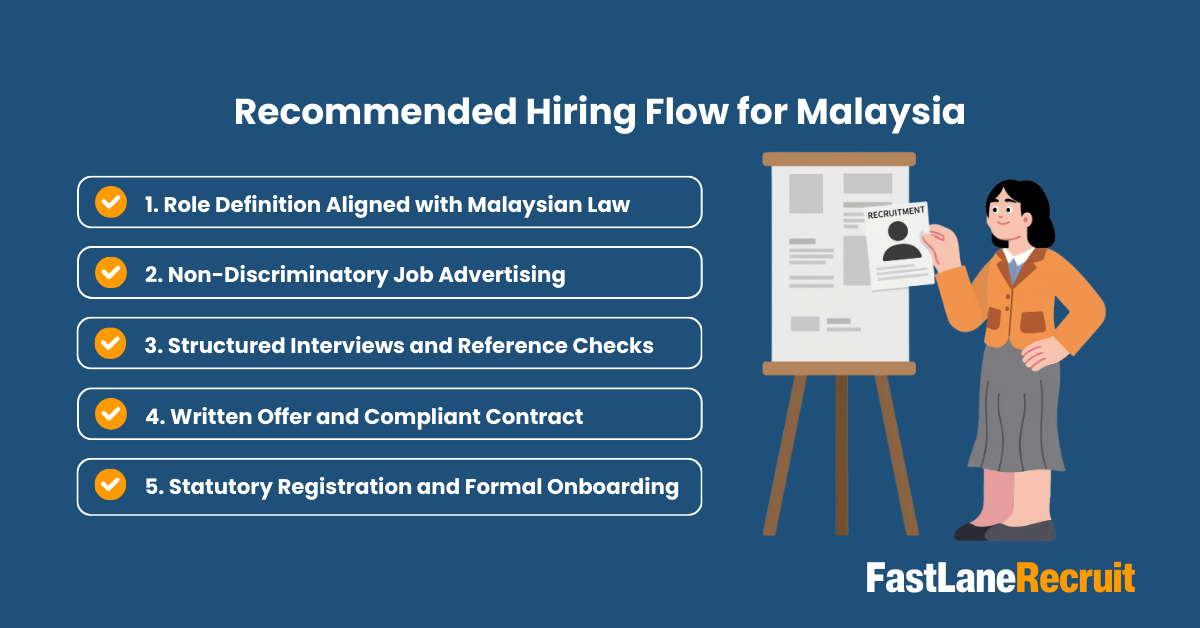
1. Role Definition Aligned with Malaysian Law
Clearly define the role’s responsibilities and ensure they align with Malaysian employment regulations. For Corporate Services Officers, this includes compliance-related duties such as payroll processing, statutory submissions, and internal reporting. A clear role scope also helps determine applicable working hours, overtime eligibility, and confidentiality requirements.
2. Non-Discriminatory Job Advertising
Job advertisements should focus on skills, experience, and qualifications relevant to the role. Malaysian law prohibits discrimination based on race, religion, gender, or other protected characteristics. Using inclusive language helps attract a broader talent pool and supports fair hiring practices.
3. Structured Interviews and Reference Checks
A structured interview process ensures candidates are assessed objectively and consistently. For Corporate Services roles, employers may include practical questions related to payroll accuracy, compliance knowledge, or reporting processes. Reference checks are permitted, provided personal data is handled in line with data protection requirements.
4. Written Offer and Compliant Contract
Once a candidate is selected, issue a written offer letter and employment contract that clearly outlines role scope, compensation, working hours, leave entitlements, and confidentiality obligations. This step is especially important for cross-border employers to avoid misalignment with local employment standards.
5. Statutory Registration and Formal Onboarding
Before or shortly after the employee’s start date, employers must complete statutory registrations with EPF, SOCSO, EIS, and LHDN. Proper onboarding ensures the employee is correctly set up in payroll and compliance systems from the beginning.
Also Read: How Outsourcing HR Operations Can Streamline Business Efficiency
Onboarding Tips for Corporate Services Officers
A thoughtful onboarding process helps Corporate Services Officers quickly adapt to their role and perform confidently in a regulated environment.
1. Introduce Local Compliance Frameworks Early
Provide an overview of Malaysia’s employment laws, payroll regulations, and statutory bodies. This ensures new hires understand the legal context in which they operate and reduces the risk of compliance errors.
2. Clarify Reporting Lines and Governance Roles
Corporate Services Officers often work across departments or support regional teams. Clearly explain reporting structures, approval workflows, and escalation paths to avoid confusion and delays.
3. Provide Access to Payroll and Statutory Systems
Ensure timely access to payroll software, statutory portals, and internal compliance tools. Early access allows new hires to familiarise themselves with processes and contribute more effectively.
4. Conduct Regular Check-Ins During Probation
Regular check-ins during the probation period help identify training needs, clarify expectations, and address challenges early. This approach supports smoother integration and higher long-term performance.
Why This Matters for Global Employers
Effective recruitment and onboarding:
- Strengthen compliance from the outset
- Reduce onboarding errors in payroll and statutory reporting
- Improve employee confidence and retention
- Support smoother collaboration across borders
For global companies, investing in a structured hiring and onboarding process ensures Corporate Services Officers can operate effectively while supporting compliant growth in Malaysia.
Practical Example: Hiring Corporate Services Officers Without a Local Entity
For many global companies expanding into Asia, Malaysia is a strategic location for building regional payroll, accounting, and compliance support teams. However, setting up a local legal entity can take time, require significant upfront investment, and introduce ongoing administrative responsibilities.
This creates a common challenge: how to legally hire Corporate Services Officers in Malaysia without immediately establishing a local entity.
The Scenario
Imagine a multinational company headquartered in Europe or North America planning to support its Asia-Pacific operations. The business needs skilled Corporate Services Officers in Malaysia to manage:
- Payroll coordination
- Statutory reporting
- Accounting support
- Internal compliance processes
At this stage, the company may still be testing the market or operating with a small regional footprint, making full incorporation impractical.
A Compliant Cross-Border Hiring Approach
In these situations, employers often explore compliant cross-border employment solutions that allow them to hire local professionals while remaining aligned with Malaysian labour laws.
These solutions enable global employers to:
- Engage Malaysian Corporate Services Officers legally
Employees are hired under locally compliant employment terms, including statutory contributions, tax deductions, and employment protections. - Reduce administrative and regulatory burden
Employment contracts, payroll processing, statutory filings, and compliance monitoring are managed locally, reducing complexity for headquarters teams. - Maintain compliance from day one
From employee registration to monthly payroll submissions, all requirements are handled according to Malaysian regulations, lowering compliance risk. - Scale teams as regional operations grow
Employers can start with one or two hires and expand as business needs evolve, without restructuring employment arrangements or forming a local entity prematurely.
Also Read: How to Build an Offshore HR Administration Team in Malaysia
Why This Matters for Corporate Services Roles
Corporate Services Officers are often responsible for ensuring compliance across the organisation. Hiring them through a compliant framework allows these professionals to focus on operational excellence rather than administrative challenges.
For global employers, this approach offers:
- Faster market entry
- Predictable employment costs
- Reduced legal exposure
- Flexibility to adapt as regional strategies change
A Smarter Path for Global Expansion
By using compliant employment models, global companies can build trusted corporate services teams in Malaysia while keeping long-term options open. This model supports growth, compliance, and operational continuity, without rushing into permanent establishment decisions.
When an Employer of Record (EOR) Is a Practical Option
An Employer of Record (EOR) service enables global employers to hire Corporate Services Officers in Malaysia without setting up a local entity.
An EOR manages:
- Employment contracts
- Payroll and statutory contributions
- Tax reporting
- Labour law compliance
This approach is particularly effective for regional hubs, pilot teams, or fast-scaling operations.
Why Global Employers Choose FastLaneRecruit
FastLaneRecruit supports global companies hiring Corporate Services Officers in Malaysia through compliant employment solutions.
With FastLaneRecruit’s EOR services, you can:
- Engage skilled Malaysian professionals quickly
- Ensure full labour law and payroll compliance
- Simplify cross-border workforce management
- Focus on growth while compliance is handled locally
Take the complexity out of global hiring and focus on growing your business. Book a Free Call!
Conclusion
Hiring Corporate Services Officers in Malaysia can be a strategic advantage for global employers, provided labour law, payroll, and compliance requirements are handled correctly.
By understanding Malaysia’s employment framework and choosing the right engagement model, global companies can build strong, compliant corporate services teams that support regional and international growth with confidence.
Ready to Build Your Corporate Services Team in Malaysia?
Expanding into Malaysia doesn’t have to mean navigating complex local regulations alone. With the right partner, you can hire skilled Corporate Services Officers quickly, compliantly, and efficiently, even without a local entity.
FastLaneRecruit offers a fully compliant cross-border employment solution, handling:
- Payroll, taxes, and statutory contributions
- Employment contracts aligned with Malaysian labour laws
- Onboarding and HR support for Corporate Services Officers
- Scalable solutions as your regional team grows
Speak to FastLaneRecruit about Employer of Record solutions and explore a compliant, scalable way to build your corporate services team in Malaysia.
