
Expanding into Malaysia gives global companies access to a highly skilled, multilingual workforce within a well-structured employment and payroll regulatory framework. However, hiring accountants, or any finance professionals, requires a clear understanding of Malaysia’s labour laws, payroll regulations, and statutory compliance requirements.
Whether you’re hiring one accountant or building a full finance team, this guide provides practical insights, tips, and examples to ensure compliance while reducing operational risk. For companies without a local entity, FastLaneRecruit’s Employer of Record (EOR) service offers a seamless solution to hire Malaysian accountants without the administrative burden.
Content Outline
Key Summary
Legal Eligibility to Hire
Ensure your business is registered with the Companies Commission of Malaysia (SSM) or partner with an EOR to hire without entity setup delays.
Work Permits & Employment Passes
Foreign accountants require valid Employment Passes; employers must register with the Expatriate Services Division (ESD) and track compliance.
Employment Contracts & Labour Law Compliance
Draft clear contracts aligned with the Employment Act 1955, covering hours, overtime, leave, termination, and sector-specific requirements.
Statutory Contributions & Payroll Setup
Register with EPF, SOCSO, EIS, LHDN, and HRDF; calculate employer and employee contributions accurately to avoid fines.
Monthly Payroll & Tax Deductions
Calculate gross salary, statutory deductions, and net pay. Automate payroll to reduce errors and ensure timely submission to regulatory bodies.
Payroll for Foreign Employees
Track residency, apply flat 30% tax for non-residents, and confirm the latest EPF/SOCSO applicability for foreign employees based on work permit and category.
Operational Best Practices
Conduct payroll audits, communicate deductions to staff, benchmark salaries, integrate with e-Invoicing, and leverage EOR services for compliance and efficiency.
Hiring Requirements in Malaysia
Expanding your business into Malaysia requires a clear understanding of the country’s legal and regulatory framework. Whether you’re hiring local or foreign talent, compliance with statutory requirements ensures smooth operations and avoids costly penalties.
1. Legal Eligibility to Hire
To employ staff in Malaysia, your company must be formally registered with the Companies Commission of Malaysia (SSM). For foreign-owned businesses, registration involves:
- Appointing at least one resident director
- Establishing a local business address
- Meeting paid-up capital requirements (if applicable to your business type)
For companies without a local entity, hiring can still proceed legally by partnering with an Employer of Record (EOR) like FastLaneRecruit. The EOR acts as your legal employer in Malaysia, allowing you to hire staff without the time, cost, and administrative burden of entity incorporation. This approach is particularly beneficial for testing the market or hiring a small, agile team.
2. Work Permits & Employment Passes
Foreign employees, including accountants or other specialized professionals, must hold a valid Employment Pass (EP) to work in Malaysia. Key points include:
- Typically for professionals earning RM5,000 or more per month
- Requires employer registration with the Expatriate Services Division (ESD) before application
- Passes are generally valid for 1–5 years, depending on the role and level
Other types of permits, such as the Professional Visit Pass or Temporary Employment Pass, may apply depending on the employee’s role, duration of stay, and industry. Ensuring proper work authorization is critical to avoid fines, penalties, or legal complications.
Also Read: Offshore Vs Local: Accountants 2025 Salary Benchmark Report (Australia Vs Malaysia Edition)
3. Employment Contracts & Labour Law Compliance
All employees must receive a written employment contract that clearly defines:
- Job scope and responsibilities
- Salary and allowances
- Working hours and overtime policy
- Leave entitlements
- Termination clauses
The Employment Act 1955 and its First Schedule set minimum employment standards for employees earning up to RM4,000 per month, as well as certain specified categories regardless of salary level. Key requirements include:
| Employment Aspect | Requirement |
| Maximum weekly hours | 45 hours |
| Overtime | Paid for hours beyond contractual hours (1.5× normal rate on regular days, 2× on rest days, 3× on public holidays) |
| Public holidays | Minimum 11 per year (5 compulsory under law) |
| Annual leave | 8–16 days depending on tenure |
| Sick leave | 14–22 days depending on tenure |
Contracts must also comply with sector-specific regulations, which may vary across industries such as finance, construction, and education. For example:
- Finance: Licenses or approvals may be required for certain positions
- Construction: Registration with the Construction Industry Development Board (CIDB) may be necessary
- Education: Institutions must be approved by the Ministry of Education
Properly drafted contracts and adherence to labor law protect both employers and employees, ensuring clarity, fairness, and compliance with Malaysian regulations.
Payroll Setup & Statutory Contributions
1. Registration with Statutory Bodies
Before you can pay your employees in Malaysia, it is mandatory to register your company with several statutory agencies. These registrations ensure compliance with employment laws, retirement planning, social protection, taxation, and workforce development. Failure to register on time can result in fines, penalties, or legal issues.
Key Statutory Bodies and Contributions
| Agency | Purpose | Employer Contribution | Explanation |
| EPF (KWSP) | Retirement savings for employees | 12–13% of monthly wages (typical; varies by category) | The Employees Provident Fund (EPF) is Malaysia’s retirement savings scheme. Contribution rates vary by employee category and KWSP schedules. Employees typically contribute 11% (subject to eligibility and current rules). |
| SOCSO (PERKESO) | Workplace injury & invalidity coverage | Based on PERKESO contribution schedule (varies by category and salary band) | SOCSO protects employees against workplace accidents, injuries, and permanent disability. Contributions vary depending on salary levels and employee category. Non-Malaysian employees on valid work permits are generally included. |
| EIS | Retraining & retrenchment support | 0.2% of monthly wages | The Employment Insurance System provides temporary financial support to retrenched employees and subsidizes reskilling programs. Both employers and employees contribute 0.2% of wages. |
| LHDN (PCB) | Monthly tax deductions | Based on salary bracket | Employers act as tax agents to deduct monthly income tax (Potongan Cukai Bulanan) from employees’ wages. The amount depends on gross salary, reliefs, and exemptions. Employers must submit deductions monthly to LHDN. |
| HRDF | Workforce training levy (industry-specific) | 1% of monthly payroll | The Human Resources Development Fund applies to certain sectors and supports employee training programs. Employers pay a 1% levy on payroll and can claim grants for upskilling staff. |
Pro Tip: Registration with these statutory bodies should be completed within 7 days of hiring your first employee to avoid fines and ensure smooth payroll operations.
Example: Practical Application
Suppose your company hires 5 Malaysian accountants, each earning RM6,000/month. Here’s how statutory contributions would work monthly:
- EPF: 12% × RM6,000 × 5 employees = RM3,600
- SOCSO: ~1.75% × RM6,000 × 5 = RM525
- EIS: 0.2% × RM6,000 × 5 = RM60
- LHDN (PCB): Depends on individual employee tax reliefs; assume RM450 total
- HRDF: 1% × RM6,000 × 5 = RM300
Total monthly statutory contribution: RM3,600 + RM525 + RM60 + RM450 + RM300 = RM4,935
This example illustrates why accurate registration and timely payroll setup are critical, as missing contributions can quickly escalate into penalties.
Also Read: Building a High-Performing Offshore Accounting Team in Malaysia (Singapore Edition)
2. Monthly Payroll & Tax Deductions
Managing monthly payroll in Malaysia involves calculating gross salary, deducting statutory contributions, and determining the net pay employees receive. Accurate payroll is crucial for compliance with Malaysian employment law and to avoid fines or penalties.
Key Components of Monthly Payroll
- Gross Salary
This is the total salary payable to an employee before deductions. It includes:- Base pay – the agreed monthly salary
- Allowances – e.g., transportation, housing, or meal allowances
- Bonuses or incentives – one-off or performance-based rewards
- Statutory Deductions
Employers must withhold and remit the following contributions:- EPF (Employees Provident Fund): Retirement savings; contributions are shared between employer and employee
- SOCSO (Social Security Organisation): Covers workplace injury and invalidity
- EIS (Employment Insurance System): Provides retrenchment support and retraining benefits
- PCB (Potongan Cukai Bulanan): Monthly income tax deductions according to the employee’s salary and reliefs
- Net Pay
The amount the employee actually takes home after all deductions.
Example: Payroll for a Local Accountant
Suppose you hire a Malaysian accountant earning RM5,000/month. Payroll would be calculated as follows:
| Component | Amount (RM) | Explanation |
| Gross Salary | 5,000 | Base salary including allowances and bonuses |
| EPF Employee Contribution (11%) | 550 | Deducted from employee’s salary for retirement savings |
| EPF Employer Contribution (13%) | 650 | Paid by employer; not deducted from salary |
| SOCSO Employer Contribution | 87.50 | Employer’s contribution for workplace protection |
| EIS Employer Contribution | 10 | Employer’s contribution to retrenchment & retraining fund |
| PCB (Monthly Tax Deduction) | 300 | Income tax withheld according to LHDN tables |
Tip: PCB varies based on reliefs claimed by the employee, such as spouse, children, and EPF contributions.
Submission of Contributions
Employers are responsible for remitting contributions to the relevant statutory bodies:
- EPF: Submit via i-Akaun Employer portal
- SOCSO & EIS: Submit via SOCSO Assist Portal
- PCB (Tax): Submit via LHDN e-PCB system
All payments and submissions are due by the 15th of the following month. Late payments can incur fines, interest, or other penalties.
Operational Tip
To reduce errors and administrative workload:
- Automate payroll using Malaysia-compliant payroll software
- Ensure accurate calculation of gross salary, deductions, and net pay
- Schedule reminders for submission deadlines to avoid late penalties
3. Overtime, Rest Days & Public Holidays
Employees covered under the Employment Act 1955 and First Schedule provisions (including employees earning up to RM4,000 and specified categories) may be entitled to overtime pay based on their coverage and contract terms.
| Work Type | Rate |
| Normal day | 1.5× hourly rate |
| Rest day | 2× daily pay |
| Public holiday | 3× daily pay |
All employees are entitled to at least one rest day per week and 11 paid public holidays annually.
Tip: Maintain a monthly roster to inform employees of rest days and holiday schedules.
Also Read: Building a High-Performing Offshore Accounting Team in Malaysia (Hong Kong Edition)
4. Payroll for Foreign Employees
Hiring foreign employees in Malaysia requires attention to special payroll rules that differ from local staff. These rules help ensure compliance with tax laws, statutory contributions, and work permit conditions.
Key Considerations
- Taxation
- Foreign employees who reside in Malaysia for less than 182 days in a calendar year are considered non-residents for tax purposes.
- Non-residents are subject to a flat 30% withholding tax on income earned in Malaysia, rather than the progressive tax rates applied to residents.
- Employers must accurately track the number of days each foreign employee spends in Malaysia to apply the correct tax rate.
- Failure to withhold the proper tax can result in penalties, back taxes, and fines from the Inland Revenue Board of Malaysia (LHDN).
- SOCSO & EIS Contributions
- SOCSO and EIS applicability for foreign employees depends on employee category and current statutory rules. Employers should verify SOCSO coverage requirements and whether EIS applies for the employee’s status before processing payroll.
- Employers must verify the employee’s residency and work permit status to determine whether contributions are required.
- EPF Contributions
- EPF treatment for foreign employees has evolved over time. Employers should confirm the latest KWSP requirements for foreign employees based on work permit and category before finalising payroll setup.
- This ensures the employee accumulates retirement savings while aligning with statutory regulations.
- Payroll Reporting & Compliance
- Employers must maintain detailed records of foreign employees, including:
- Arrival and departure dates for residency tracking
- Salary details and statutory deductions (if applicable)
- Work permit validity and renewal dates
- Accurate reporting reduces the risk of fines and audit complications.
- Employers must maintain detailed records of foreign employees, including:
Example: Foreign Accountant Payroll
Suppose you hire a foreign accountant in Malaysia earning RM6,000/month who stays in Malaysia for less than 182 days in a year:
| Component | Amount (RM) | Notes |
| Gross Salary | 6,000 | Base salary including allowances |
| EPF Employer Contribution (2%) | 120 | Mandatory from 2026 onward |
| SOCSO/EIS | 0 | Exempt for non-residents |
| PCB (30% flat tax) | 1,800 | Withholding tax for non-resident |
| Net Pay | 4,080 | Take-home salary after deductions |
Tip: If the same employee exceeds 182 days in Malaysia, you must switch to resident tax rates and may also require SOCSO/EIS contributions.
Recommendations for Employers
- Track Residency Days: Use a calendar or HR system to monitor foreign employee presence in Malaysia.
- Verify Work Permits: Ensure Employment Pass or other permits are valid before payroll processing.
- Automate Calculations: Use payroll software that can differentiate resident and non-resident employees for tax and contribution purposes.
- Stay Updated: Statutory rules for foreign employees may change; consult local experts or EOR providers to remain compliant.
5. Annual Reporting & Recordkeeping
Employers must issue:
- Form EA: Employee income statement
- Form E: Employer declaration of payroll
Records must be retained for at least six years. Non-compliance can result in fines, interest, or legal action.
Tip: Cloud-based payroll systems simplify annual reporting and document retention.
Also Read: Building a High-Performing Offshore Accounting Team in Malaysia (Australia Edition)
Common Payroll Mistakes & How to Avoid Them
1. Late or Incorrect Statutory Contributions
Mistake: Employers sometimes pay EPF, SOCSO, EIS, or PCB late, or calculate the amounts incorrectly. This can result in fines, interest penalties, and audits.
Solution: Use automated payroll software that calculates contributions for each employee correctly. Set reminders for submission deadlines so payments are made on time.
Example: If EPF contributions for 10 employees are delayed by one month, fines can quickly add up, costing thousands of RM. Automating the process eliminates human error.
2. Incomplete or Missing Payslips
Mistake: Employees don’t receive payslips, or payslips are missing details like deductions, overtime, or bonuses. This can lead to disputes and non-compliance with the Employment Act.
Solution: Standardize payslip generation using payroll software. Ensure each payslip clearly shows gross salary, statutory deductions, allowances, overtime, and net pay.
Example: Without detailed payslips, an employee may challenge a deduction for a no-pay leave day, creating unnecessary HR conflicts.
3. Misclassifying Employees
Mistake: Treating contractors as full-time employees or vice versa, or failing to classify part-time vs full-time staff correctly. Misclassification affects tax, EPF, and SOCSO contributions.
Solution: Clearly define employment status in contracts. Consult local payroll experts or your EOR provider to ensure each employee is classified correctly.
Example: Hiring a contractor as a full-time employee without deducting EPF could result in backdated contributions and penalties.
4. Ignoring Non-Resident Tax Rules
Mistake: Applying resident tax rates to short-term foreign employees can result in over- or underpayment of taxes, leading to audits and penalties.
Solution: Track how many days foreign employees spend in Malaysia each year. Apply the correct withholding tax rate: flat 30% for non-residents or progressive rates for residents.
Example: A foreign accountant working 120 days in Malaysia should be taxed at 30% withholding, not the standard resident progressive rate.
5. Incorrect Termination Payments
Mistake: Employers sometimes fail to pay accrued leave, notice periods, or bonuses when employees leave. This can trigger legal disputes.
Solution: Use a detailed offboarding checklist. Include final salary, accrued annual leave, unpaid overtime, and any other contractual entitlements.
Example: An accountant resigns after 3 years, but unpaid annual leave is not calculated. The employee can file a complaint with the Labour Department.
6. Missing Reporting Deadlines
Mistake: Employers miss filing deadlines for Form E, Form EA, PCB, or statutory contributions. This can result in fines and additional audits.
Solution: Maintain a statutory compliance calendar marking all monthly and annual deadlines. Automate reminders and assign responsibility within your team.
Example: Filing Form EA late could result in fines ranging from RM200 to RM20,000, depending on the severity of the delay.
Also Read: Types Of Accounting Services That Can Be Outsourced
7. Poor Record-Keeping
Mistake: Payroll records, payslips, and statutory submissions are not stored properly or are hard to access. This creates problems during audits or disputes.
Solution: Keep digital records securely for at least six years. Use cloud-based payroll systems to back up payslips, payment confirmations, and reports.
Example: If the Labour Department requests past payroll records for an audit, missing files can lead to fines or legal complications.
Operational Tips & Recommendations
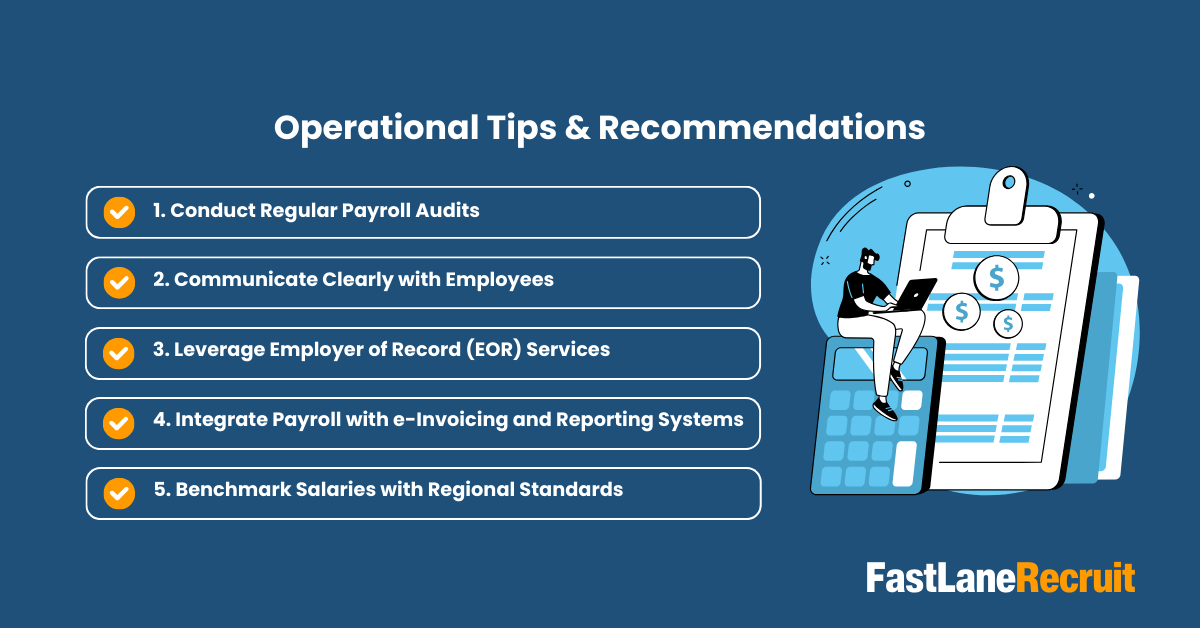
1. Conduct Regular Payroll Audits
Tip: Periodically review your payroll processes to catch errors before they become costly.
Why it matters: Mistakes in salary calculation, statutory contributions, or tax deductions can lead to fines, employee dissatisfaction, and compliance risks.
How to do it: Schedule monthly or quarterly internal audits. Cross-check payslips, EPF/SOCSO/EIS contributions, and tax deductions against payroll records.
Example: A company discovered that overtime payments for two departments were miscalculated for three months. A regular audit allowed them to correct this before employees filed complaints or the Labour Department intervened.
2. Communicate Clearly with Employees
Tip: Keep employees informed about deductions, contributions, and tax reliefs.
Why it matters: Transparency builds trust, reduces queries or disputes, and ensures employees understand their net pay.
How to do it: Provide detailed payslips and host regular sessions explaining EPF contributions, SOCSO coverage, PCB (tax) deductions, and any benefits.
Example: Explaining that EPF contributions are matched by the employer and reduce taxable income helps employees understand why their take-home pay may seem lower than their gross salary.
3. Leverage Employer of Record (EOR) Services
Tip: Use EOR providers like FastLaneRecruit to simplify hiring, payroll, and compliance in Malaysia.
Why it matters: For companies without a local entity, managing payroll, statutory contributions, work permits, and taxes can be complex. EOR services handle these processes while keeping you compliant.
How to do it: Partner with a reputable EOR that understands Malaysian labor laws and payroll regulations. They act as the legal employer, while you manage day-to-day work and performance.
Example: A company hiring 20 foreign accountants avoids months of entity setup paperwork and ensures all EPF, SOCSO, and tax obligations are automatically handled by the EOR.
4. Integrate Payroll with e-Invoicing and Reporting Systems
Tip: Integrate payroll with your finance reporting workflows.
Why it matters: Integration reduces manual entry errors, streamlines statutory reporting, and saves time.
How to do it: While MyInvois focuses on invoicing compliance, aligning payroll data with finance systems improves reporting accuracy, audit readiness, and month-end controls.
Example: Automated integration ensures that EPF contributions for 50 employees are reported correctly every month without manual calculation errors.
5. Benchmark Salaries with Regional Standards
Tip: Compare your salary packages with regional averages to attract top talent while managing costs.
Why it matters: Offering competitive salaries helps you retain skilled employees and stay ahead in the labor market. Overpaying unnecessarily increases operational costs.
How to do it: Use salary surveys, industry reports, or EOR/PEO data to benchmark roles. Consider allowances, bonuses, and statutory contributions in total compensation.
Example: Hiring 50 foreign accountants with EPF contributions may increase operational costs by RM60,000/year. Accurate payroll forecasting ensures budgets are realistic and prevents unexpected financial strain.
Why FastLaneRecruit’s EOR Service is the Smart Alternative
Expanding into Malaysia offers tremendous growth potential, but establishing a local legal entity can be time-consuming, costly, and administratively complex. Companies often face months of paperwork, capital requirements, local director appointments, and ongoing compliance obligations. This can slow hiring, increase operational risk, and distract leadership from core business goals.
FastLaneRecruit’s Employer of Record (EOR) Service provides a streamlined solution. By acting as your legal employer in Malaysia, we handle the local complexities so you can focus on growing your business. Here’s what you get with our EOR service:
End-to-End Payroll Management
We take care of monthly salary processing, payslip generation, and accurate calculations for allowances, overtime, and bonuses. Automated payroll ensures timely payment and reduces errors, keeping employees satisfied and compliant with Malaysian labor laws.
Statutory Compliance Made Easy
FastLaneRecruit manages all mandatory contributions, including:
- EPF (Employees Provident Fund)
- SOCSO (Social Security Organisation)
- EIS (Employment Insurance System)
- PCB (Monthly Tax Deductions)
Our team ensures submissions are accurate and timely, protecting your company from penalties or audits.
Flexible Workforce Scaling
Whether you’re hiring one accountant or building a full accounting team, our EOR service allows you to scale up or down without the long-term commitments or bureaucracy of entity setup. This flexibility saves time, reduces upfront costs, and enables rapid expansion.
Conclusion
Hiring accountants in Malaysia in 2026 requires careful attention to labour laws, payroll obligations, and statutory compliance. Payroll and statutory compliance requirements in Malaysia continue to evolve. Employers should stay updated on Employment Act obligations, tax treatment (resident vs non-resident), and statutory contribution requirements to reduce compliance risk.
Proactive planning, automation, and expert guidance, such as partnering with FastLaneRecruit’s EOR service, can help your business stay compliant, reduce operational risk, and attract top talent. By following the strategies outlined in this guide, global employers can confidently navigate Malaysia’s workforce regulations and focus on growing their business in the region.
Get Started with FastLaneRecruit Today
Hiring in Malaysia doesn’t have to be complicated. FastLaneRecruit lets you onboard local talent quickly, stay fully compliant with labour and payroll laws, and manage your workforce efficiently, all without establishing a legal entity.
Take the next step:
- Speak with our experts to discuss your hiring needs
- Receive a customised cost simulation for your team
- Start hiring Malaysian accountants or finance professionals in days
Don’t let entity setup slow your growth. Partner with FastLaneRecruit and simplify your expansion into Malaysia today.
