

The Complete 2025 Guide for Global Employers
Looking for the right web developers? It can feel like hunting for a needle in a digital haystack, especially if you’re growing a startup or building a global tech team. The real challenge? Not just finding talent, but finding skilled, reliable, and cost-effective developers who actually get results.
Malaysia has become one of the most strategic places to build or expand a development team. With its highly educated workforce, competitive costs, English proficiency, strong digital infrastructure, and business-friendly environment, Malaysia is now a go-to destination for hiring web developers, either directly or through global talent solutions like FastLaneRecruit.
In this guide, we’ll walk you through everything you need to know about hiring web developers in Malaysia, from skills to look for to hiring processes, challenges, salary expectations, and smarter ways to hire (EOR solution).
Content Outline
Key Summary
Malaysia’s Tech Talent Advantage
Malaysia produces thousands of skilled web developers annually, supported by top universities and strong STEM programs, making it ideal for startups and global teams.
Cost-Efficiency Without Compromise
Hiring Malaysian developers can reduce labor costs by 40–60% compared to Western markets while maintaining high-quality technical output.
Strong English & Cultural Compatibility
High English proficiency and familiarity with Western business practices ensure smooth collaboration for remote or distributed teams.
Structured Hiring Process for Success
Define roles, set clear technical requirements, conduct coding tests, portfolio reviews, and problem-solving challenges to hire effectively.
Compliance & Payroll Made Simple
Managing EPF, SOCSO, EIS, contracts, and tax compliance can be complex, FastLaneRecruit’s Employer of Record (EOR) solution handles it end-to-end.
Overcoming Startup Hiring Challenges
Startups can tackle skill shortages, competitive offers, and retention issues by leveraging structured assessments, flexible work policies, and local expertise.
FastLaneRecruit: Smarter Hiring Solution
With talent sourcing, onboarding, payroll, and HR support, FastLaneRecruit simplifies hiring Malaysian web developers while ensuring compliance and scalability.
Why Hire Web Developers in Malaysia
Malaysia has quickly evolved into one of Southeast Asia’s most capable tech hubs, thanks to strong government support, a growing pool of digital talent, and a business environment designed to attract global companies. National initiatives like the Malaysia Digital Economy Blueprint (MyDIGITAL) and the Malaysia Digital Initiative, led by the Malaysia Digital Economy Corporation (MDEC), aim to accelerate innovation, strengthen digital adoption, and position Malaysia as a world-class technology destination.
Also Read: Best Countries to Outsource Web Development Services
For global companies building remote or distributed tech teams, Malaysia offers a strong balance of quality, affordability, and scalability. Here’s a deeper look at the main reasons companies hire Malaysian web developers:
1. Strong Tech Talent Pipeline
Malaysia invests heavily in STEM education and produces a steady stream of skilled web developers every year. Top universities offering Computer Science, Software Engineering, and IT programs include:
- Universiti Malaya (UM) – consistently ranked among the top universities in Asia
- Universiti Teknologi Malaysia (UTM) – known for engineering and computing excellence
- Multimedia University (MMU) – specialized in digital tech, multimedia, and information systems
Graduates from these institutions generally have solid foundations in:
- Full-stack development
- Front-end frameworks like React, Vue, and Angular
- Back-end stacks such as Node.js, PHP (Laravel), Python (Django/Flask)
- Cloud environments like AWS, Azure, and Google Cloud
This strong academic ecosystem keeps Malaysia competitive for web development talent across a wide range of industries.
2. High English Proficiency for Seamless Collaboration
Malaysia consistently ranks as one of the top Asian countries in the EF English Proficiency Index, outperforming neighbors like Thailand, Vietnam, and Indonesia. This reduces communication friction and makes collaboration with Western teams smoother.
For companies adopting agile methodologies, like daily standups, sprint reviews, and asynchronous communication, this language proficiency becomes a major operational advantage.
3. Cost-Efficient Compared to Western Markets
One of the biggest reasons global companies hire web developers in Malaysia is the significant cost advantage, often without compromising skill level.
On average, hiring Malaysian developers can cost 40–60% less than hiring in countries like:
- United States
- United Kingdom
- Canada
- Australia
At the same time, Malaysia’s developers are widely known for being competent in modern frameworks, writing clean code, and working well in remote teams.
(Salary tables will be included in the later section for easy comparison.)
Also Read: How To Choose Between In-House or Outsourced Website Development
4. Business-Friendly Regulations for Global Hiring
Malaysia is considered one of the more flexible and straightforward countries in Southeast Asia for hiring remote talent. Some advantages include:
- Transparent labor laws
- Clear payroll and tax requirements
- Employer-friendly regulations
- Government encouragement for digital and remote work initiatives
Foreign companies are allowed to hire Malaysian developers as remote employees or contractors, provided compliance requirements are met. This makes Malaysia more accessible than countries with more complex employment barriers.
5. Cultural Compatibility and Global Work Mindset
Malaysian professionals are known for:
- Strong professionalism
- Respect for deadlines
- Adaptability in multicultural settings
- Familiarity with Western business etiquette
- High willingness to work in distributed teams
Because Malaysia itself is culturally diverse and bilingual/multilingual, most developers are comfortable collaborating with international clients, teammates, and product managers.
This cultural compatibility minimizes misunderstandings and helps global teams maintain long-term collaboration with stable, reliable developers.
Benefits of Hiring Web Developers in Malaysia
Hiring web developers in Malaysia offers more than cost savings, it gives companies access to stable, multilingual, and highly capable tech talent that fits naturally into global teams. Below are the core advantages, fully expanded for clarity and supported with real-world examples.
Cost Efficiency
Why it matters: Malaysia allows companies to significantly reduce development costs while maintaining strong technical quality.
Compared to hiring developers in the US, UK, or Australia, companies typically save 40–60% in total compensation. This is especially valuable for startups or mid-sized companies looking to scale their engineering teams without stretching budgets.
Example: A US-based SaaS startup hires a Malaysian full-stack developer at USD 2,500/month instead of USD 8,000/month domestically. The company saves over USD 60,000 annually while still deploying high-quality features built with React + Node.js.
Also Read: How to Effectively Manage Offshore Software Development Teams in Malaysia
Multilingual Talent
Why it matters: Malaysia’s multilingual workforce, typically fluent in English, Malay, and often Mandarin, adds a huge advantage for global communication and regional expansion.
This is particularly useful for companies serving APAC markets or working with international stakeholders.
Example: A Singapore e-commerce company hires Malaysian front-end developers who can communicate fluently with both English-speaking product managers and Mandarin-speaking suppliers. This reduces miscommunication, especially during sprint planning or cross-functional tasks.
Strong Work Ethic
Why it matters: Malaysian developers are known for reliability, collaborative attitudes, and consistency. The work culture tends to value:
- Meeting deadlines
- Clear communication
- Respect for structure
- Long-term growth
This aligns smoothly with agile development processes where accountability and iteration speed matter.
Example: A UK health-tech company reports that its Malaysian dev team consistently hits sprint goals and provides early warnings when blockers appear, reducing delays in product releases.
Time Zone Convenience (GMT+8)
Why it matters: Malaysia’s time zone overlaps comfortably with many major regions:
- Full overlap with Singapore, Hong Kong, Australia
- Partial overlap with the Middle East
- 2–4 hours overlap with Europe
- Early-morning or late-afternoon overlap with the US West Coast
This makes coordination with distributed teams significantly easier than hiring from regions with extreme time differences.
Example: A German recruiting software company works with Malaysian developers for daily standups at 3 PM German time (10 PM Malaysia), a manageable collaboration window that keeps everyone aligned.
Government Support for Digital Talent
Why it matters: Malaysia’s government actively invests in tech innovation and digital workforce development through MDEC and MyDIGITAL. These initiatives improve talent readiness, digital infrastructure, and nationwide tech adoption.
This government backing ensures the talent pipeline remains strong and updated with modern development skills (e.g., cloud, cybersecurity, web frameworks).
Example: Through MDEC-backed programs, Malaysian developers gain certifications in AWS, Microsoft Azure, and cybersecurity, skills highly valuable for global engineering teams.
Additional Bonus: High Retention Rates
Why it matters: One of Malaysia’s most overlooked strengths is its employee stability. Compared to other popular hiring destinations like India, the Philippines, or Vietnam, Malaysian developers:
- Change jobs less frequently
- Prefer long-term roles
- Value career progression and workplace culture
- Are less likely to engage in job-hopping solely for higher pay
This helps companies reduce onboarding cycles, turnover costs, and project interruptions.
Example: A startup that builds an engineering team in Malaysia instead of rotating contractors in other markets experiences 2–3 years of stable retention, allowing them to maintain consistent product knowledge and avoid costly retraining.
Also Read: How to Hire Full-Stack Developers in Malaysia
How to Hire Web Developers in Malaysia
Here’s a streamlined, beginner-friendly process to hire skilled Malaysian web developers efficiently:
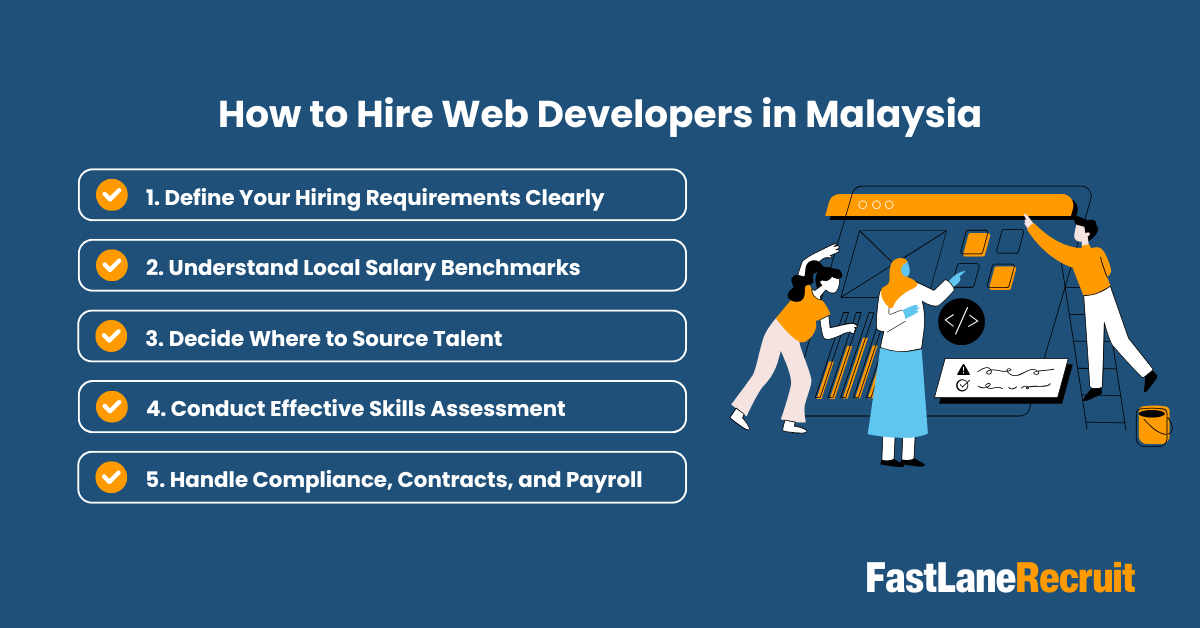
1. Define Your Hiring Requirements Clearly
Before posting any job ad, identify the specific skills and responsibilities. Consider these:
Essential Technical Skills
| Role | Required Skills |
| Front-End Developer | HTML5, CSS3, JavaScript, React.js, Vue.js, Angular |
| Back-End Developer | Node.js, PHP (Laravel), Python (Django), Java, .NET |
| Full-Stack Developer | Front-end frameworks + back-end languages + databases |
| Web Designer / UI Developer | Figma, Adobe XD, responsive design |
| DevOps for Web | CI/CD, Docker, cloud (AWS, Azure, GCP) |
Non-Technical Skills
- Clear communication
- English proficiency
- Remote work discipline
- Ability to meet deadlines
2. Understand Local Salary Benchmarks
Realistic salary expectations help attract the right talent.
Average Monthly Salary Range for Web Developers in Malaysia (2025)
| Experience Level | Salary Range (MYR) | Approx. USD Equivalent |
| Junior (0–2 yrs) | 3,000–5,000 | 650–1,100 |
| Mid-Level (3–5 yrs) | 5,500–8,000 | 1,200–1,700 |
| Senior (6–10 yrs) | 8,500–12,000 | 1,800–2,600 |
| Lead Developer | 12,000–18,000 | 2,600–3,800 |
Note: These are market averages from leading Malaysian job boards and hiring agencies.
3. Decide Where to Source Talent
Top Places to Find Malaysian Web Developers
| Platform | Notes |
| JobStreet Malaysia | Largest job board; strong for local hires |
| Ideal for mid–senior developers | |
| GitHub / StackOverflow | Great for assessing technical portfolios |
| MDEC Malaysia Digital Talent Portal | Verified talent pool (https://mdec.my/) |
| FastLaneRecruit | For hiring, onboarding, Payroll and compliance support |
4. Conduct Effective Skills Assessment
Evaluating a Malaysian web developer’s skill set goes beyond checking a résumé. A structured, fair, and practical assessment process helps you filter out candidates who can actually deliver high-quality code in real-world scenarios. The goal is to verify technical competence, coding style, communication ability, and problem-solving skills.
Below are the key methods to use, along with tips and examples:
Coding Tests (HackerRank, Codility, TestGorilla)
Coding test platforms help you objectively benchmark a candidate’s technical skills. They’re ideal for evaluating:
- Algorithm knowledge
- Code efficiency
- Debugging skills
- Familiarity with common data structures
- Ability to handle time-boxed challenges
Example: A company looking for a React + Node.js developer gives candidates a 60-minute HackerRank test focused on API integration, array manipulations, and async JavaScript.
Tip: Use role-specific tests. Generic algorithm challenges can filter out good developers who are not necessarily competitive in competitive programming.
Also Read: Hiring Front-End Developer Teams in Malaysia
Live Coding Interviews
Live coding sessions offer a closer look at how a developer thinks and collaborates under realistic conditions. They also reveal communication style, which is important when working with remote teams.
Live sessions can include:
- Pair programming on a small feature
- Building a simple component (e.g., a dropdown menu or form)
- Reading and improving a piece of existing code
- Explaining how they’d structure a backend endpoint
Example: A startup may ask the candidate to build a simple REST endpoint using Node.js while explaining error handling and folder structure. This shows both coding skill and architectural thinking.
Tip: Keep the session short (30–45 minutes) and practical. Avoid questions like “reverse a linked list” if your company builds e-commerce apps.
Portfolio or GitHub Review
A developer’s portfolio often reveals what tests cannot, how they write code in the real world and how they manage projects end-to-end.
Key things to look for:
- Code readability and consistency
- Use of modern frameworks (React, Vue, Laravel, Django)
- Frequency of contributions
- Personal or open-source projects
- Whether they’ve built apps similar to your product
Example: If you’re building a marketplace, prioritize candidates whose GitHub repos show experience with payment integrations, admin dashboards, and user authentication.
Tip: Check commit messages too. Developers who write clean, descriptive messages often demonstrate strong attention to detail.
Product-Relevant Problem-Solving Challenges
These mimic the real life issues your engineering team faces. This is often the most accurate indicator of job performance.
Examples include:
- Debugging a slow SQL query
- Fixing a broken CSS layout
- Designing a scalable database schema
- Improving the performance of a React component
- Writing a reusable API helper function
Example: A fintech company hiring a Malaysian full-stack developer gives them a mini-task: “Build a login form with validation and a session token. Explain how you’d secure it.” This reveals not just coding knowledge, but understanding of security, product thinking, and best practices.
Tip: Keep assessments manageable, no multi-day homework projects. Candidates often drop out when tests take too long.
5. Handle Compliance, Contracts, and Payroll
Hiring Malaysian web developers isn’t just about onboarding talent, it also requires navigating Malaysia’s employment regulations. If you’re a foreign company hiring remotely in Malaysia, you’re still responsible for ensuring proper contracts, compliant payroll, and correct statutory contributions. Failing to comply can lead to penalties, backdated payments, or the inability to legally employ talent in the country.
Below are the key components you must manage:
EPF (Employees Provident Fund)
EPF is Malaysia’s mandatory retirement savings scheme. Employers must contribute between 12–13% of the employee’s monthly salary, depending on wage level, while employees contribute 11%.
Example: If you hire a Malaysian web developer at MYR 6,000 per month, you must allocate employer contributions to EPF. This applies even if they work fully remotely for a foreign startup.
SOCSO (Social Security Organisation)
SOCSO provides workplace injury, disability, and insurance protection. Contributions are mandatory for employees earning up to a certain monthly salary threshold.
What it covers:
- Medical benefits
- Temporary/permanent disability benefits
- Dependents’ benefits
- Rehabilitation
Example: If a developer experiences a work-related accident (even when working from home), SOCSO benefits help cover treatment and compensation.
EIS (Employment Insurance System)
EIS supports employees who lose their jobs by providing temporary financial assistance and job support programs.
Employers must contribute monthly, similar to unemployment insurance in other countries.
Why Compliance Can Be Challenging for Foreign Companies
Foreign companies hiring Malaysian developers as remote staff must:
- Register with Malaysian authorities
- Set up a local entity or presence
- Manage monthly payroll submissions
- File statutory contributions accurately
- Draft legally compliant employment contracts
- Stay updated with local labor law changes
Each of these steps adds administrative burden, cost, and legal risk. Most startups simply don’t have the internal HR/legal infrastructure to handle Malaysian employment compliantly.
How FastLaneRecruit Simplifies This Entire Process
This is exactly why many global companies turn to an expert partner like FastLaneRecruit, which provides an Employer of Record (EOR) service in Malaysia.
With FastLaneRecruit:
- You hire Malaysian web developers without opening a local entity
- FastLaneRecruit becomes the legal employer on your behalf
- They handle EPF, SOCSO, and EIS contributions
- Your developers remain fully dedicated to your company
- You stay compliant, without dealing with any paperwork
- Payroll, contracts, and benefits are all managed seamlessly
Example: A Singapore-based SaaS startup wants to hire two Malaysian React developers. Instead of registering a Malaysian Sdn Bhd (which can take months), they onboard the developers through FastLaneRecruit’s EOR service and start the project within days, completely compliant and risk-free.
Also Read: Hiring App Developers in Malaysia
Key Challenges Startups Face When Hiring Developers (And How to Solve Them)
1. Talent Shortage in Niche Skill Areas
Skills like DevOps, cloud engineering, and advanced JavaScript frameworks may be harder to find.
Solution: Expand hiring channels, offer competitive pay, and consider alternative hiring models like cross-border employment via FastLaneRecruit.
2. Difficulty Verifying Technical Skills
A polished resume doesn’t always mean strong coding ability.
Solution: Use structured coding tests, assign portfolio challenges, and review GitHub activity.
3. Payroll and Labor Compliance for Foreign Companies
Navigating EPF, tax requirements, and local labor rules can be overwhelming.
Solution: Use an Employer of Record (EOR) provider like FastLaneRecruit that hires Malaysian developers on your behalf and manages compliance end-to-end.
4. Competition from Local Startups and MNCs
Malaysia’s tech landscape is booming, so developers have multiple offers.
Solution: Promote remote-friendly policies, career advancement opportunities, and flexible work arrangements.
Why FastLaneRecruit Is the Smarter Way to Hire Developers in Malaysia
FastLaneRecruit’s Employer of Record Service simplifies the entire process of building a development team in Malaysia, especially if you’re a foreign company without a local entity.
What FastLaneRecruit’s EOR Offers
| Service | Benefit |
| Talent Sourcing | Access to vetted Malaysian web developers across all tech stacks |
| Employer of Record (EOR) | Hire developers legally without setting up a company |
| Onboarding & Contracts | Compliance with Malaysian labor laws |
| Payroll & Tax Management | EPF, SOCSO, EIS, tax filing handled for you |
| HR Support | Leave, attendance, performance, offboarding |
Why It Matters
- No need to set up a Malaysian entity
- Zero compliance headaches
- Faster hiring cycles
- Transparent cost structure
- Scalable team building
If you want a more stress-free alternative to direct hiring or talent contracting, FastLaneRecruit provides a complete end-to-end hiring and workforce management solution.
Conclusion
Hiring web developers in Malaysia is one of the smartest moves a startup or scaling company can make in 2025. The country offers an ideal blend of affordability, highly skilled talent, English fluency, stable work culture, and a supportive digital ecosystem.
Whether you’re building your first development team or expanding into Southeast Asia, Malaysia is an exceptional choice. And with the right process or the right partner, you can hire top-tier talent quickly and compliantly.
Ready to Hire Web Developers in Malaysia?
If you want to hire Malaysian developers without dealing with local labor laws, payroll, or entity setup, FastLaneRecruit’s Employer of Record (EOR) service lets you:
- Build your team in Malaysia fast
- Stay fully compliant
- Pay developers seamlessly
- Scale up or down anytime
Let FastLaneRecruit handle the operational load while you focus on building great products. Contact us for a free discovery call!
