

A Practical Guide for Global Businesses
As businesses grow across borders, leaders often find themselves stretched thin. Daily tasks like scheduling, inbox management, reporting, customer follow-ups, and coordination can quietly consume hours that should be spent on strategy and growth.
This is where remote assistants come in.
For many global companies, Malaysia has become a trusted location for building reliable remote support teams. With a strong professional workforce, excellent English proficiency, and a business-friendly environment, Malaysia offers a practical way to extend operations without adding internal strain.
In this guide, we’ll walk through how to hire and manage remote assistants in Malaysia, what to look for, how to stay compliant, and how FastLaneRecruit can support you through a structured Employer of Record (EOR) solution.
Content Outline
Key Summary
Remote Assistants Support Daily Operations
Remote assistants help businesses manage scheduling, communication, administration, and operational tasks, allowing teams to focus on strategic growth.
Malaysia Is a Strong Remote Hiring Destination
Malaysia offers skilled professionals, strong English proficiency, reliable infrastructure, and favorable time-zone coverage for global teams.
Remote Assistants Provide Flexible Business Support
Remote assistants can support administration, marketing, research, operations, and customer service with responsibilities that scale as businesses grow.
Hiring the Right Skills Is Essential
Successful remote assistants combine organizational ability, communication skills, technology proficiency, and independent problem-solving.
Structured Hiring Reduces Risk
Clear role definitions, proper screening, background checks, and compliant employment structures improve hiring outcomes and long-term success.
Effective Management Drives Performance
Structured onboarding, clear communication, regular check-ins, and documented processes help remote assistants stay productive and aligned.
Compliance Matters for Global Employers
Employment contracts, statutory contributions, and tax obligations must be handled correctly, making structured solutions like EOR valuable.
What Is a Remote Assistant?
A remote assistant is a professional who provides business support while working from a location outside your office. Instead of being physically present, they work online and stay connected with your team through digital tools such as email, video calls, shared documents, and project management platforms.
Just like an in-office assistant, a remote assistant helps keep daily operations running smoothly. The main difference is how they work, not what they do. From scheduling meetings and managing inboxes to updating systems and supporting customers, remote assistants handle essential tasks that are necessary for the business to function well.
Remote assistants often support:
- Business owners and founders who need help managing daily responsibilities
- Executives who handle packed schedules and frequent communication
- Teams and departments that require ongoing administrative or operational support
By taking care of routine but time-consuming tasks, remote assistants allow your internal teams to focus on higher-value work such as strategy, client relationships, and business growth.
Today, remote assistants are widely used by:
- Startups and SMEs that are scaling and need flexible support without adding pressure on their core team
- Global companies expanding into the Asia-Pacific region and looking for reliable regional support
- Executives managing distributed teams across different locations and time zones
- Businesses seeking operational flexibility, especially those adopting remote or hybrid work models
In short, a remote assistant acts as an extension of your team, helping you stay organized, responsive, and focused, no matter where your business operates.
Also Read: How to Build an Offshore Data Entry Team in Malaysia
Why Global Companies Hire Remote Assistants in Malaysia
Malaysia has steadily built a strong reputation as a reliable hub for remote business support. Many international companies choose Malaysia when building remote teams because it offers a balance of professional talent, modern infrastructure, and a supportive business environment.
Below are the key reasons why global businesses hire remote assistants in Malaysia.
Skilled, Multilingual Workforce
Malaysia has a well-educated workforce with strong communication skills. English is widely used in professional and business settings, especially in multinational companies and service-based roles. This makes collaboration easier for global teams, as remote assistants can communicate clearly with stakeholders across different regions.
In addition to English, many professionals are multilingual, which is helpful for businesses serving customers in Asia-Pacific and beyond. This language capability allows remote assistants to support cross-border communication smoothly and professionally.
Strong Digital Infrastructure
Remote work relies heavily on technology, and Malaysia is well-prepared in this area. The country has reliable internet connectivity and widespread access to digital tools used by global companies. Remote assistants in Malaysia are familiar with platforms such as Google Workspace, Microsoft Office, Zoom, Slack, and project management tools.
This digital readiness allows teams to collaborate in real time, share files securely, and manage tasks efficiently without disruption.
Time Zone Coverage for Global Operations
Malaysia’s time zone (GMT+8) is ideal for businesses operating across multiple regions. It aligns well with Asia-Pacific markets and provides working-hour overlap with Australia and parts of Europe.
For global companies, this means:
- Faster response times for APAC clients
- Extended daily operational coverage
- Better coordination across international teams
This time zone advantage makes Malaysia especially useful for businesses managing regional or global workflows.
Also Read: Payroll and Statutory Compliance for Hiring Data Entry Clerks in Malaysia
Business-Friendly Environment
Malaysia supports foreign business operations and digital employment through structured labor regulations and clear employment frameworks. The government continues to encourage digital transformation and international collaboration, which helps global companies operate with confidence.
Organizations such as the Malaysia Digital Economy Corporation (MDEC) actively promote digital talent development and remote work initiatives, while the Ministry of Human Resources (MOHR) provides guidance on employment practices and workforce policies.
You can learn more from official sources:
- Malaysia Digital Economy Corporation (MDEC): https://mdec.my
- Ministry of Human Resources (MOHR): https://www.mohr.gov.my
A Strategic Choice for Global Teams
Taken together, Malaysia offers global companies a dependable environment to build remote support teams. With capable professionals, strong digital infrastructure, favorable time-zone positioning, and supportive labor frameworks, Malaysia continues to be a practical and trusted choice for hiring remote assistants.
What Tasks Can Remote Assistants Handle?
Remote assistants can support many day-to-day business functions across different teams. Their role can be broad or highly focused, depending on your business needs. Some companies use remote assistants for general administrative support, while others assign them to specific departments such as operations, marketing, or customer service.
Below is a practical overview of common tasks remote assistants can handle and how they support business operations.
| Business Area | Example Tasks | How This Helps Your Business |
| Administration | Email management, document preparation, data entry, file organization | Keeps information organized and reduces administrative workload for internal teams |
| Scheduling | Calendar coordination, meeting setup, appointment reminders | Ensures meetings run smoothly and helps teams manage time more effectively |
| Communication | Call handling, internal coordination, follow-ups with clients or vendors | Improves response times and maintains clear communication across teams |
| Research | Market research, data collection, reporting | Provides useful insights to support planning and decision-making |
| Operations Support | CRM updates, invoice tracking, system updates | Helps maintain accurate records and supports daily operational processes |
| Marketing Support | Content scheduling, basic social media coordination, campaign tracking | Supports marketing teams with consistent content and campaign execution |
| Customer Support | Responding to inquiries, ticket tracking, order follow-ups | Enhances customer experience by ensuring timely and organized responses |
Flexible Support Based on Your Needs
One of the biggest advantages of working with remote assistants is flexibility. Their responsibilities can be adjusted as your business grows or changes. For example:
- A startup may rely on one remote assistant to manage emails, scheduling, and basic research.
- A growing company may assign different remote assistants to operations, marketing, or customer support.
- A global team may use remote assistants to provide coverage across different time zones.
This flexibility makes remote assistants suitable for both general support roles and specialized, role-specific functions, helping businesses stay efficient without overloading internal teams.
Also Read: Benefits of Outsourcing Data Entry Operations for Global Businesses
Key Skills to Look for When Hiring Remote Assistants
Successful hiring starts with understanding what makes a remote assistant effective. The best remote assistants are not only comfortable using digital tools but are also reliable communicators who can work independently and adapt to changing priorities.
When reviewing candidates, look for a balance of technical skills and soft skills. Together, these abilities ensure smooth collaboration and consistent performance in a remote setting.
Administrative & Organizational Skills
Strong administrative and organizational skills are essential, as remote assistants often manage multiple tasks at the same time.
Key abilities include:
- Inbox and calendar management, ensuring important messages and meetings are not missed
- Documentation and record-keeping, keeping files, data, and records accurate and well organized
- Task prioritization, knowing what needs attention first and managing deadlines effectively
These skills help maintain structure and reduce the day-to-day workload for business owners and teams.
Communication Skills
Clear communication is one of the most important qualities in a remote assistant. Because all interactions happen online, instructions, updates, and feedback must be easy to understand.
Look for candidates who demonstrate:
- Clear written and verbal communication, especially in emails and virtual meetings
- A professional and respectful tone when interacting with colleagues, clients, and partners
- Confidence working across cultures and time zones, which is essential for global teams
Strong communication helps avoid misunderstandings and keeps everyone aligned.
Technology Proficiency
Remote assistants rely on technology to perform their work efficiently. They should be comfortable using common digital tools without needing constant guidance.
Important tools include:
- Productivity platforms such as Google Workspace or Microsoft Office
- Communication tools like Slack, Zoom, or Microsoft Teams for daily collaboration
- Project management tools such as Asana, Trello, or Monday.com to track tasks and deadlines
Technology proficiency allows remote assistants to integrate smoothly into your existing workflows.
Problem-Solving & Initiative
Remote assistants often work independently, so they need to be able to think through challenges and take action when needed.
Key traits include:
- The ability to handle unexpected changes, such as schedule shifts or urgent requests
- Proactive follow-ups, ensuring tasks are completed without constant reminders
- Independent decision-making, knowing when to act and when to ask for clarification
These qualities make a remote assistant a dependable partner rather than just task support.
Why These Skills Matter
When a remote assistant has the right mix of skills, they become an extension of your team. They help keep operations organized, communication clear, and tasks moving forward, no matter where your business or team members are located.
Also Read: Why Malaysia Is a Top Choice for Offshore Data Entry Teams
Common Hiring Models for Remote Assistants
Global businesses typically choose one of the following approaches:
1. Direct Hiring
You recruit and employ the assistant directly.
Best for:
Companies with an existing Malaysian entity and internal HR resources.
Considerations:
You manage payroll, contracts, tax filings, and statutory contributions.
2. Freelance or Platform-Based Hiring
You engage individuals on a contract basis via platforms.
Best for:
Short-term or project-based needs.
Considerations:
Limited control, inconsistent availability, and higher compliance responsibility.
3. Employer of Record (EOR) Model
A third-party provider legally employs the remote assistant on your behalf.
Best for:
Companies hiring in Malaysia without setting up a local entity.
Benefits:
- Local payroll management
- Employment contracts aligned with Malaysian law
- Statutory contributions handled correctly
- Reduced compliance risk
This is where FastLaneRecruit’s EOR service fits in.
How to Hire Remote Assistants in Malaysia: Step-by-Step
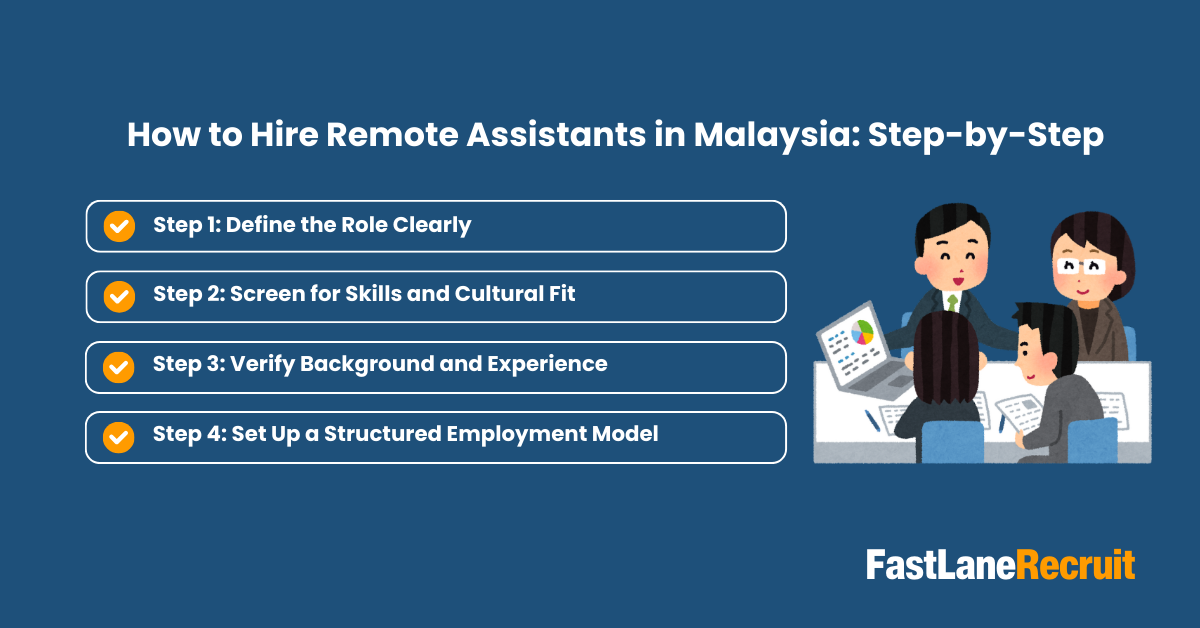
Hiring remote assistants in Malaysia can be a smooth and scalable process when approached with the right structure. By following a clear step-by-step method, global companies can reduce hiring risks, improve candidate quality, and ensure long-term success.
Step 1: Define the Role Clearly
The foundation of a successful hire starts with clarity. Before sourcing candidates, clearly outline what the remote assistant will be responsible for and how they will fit into your team.
Key details to define include:
- Daily responsibilities, such as administrative support, scheduling, or system updates
- Required tools, including software platforms, communication tools, and internal systems
- Reporting structure, specifying who the assistant reports to and how performance is reviewed
- Working hours and expectations, including time zone overlap, response times, and availability
A well-defined role helps attract candidates with the right experience and avoids misunderstandings after hiring. Clear scope leads to better candidate matches and faster onboarding.
Also Read: Benefits of Outsourcing Data Entry Operations for Global Businesses
Step 2: Screen for Skills and Cultural Fit
Once candidates are shortlisted, screening should go beyond resumes. Remote assistants must be able to communicate clearly, manage tasks independently, and adapt to your company’s workflow.
Use interviews and short task-based assessments to evaluate:
- Communication style, including clarity, tone, and responsiveness
- Task prioritization, especially how candidates handle multiple responsibilities
- Tool familiarity, such as email platforms, spreadsheets, CRMs, or project management tools
- Problem-solving approach, including how they respond to unclear instructions or unexpected issues
This step ensures the candidate not only has the technical skills but also aligns with your team’s working style.
Step 3: Verify Background and Experience
Verification is an important step, particularly when hiring remotely. It helps ensure reliability, professionalism, and trust.
Confirm the following:
- Employment history, to validate relevant experience and role consistency
- Certifications or training, if the role requires specific technical or industry knowledge
- References, focusing on reliability, communication skills, and work ethic
This step reduces hiring risk and gives employers confidence in the candidate’s background.
Step 4: Set Up a Structured Employment Model
Hiring in Malaysia requires compliance with local labor and statutory regulations. Whether you hire directly or through a partner, employment terms should be clearly documented.
Key considerations include:
- Employment contracts, outlining role scope, compensation, confidentiality, and termination terms
- Payroll setup, ensuring accurate salary payments and deductions
- Statutory contributions and compliance, including:
- EPF (Employees Provident Fund) – retirement contributions
https://www.kwsp.gov.my - SOCSO (PERKESO) – social security protection
https://www.perkeso.gov.my - Inland Revenue Board (LHDN) – income tax compliance
https://www.hasil.gov.my
- EPF (Employees Provident Fund) – retirement contributions
Ensuring compliance protects both the employer and the employee while maintaining legal and operational stability.
Why a Structured Hiring Process Matters
A step-by-step hiring approach helps global companies build reliable remote teams in Malaysia without unnecessary complexity. With clear role definition, thoughtful screening, proper verification, and compliant employment structures, businesses can scale efficiently while minimizing risk.
Also Read: Data Entry Clerk Salary Guide 2026
How to Manage Remote Assistants Successfully
Hiring a remote assistant is just the first step. To get the most value from your investment, strong management and ongoing support are crucial. Proper management ensures that your remote assistant remains productive, motivated, and aligned with your business goals. Here’s how to do it effectively.
1. Structured Onboarding
A smooth onboarding process sets your remote assistant up for success from day one. It’s important to introduce them to your company culture, tools, and workflows in a clear, organized way.
Key onboarding steps include:
- Tool setup: Provide access to email, project management platforms, communication tools, and any other essential software
- Workflow introduction: Explain task flows, priority levels, and reporting expectations
- Role clarity: Outline day-to-day responsibilities, long-term goals, and how their work contributes to broader business objectives
A structured onboarding process helps new hires feel confident and reduces mistakes caused by unclear expectations.
2. Clear Communication Channels
Remote work depends on effective communication. Defining where and how updates, questions, and feedback should happen keeps everyone on the same page.
Best practices include:
- Dedicated platforms: Use tools like Slack, Microsoft Teams, or email for different types of communication (e.g., instant updates vs formal reports)
- Guidelines: Specify expected response times for messages and emails
- Transparency: Encourage remote assistants to share updates regularly and ask questions proactively
Clear communication reduces misunderstandings and ensures tasks are completed accurately and on time.
3. Regular Check-Ins
Even with a skilled assistant, regular touchpoints are necessary to maintain alignment and engagement.
- Frequency: Schedule weekly or bi-weekly meetings to review progress, address challenges, and plan upcoming work
- Agenda: Discuss priorities, upcoming deadlines, and any obstacles the assistant may be facing
- Feedback: Offer guidance, recognize achievements, and clarify expectations as needed
These check-ins foster trust, prevent small issues from escalating, and help remote assistants feel connected to the team.
4. Documented Processes
Standard Operating Procedures (SOPs) and written instructions are essential for remote teams. They provide clarity, reduce errors, and make it easier for assistants to work independently.
- Create SOPs: Document recurring tasks, workflows, and best practices
- Update regularly: Keep processes current as tools or business requirements evolve
- Make them accessible: Store SOPs in shared drives or project management platforms so they’re easy to reference
Documented processes save time for both managers and remote assistants and improve consistency across tasks.
5. Performance Feedback and Recognition
Feedback is key to growth and engagement. Clear goals combined with constructive feedback help your assistant improve and feel valued.
- Set measurable goals: Use key performance indicators (KPIs) or project milestones
- Provide constructive feedback: Highlight areas for improvement along with actionable advice
- Recognize achievements: Celebrate successes to boost motivation and retention
Consistent feedback strengthens trust and helps remote assistants perform at their best, ultimately benefiting the entire business.
Bonus Tips for Effective Management
- Leverage collaboration tools: Use shared calendars, task trackers, and cloud storage to keep everyone aligned
- Encourage autonomy: Allow assistants to take ownership of tasks to increase efficiency and engagement
- Foster team culture: Include remote assistants in team meetings and social activities to build connection
By combining structured onboarding, clear communication, regular check-ins, documented processes, and performance feedback, you can manage remote assistants effectively and ensure long-term success for both your team and your business.
Compliance Considerations When Hiring in Malaysia
When hiring remote assistants in Malaysia, understanding local employment regulations is essential. Malaysia has well-defined labor laws designed to protect both employees and employers. Global companies need to ensure they comply with these regulations to avoid legal issues, fines, or misunderstandings.
Key compliance areas include:
1. Employment Contracts
Every employee in Malaysia must have a clear and legally compliant employment contract. This contract should outline:
- Job responsibilities and reporting lines – Clearly define what the assistant will do and who they report to
- Compensation and benefits – Specify salary, allowances, bonuses, and any benefits offered
- Working hours and leave entitlements – Include standard working hours, overtime policies, and annual leave entitlements
- Termination and notice period – Outline conditions for ending employment and notice requirements
A well-structured contract protects both your company and your remote assistant, ensuring expectations are clear from the start.
2. Statutory Contributions
Employers in Malaysia are required to make certain statutory contributions for employees:
- Employees Provident Fund (EPF): Retirement savings plan, with contributions from both employer and employee
EPF Official Site - Social Security Organization (SOCSO/PERKESO): Provides insurance protection in case of workplace injuries or employment-related incidents
SOCSO Official Site
These contributions are mandatory for most Malaysian employees and help ensure compliance with labor laws.
3. Tax Obligations
Employers must comply with Malaysian income tax regulations:
- Employee income tax withholding: Employers may need to deduct taxes from salaries and report to the Inland Revenue Board (LHDN)
LHDN Official Site - Corporate tax responsibilities: Companies must ensure that payroll and reporting comply with Malaysian tax rules
Proper handling of tax obligations prevents legal issues and protects your business reputation.
4. Employee Protections
Malaysian labor laws provide various protections to employees, including:
- Minimum wage and overtime compensation
- Leave entitlements, including annual, sick, and maternity leave
- Protection against unfair dismissal and workplace discrimination
Complying with these protections helps build trust, maintain employee morale, and reduce turnover risks.
Why Global Companies Use Structured Employment Partners
For international businesses without local HR expertise, navigating these rules can be challenging. Missteps in employment contracts, statutory contributions, or tax reporting can lead to fines or legal disputes.
Many companies turn to structured employment partners, such as Employer of Record (EOR) services, which:
- Handle all legal and regulatory compliance
- Manage payroll, taxes, and statutory contributions
- Draft compliant employment contracts
- Provide local HR support and employee management guidance
Using a structured employment partner allows global companies to hire Malaysian remote assistants quickly, confidently, and without the risk of non-compliance.
A Simpler Alternative: FastLaneRecruit’s EOR Service
If you want to hire remote assistants in Malaysia without setting up a local entity, FastLaneRecruit’s Employer of Record (EOR) service offers a practical solution.
How FastLaneRecruit helps:
- Employs remote assistants legally in Malaysia
- Manages payroll, tax, and statutory contributions
- Ensures contracts align with local labor laws
- Reduces administrative workload for your team
- Lets you focus on performance, not compliance
This approach gives you the flexibility of a remote workforce with the confidence of local compliance.
Conclusion
Hiring and managing remote assistants in Malaysia can be a smart move for global businesses looking to scale efficiently and stay focused on growth.
With the right hiring approach, clear management practices, and a compliant employment structure, remote assistants become a reliable extension of your team—not just extra support.
If you’re exploring a structured and compliant way to build your remote team in Malaysia, FastLaneRecruit’s EOR service can help you get started with clarity and confidence.
Ready to Build Your Remote Support Team in Malaysia?
Scaling your business with skilled remote assistants has never been easier. Whether you’re looking to streamline operations, improve productivity, or access top talent in Malaysia, FastLaneRecruit can help you every step of the way.
Start building your global remote support team today and enjoy a worry-free hiring experience. Talk to FastLaneRecruit now to discover a smarter, simpler way to hire and manage remote assistants in Malaysia and beyond.
