
Skills & Best Practices for Global Teams
As companies expand across regions, managing people effectively becomes more complex. Payroll accuracy, employee data management, onboarding, compliance, and HR reporting must work smoothly to support growth. This is where HR Operations Analysts play a critical role. They ensure HR processes run efficiently while providing data-backed insights that help leaders make better workforce decisions.
Malaysia is becoming a top choice for companies looking for HR operations talent. With a digitally savvy workforce, multilingual skills, and experience with global HR practices, it’s a prime location for building or scaling HR teams. In this guide, we’ll walk you through what HR Operations Analysts do, the skills to look for, best hiring practices, and how you can confidently hire HR talent in Malaysia.
Content Outline
Key Summary
Understand the Role Clearly
HR Operations Analysts manage payroll, employee data, onboarding, compliance, and reporting. Clear role definitions help attract the right talent.
Look for Core Skills
Essential skills include HR operations knowledge, data analysis, HRIS proficiency, reporting, attention to detail, and problem-solving abilities.
Prioritize Communication & Collaboration
Analysts work with HR, finance, and global teams. Strong communication ensures processes run smoothly across regions.
Focus on Compliance and Accuracy
Knowledge of local labor laws, statutory reporting, and data privacy is critical to reduce risks and maintain governance.
Assess Practical Skills, Not Just Resumes
Evaluate candidates using sample reports, case scenarios, and HRIS tasks to ensure they can handle real-world operations efficiently.
Consider Malaysia as a Strategic Hub
The country offers multilingual talent, digital readiness, cross-cultural experience, and familiarity with international HR processes.
Use EOR or Structured Hiring Solutions
Employer of Record services, like FastLaneRecruit, simplify hiring, payroll, and compliance while giving companies control over HR operations talent.
What Does an HR Operations Analyst Do?
An HR Operations Analyst helps keep the daily HR activities of a company running smoothly. They work behind the scenes to make sure employee information is accurate, HR processes are consistent, and managers have clear data to make decisions.
In simple terms, they act as the bridge between HR operations and data. While HR managers focus on people strategy, HR Operations Analysts focus on making sure the systems, records, and reports that support those strategies are reliable.
Their role becomes especially important in growing companies, remote teams, or global organizations, where HR processes must work across different locations.
Key Responsibilities Explained with Examples
Maintaining employee data in HR systems
HR Operations Analysts are responsible for keeping employee records up to date in HR systems (HRIS). This includes personal details, job titles, reporting lines, and employment status.
Example:
When an employee is promoted or transfers to another department, the HR Operations Analyst updates the HR system to reflect the new role and salary, ensuring payroll and reporting remain accurate.
Supporting payroll, benefits, and statutory reporting
They assist with payroll preparation by checking employee data, attendance, leave records, and benefits information before payroll is processed. They may also help prepare reports required for statutory contributions.
Example:
Before monthly payroll runs, the analyst reviews attendance data and approved leave to confirm employees are paid correctly and statutory contributions are calculated accurately.
Also Read: Building a High-Performing Offshore HR and Payroll Management Team in Malaysia (Singapore Edition)
Preparing HR reports and dashboards
HR Operations Analysts create regular reports that help HR leaders and managers understand workforce trends. These reports may include headcount changes, hiring progress, or attrition patterns.
Example:
A monthly dashboard showing total employees by department helps leadership plan hiring needs and track team growth across regions.
Tracking key HR metrics such as headcount, turnover, and attendance
They monitor important HR metrics and flag trends or issues early. This helps HR teams respond before small problems become larger challenges.
Example:
If turnover increases in a specific team, the HR Operations Analyst highlights this trend, allowing HR managers to investigate and address potential concerns.
Supporting onboarding and offboarding processes
HR Operations Analysts ensure new hires are set up correctly in HR systems and that departing employees are processed smoothly. This includes system access, documentation, and final payroll coordination.
Example:
When a new employee joins, the analyst ensures their employee profile, payroll setup, and benefits enrollment are completed on time so they can start work without delays.
Ensuring HR practices follow local labor regulations
They help ensure HR processes align with local employment rules and internal company policies. This is especially important for companies operating in multiple countries.
Example:
When updating leave policies or employment records, the HR Operations Analyst checks that changes comply with local labor regulations and company guidelines.
Working with global HR and finance teams to align processes
HR Operations Analysts often coordinate with HR, payroll, and finance teams across different regions to ensure consistency and accuracy.
Example:
For a company with teams in APAC and Europe, the analyst works with regional HR teams to standardize reporting formats and timelines.
Why HR Operations Analysts Matter for Growing and Global Teams
As companies grow or expand internationally, HR processes become more complex. Manual data entry, inconsistent reporting, and compliance risks can slow down operations.
HR Operations Analysts help by:
- Reducing manual work through structured processes
- Improving data accuracy across systems
- Supporting compliance in different locations
- Providing reliable insights for decision-making
This makes them a key part of any HR team supporting regional or global operations.
Also Read: Building a High-Performing Offshore HR and Payroll Management Team in Malaysia (Hong Kong Edition)
Why Global Companies Hire HR Operations Analysts in Malaysia
Malaysia is increasingly selected by global organizations as a location for HR operations roles. This is not by chance. The country offers a combination of skilled professionals, strong digital readiness, and a structured employment environment that supports regional and global HR teams.
Below are the key reasons why global companies choose HR Operations Analysts in Malaysia.
Strong HR and Digital Skills Base
Malaysia has a mature professional services ecosystem, particularly in HR operations and shared services. Many HR Operations Analysts are experienced in supporting multinational organizations and are familiar with international HR workflows.
They commonly work with:
- Global HRIS platforms
- Payroll and benefits systems
- HR reporting and workforce analytics tools
This makes it easier for global employers to integrate Malaysian HR Operations Analysts into existing systems and processes with minimal onboarding time.
Experience with Global HR Systems and Processes
HR Operations Analysts in Malaysia often support regional or global teams and are used to standardized HR processes across multiple countries.
Example:
An HR Operations Analyst in Malaysia may manage employee data updates for teams in several APAC countries while following global HR reporting standards set by headquarters.
This experience helps ensure consistency and accuracy across regions.
Multilingual and Cross-Cultural Communication
Malaysia is a multicultural and multilingual country. Many HR professionals communicate confidently with teams across Asia-Pacific, Europe, and North America.
This cross-cultural exposure supports:
- Clear communication with global stakeholders
- Better understanding of regional HR expectations
- Smoother collaboration with international HR and finance teams
For global organizations, this reduces miscommunication and improves workflow alignment.
Familiarity with Regional Employment Compliance
HR Operations Analysts in Malaysia regularly work with structured employment frameworks and statutory reporting. This experience is valuable when managing HR operations across different markets.
They understand the importance of:
- Accurate employment records
- Timely statutory submissions
- Clear audit trails and documentation
This compliance-focused approach helps reduce risk and supports consistent HR governance.
Also Read: Building a High-Performing Offshore HR and Payroll Management Team in Malaysia (Australia Edition)
Strong Support for Remote and Regional Teams
Malaysia has become a key hub for supporting remote and hybrid teams. HR Operations Analysts are accustomed to managing employees who work across different locations and time zones.
Example:
An HR Operations Analyst may support onboarding for remote hires, manage attendance tracking for distributed teams, and coordinate payroll inputs across regions.
This makes Malaysia well suited for companies operating with flexible or regional workforce models.
Alignment with Global Business Standards
Many HR professionals in Malaysia have experience working with multinational companies, global policies, and shared service models. This exposure ensures alignment with international HR standards and reporting requirements.
As a result, global employers can expect:
- Structured processes
- Clear documentation
- Professional HR operations support
Reliable Infrastructure and Digital Readiness
Malaysia has invested heavily in digital infrastructure, making it a reliable location for HR operations support. Stable systems and connectivity enable HR Operations Analysts to work efficiently with cloud-based HR platforms and global teams.
This digital readiness supports:
- HR system automation
- Real-time reporting
- Secure handling of employee data
Trusted Employment and Workforce References
For companies seeking authoritative information on Malaysia’s workforce and employment framework, the following government and statutory bodies provide reliable guidance:
- Ministry of Human Resources Malaysia
https://www.mohr.gov.my - Employees Provident Fund (EPF)
https://www.kwsp.gov.my - Social Security Organisation (SOCSO)
https://www.perkeso.gov.my
These institutions reflect Malaysia’s structured and transparent employment environment, reinforcing trust for global employers.
Core Skills to Look for in HR Operations Analysts
When hiring HR Operations Analysts in Malaysia, it’s important to look beyond job titles. The strongest candidates combine hands-on HR operations experience with strong data, system, and communication skills. This balance helps ensure HR processes run smoothly while providing accurate insights to support business decisions.
Below is a detailed breakdown of the core skills global employers should look for and why each one matters.
HR Operations Knowledge
What to look for:
Experience with payroll support, onboarding and offboarding processes, employee records management, and compliance-related tasks.
Also Read: 2026 Hong Kong Salary Guide
Why it matters:
Strong HR operations knowledge ensures that daily HR activities are completed accurately and on time. This reduces delays, employee issues, and administrative bottlenecks.
Example:
An HR Operations Analyst reviews new hire documents, updates employment details in the HR system, and ensures payroll setup is completed before the employee’s first pay cycle.
Data & Reporting Skills
What to look for:
Comfort with Excel or similar tools, basic data analysis, and experience creating HR reports or dashboards.
Why it matters:
HR leaders rely on accurate data to make workforce decisions. Analysts who understand HR metrics help turn raw data into useful insights.
Example:
The analyst prepares a monthly report showing headcount changes, absenteeism trends, and turnover rates to support workforce planning.
HR Systems and Technology
What to look for:
Hands-on experience with HRIS, Applicant Tracking Systems (ATS), payroll platforms, or benefits administration systems.
Why it matters:
HR systems are the backbone of HR operations. Analysts who are confident with these platforms help improve efficiency, reduce manual work, and maintain data accuracy.
Example:
When an employee transfers to a new role, the HR Operations Analyst updates multiple systems to ensure payroll, reporting, and access permissions remain aligned.
Clear Communication and Coordination
What to look for:
Ability to communicate clearly in writing and verbally, especially when coordinating with HR, finance, and global stakeholders.
Why it matters:
HR Operations Analysts often act as a point of contact between teams. Clear communication helps avoid misunderstandings and ensures smooth execution of HR tasks.
Example:
The analyst explains payroll timelines and data requirements to regional managers, helping them submit accurate information on time.
Also Read: 2026 Singapore Salary Guide
Attention to Detail
What to look for:
Strong focus on accuracy, process checks, and validation of HR data.
Why it matters:
Small data errors can lead to payroll issues or compliance risks. Attention to detail helps prevent costly mistakes.
Example:
Before payroll is finalized, the analyst double-checks attendance records, salary changes, and statutory contribution calculations.
Problem-Solving and Process Improvement
What to look for:
Ability to identify inefficiencies and suggest improvements to HR workflows.
Why it matters:
As organizations grow, HR processes must scale. Analysts who can improve workflows help HR teams work more effectively.
Example:
An HR Operations Analyst identifies repetitive manual reporting and recommends a standardized dashboard to reduce time spent on monthly reporting.
Adaptability in a Global Environment
What to look for:
Comfort working across time zones, regions, and changing priorities.
Why it matters:
Global organizations need HR professionals who can adapt quickly and support evolving business needs.
Example:
The analyst adjusts reporting timelines to support stakeholders in different regions while maintaining data accuracy.
Core Skills Summary Table
| Skill Area | What to Look For | Why It Matters |
| HR Operations Knowledge | Payroll, onboarding, offboarding, compliance | Ensures smooth daily HR execution |
| Data & Reporting | Excel, HR metrics, dashboards | Supports data-driven decisions |
| HR Systems | HRIS, ATS, payroll platforms | Improves accuracy and efficiency |
| Communication | Clear reporting and coordination | Enables collaboration with global teams |
| Attention to Detail | Data accuracy and process checks | Reduces errors and compliance risks |
| Problem-Solving | Process improvement mindset | Helps HR operations scale efficiently |
| Adaptability | Regional and global support experience | Supports growing, distributed teams |
How to Hire HR Operations Analysts in Malaysia (Step-by-Step Guide)
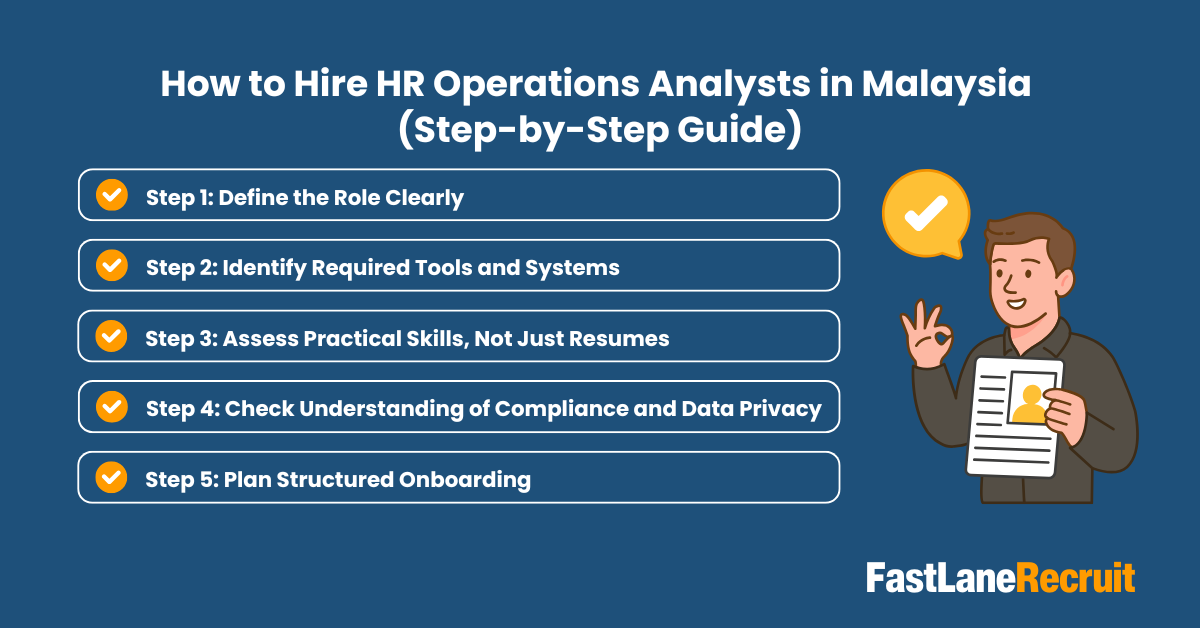
Step 1: Define the Role Clearly
Start by outlining whether the role is:
- Operational (payroll, HR admin, compliance)
- Analytical (reporting, dashboards, workforce data)
- Or a hybrid role
A clear role definition helps attract candidates with the right experience and avoids mismatched expectations.
Step 2: Identify Required Tools and Systems
List the HR systems and tools the analyst will use, such as:
- HRIS platforms
- Payroll systems
- Reporting or dashboard tools
- Excel or data visualization software
This ensures candidates are evaluated on relevant technical skills.
Also Read: 2026 Australia Salary Guide
Step 3: Assess Practical Skills, Not Just Resumes
Beyond resumes and interviews:
- Ask candidates to explain how they would handle payroll data checks
- Review sample reports or dashboards
- Use simple case scenarios (e.g., resolving data inconsistencies or reporting headcount changes)
This approach gives better insight into real-world capability.
Step 4: Check Understanding of Compliance and Data Privacy
HR Operations Analysts handle sensitive employee data. Confirm their understanding of:
- Employment regulations
- Data protection practices
- Internal controls and confidentiality standards
For reference, companies should align with Malaysia’s employment regulations published by government authorities.
Step 5: Plan Structured Onboarding
Once hired:
- Provide clear documentation of HR processes
- Introduce systems and reporting expectations early
- Set clear KPIs for the first 90 days
Strong onboarding helps analysts become productive faster.
Best Practices for Hiring HR Operations Talent in Malaysia
Hiring HR Operations Analysts in Malaysia can be highly effective when the right structures and expectations are in place. The following best practices help global companies build reliable HR operations teams while maintaining accuracy, compliance, and strong collaboration.
Work with Local HR Experts Who Understand Employment Requirements
Partnering with local HR specialists or workforce providers helps ensure employment practices align with Malaysia’s labor framework and statutory requirements.
Local experts understand:
- Employment documentation standards
- Statutory contribution processes
- Reporting timelines and compliance expectations
Example:
A local HR partner supports the onboarding of HR Operations Analysts by ensuring employment contracts, statutory registrations, and HR documentation are handled correctly from day one.
Use Standardized Reporting Templates Early
Introducing consistent HR reporting formats from the start helps reduce confusion and improves data accuracy across regions.
Standardized templates support:
- Clear headcount and workforce reporting
- Consistent payroll inputs
- Easier comparison across teams and locations
Example:
A global company provides a standard monthly HR report template for headcount, attrition, and leave data, allowing HR Operations Analysts in Malaysia to align with global reporting expectations.
Establish Clear Communication Channels with Global Teams
HR Operations Analysts often work with HR, finance, and leadership teams across multiple regions. Clear communication structures help prevent delays and misunderstandings.
Best practices include:
- Defined points of contact
- Regular check-ins or status updates
- Clear escalation paths for urgent issues
Example:
Weekly coordination calls with regional HR teams ensure payroll timelines and reporting deadlines are aligned.
Review HR Processes Regularly for Compliance and Accuracy
As organizations grow, HR processes need to evolve. Regular reviews help ensure workflows remain compliant, accurate, and efficient.
This includes:
- Reviewing payroll inputs and outputs
- Checking data accuracy in HR systems
- Updating procedures when policies or regulations change
Example:
Quarterly internal reviews help identify gaps in onboarding or reporting workflows and allow teams to make timely improvements.
Invest in Continuous Learning for HR Systems and Analytics
HR tools and systems continue to evolve. Supporting ongoing learning helps HR Operations Analysts stay current with new features, reporting capabilities, and best practices.
Continuous learning supports:
- Better use of HRIS and payroll systems
- Improved data analysis and reporting
- Stronger process optimization
Example:
Providing system training or access to learning resources enables HR Operations Analysts to improve dashboard reporting and reduce manual work.
Set Clear Role Expectations and Success Metrics
Defining responsibilities and performance measures helps HR Operations Analysts understand priorities and deliver consistent results.
Clear expectations may include:
- Reporting timelines
- Data accuracy benchmarks
- Process improvement goals
Example:
An organization sets a goal for payroll data accuracy and reporting turnaround times, creating clarity and accountability.
Build Scalable HR Processes from the Start
When hiring HR Operations talent, it’s important to design processes that can scale as the company grows.
Scalable practices include:
- Documented workflows
- Automation where possible
- Shared knowledge across teams
Example:
Documented onboarding and reporting procedures allow new HR Operations Analysts to integrate quickly as the team expands.
Also Read: 2026 Malaysia Salary Guide
Example: Outsourcing HR Operations Support to Malaysia
Many growing global companies choose to centralize HR operations support in Malaysia as their regional or global HR hub. This approach allows organizations to streamline day-to-day HR tasks while keeping strategic decision-making with senior leadership.
How the Model Works
A global company with distributed teams across APAC may assign HR Operations Analysts in Malaysia to support multiple countries and business units. These analysts act as the operational backbone of HR, ensuring consistency and accuracy across all employee processes.
Typical responsibilities handled from Malaysia include:
- Coordinating payroll inputs with local providers across different markets
- Updating and maintaining employee records in HR systems
- Preparing regular HR reports such as headcount, turnover, and attendance
- Supporting onboarding and offboarding processes for regional hires
- Assisting with statutory reporting and compliance documentation
By centralizing these tasks, companies reduce duplication of effort across regions and ensure standardized processes.
Why Malaysia Works Well for Centralized HR Operations
Malaysia offers a strong professional services environment with HR talent experienced in working with regional and global teams. HR Operations Analysts are familiar with structured workflows, HRIS platforms, and cross-border coordination, making them well-suited for centralized HR support roles.
This setup helps organizations:
- Maintain consistent HR data across locations
- Improve visibility into workforce metrics
- Reduce manual errors through standardized processes
- Support multiple time zones with reliable coverage
Business Impact for Global Teams
With HR Operations Analysts managing operational tasks, HR leaders and managers can focus on higher-value activities such as workforce planning, talent development, and employee experience initiatives.
For example:
Instead of each regional office handling its own reporting and data updates, the centralized HR operations team in Malaysia produces a single, consolidated HR dashboard for leadership. This improves decision-making and ensures leadership has timely, accurate insights.
Scalability as the Business Grows
As the organization expands into new markets, the HR operations team in Malaysia can scale alongside growth. Processes, systems, and reporting frameworks are already in place, making it easier to support new hires and locations without rebuilding HR workflows.
Key Takeaway
Outsourcing HR operations support to Malaysia enables global companies to build a centralized, scalable HR foundation. It improves consistency, strengthens data visibility, and allows internal teams to focus on strategic priorities without increasing operational complexity.
When to Consider an Employer of Record (EOR)
For many global companies, expanding into Malaysia can be complex if it involves setting up a local legal entity. Establishing a subsidiary or branch office requires navigating local regulations, registration processes, and compliance obligations, a process that can take months and significant resources.
In such cases, an Employer of Record (EOR) provides a practical alternative. An EOR acts as the legal employer on your behalf, allowing you to hire and manage employees in Malaysia without the administrative burden of creating a local entity.
How an EOR Supports HR Operations Roles
When hiring offshore HR Operations Analysts or other HR professionals, an EOR can handle critical employment and administrative tasks, including:
- Employment contracts: Drafting and maintaining contracts that comply with Malaysian labor laws
- Payroll and statutory contributions: Ensuring timely salary payments, EPF (Employees Provident Fund), SOCSO (Social Security Organization), and other statutory obligations
- Compliance with local labor regulations: Staying up-to-date with Malaysia’s employment laws to mitigate legal risk
- Ongoing HR administration: Managing leave, benefits enrollment, reporting, and other routine HR processes
This arrangement allows companies to access a top offshore HR team without the overhead of a local entity. Essentially, the EOR acts as the operational backbone for HR employment, letting your team focus on strategic activities rather than administrative compliance.
Benefits of Using an EOR vs Traditional Outsourcing
| Aspect | Traditional Outsourcing | EOR Solution |
| Legal Entity Setup | Required | Not required |
| Employment Compliance | Handled by vendor, sometimes limited visibility | Fully managed by EOR |
| Payroll & Benefits | Vendor handles payroll for specific tasks | Complete payroll management with statutory compliance |
| Control over Employees | Limited, vendor manages staff | You directly manage the team while EOR handles legal responsibilities |
| Speed of Hiring | Moderate, depends on vendor availability | Fast onboarding of employees in weeks |
By choosing an EOR, companies get the operational efficiency of outsourcing while maintaining control over HR Operations Analysts and ensuring compliance across all processes.
How FastLaneRecruit Can Help
FastLaneRecruit’s EOR services make it easy for global companies to hire skilled HR Operations Analysts and an offshore HR team in Malaysia quickly and compliantly. Our service includes:
- Acting as the legal employer for HR professionals
- Managing payroll, statutory contributions, and benefits
- Ensuring full compliance with Malaysian labor laws
- Handling day-to-day HR administration
This solution reduces risk, saves time, and allows your organization to scale globally with confidence. It’s an ideal option for companies that want the advantages of outsourcing HR operations without giving up control of talent.
Conclusion
HR Operations Analysts are essential for companies managing distributed teams and complex HR processes. Malaysia offers a strong talent pool with the skills, systems knowledge, and global exposure needed to support modern HR operations.
By following a structured hiring approach or partnering with an EOR like FastLaneRecruit, global companies can confidently build or extend their HR operations in Malaysia while staying compliant and efficient.
Ready to Hire HR Operations Analysts in Malaysia?
Partner with FastLaneRecruit to simplify your HR expansion in Malaysia. Our Employer of Record (EOR) services let you onboard skilled HR Operations Analysts quickly and compliantly without setting up a local legal entity.
With FastLaneRecruit, you gain:
- Access to experienced HR professionals familiar with global HR systems and compliance
- Fully managed payroll, statutory contributions, and HR administration
- Reduced risk and faster time-to-hire
- The flexibility to scale your HR operations while maintaining control
Take the next step in building your global offshore HR team. Explore FastLaneRecruit’s EOR solutions today and focus on strategy while we handle the operational details.
