
As companies expand across borders, HR operations become harder to manage—payroll, onboarding, documentation, and compliance across markets. One practical solution is building an offshore HR administration team that runs operational HR with consistent SOPs and reporting. Malaysia s a strong base for offshore HR administration due to an experienced talent pool, English proficiency, clear employment rules, and APAC time zone alignment.
This guide explains what offshore HR means, why Malaysia works, and how to build the team step by step, plus when an EOR model is the better starting point.
Content Outline
Key Summary
What Offshore HR Means
Offshore HR is an embedded HR ops team abroad handling payroll inputs, onboarding ops, documentation, and reporting.
Why Malaysia Is Ideal
Malaysia offers HR-ready talent, English fluency, HR system familiarity, regulatory clarity, and APAC time zone fit.
Core Roles of Offshore HR Teams
Offshore HR typically covers recruitment ops, onboarding ops, payroll prep, benefits admin, records, and reporting.
Legal and Compliance Risks
Misclassification, PE exposure, payroll errors, and data privacy—managed with proper structure and controls.
FastLaneRecruit’s EOR Solution
EOR lets you hire Malaysian HR staff without entity setup while employment, payroll, statutory filings, and compliance are handled locally.
Best Practices for Long-Term Success
Start small, document SOPs, use HR tech, enforce access controls, and run regular compliance reviews.
Strategic Advantage of Offshore HR
A well-run offshore HR team improves scalability, consistency, and turnaround, freeing HQ HR to focus on strategy.
What Is Offshore HR?
Offshore HR is running HR operations through a dedicated team in another country while HR leadership remains with HQ. Instead of building a complete HR department locally, companies set up or engage an offshore HR administration team that supports day-to-day HR operations from abroad.
In practice, HQ owns strategy and decisions; the offshore team runs operational workflows inside your systems and SOPs.
For example, a company headquartered in Singapore may retain its HR director and senior leadership locally, while building an offshore HR admin team in Malaysia to manage payroll preparation, onboarding paperwork, and employee data updates for the wider region.
An offshore HR administration team typically focuses on operational, process-driven tasks that require accuracy, consistency, and strong knowledge of HR systems, including:
- Recruitment coordination and onboarding support – scheduling interviews, preparing offer letters, issuing employment documents, and coordinating new-hire onboarding activities.
- Payroll processing and statutory reporting – preparing payroll data, calculating statutory contributions, and ensuring submissions are completed on time in line with local regulations.
- Employee records management – maintaining employee files, updating HR systems, and ensuring documentation is organized and audit-ready.
- Benefits administration and leave tracking – managing leave balances, coordinating insurance or allowances, and supporting employee benefit queries.
- HR documentation and compliance support – preparing HR letters, policy acknowledgements, and compliance-related reports.
To make this more concrete, consider a global company with 200 employees across Asia-Pacific. Instead of hiring multiple HR administrators in high-cost markets, the company builds an offshore HR admin team in Malaysia to support payroll and HR administration for the entire region. The offshore team works within the company’s HR systems, follows internal SOPs, and reports to the central HR manager, functioning as a seamless extension of the internal HR department.
Unlike traditional outsourcing models, where processes are fully handed off to a third party with limited visibility, offshore HR teams are typically embedded into your organization. They follow your policies, use your tools, and align with your workflows, allowing you to maintain control while benefiting from cost efficiency and scalability.
Also Read: Malaysia’s Employment Laws for System Administrators
Benefits of an Offshore HR Administration Team
Building an offshore HR administration team delivers more than just cost savings. When structured correctly, it improves operational efficiency, scalability, and service consistency.
1. Lower Operating Costs Without Compromising Quality
Labour and overhead costs in Malaysia allow companies to run offshore HR operations at a fraction of the cost of hiring locally in high-cost markets. Savings can then be reinvested into HR technology, employee experience, or business growth.
2. Access to Specialized HR Talent
Malaysia’s talent pool includes HR administrators experienced in payroll systems, HRIS platforms, and regional compliance. This makes it easier to build a capable offshore HR admin team that can support multi-country operations.
3. Improved Process Efficiency
Offshore HR teams focus on repeatable, process-driven tasks. With clear SOPs and service-level expectations, HR workflows such as onboarding, payroll preparation, and reporting become faster and more consistent.
4. Extended Operational Coverage
Time zone differences allow offshore HR teams to handle tasks outside HQ business hours, supporting faster turnaround times and near-continuous HR support.
What an Offshore HR Admin Team Typically Handles
When companies build an offshore HR administration team, they usually separate strategic HR from operational HR. Strategic decisions, such as workforce planning, compensation strategy, performance management, and employee relations, often remain with senior HR leaders in the home market.
Offshore HR teams, on the other hand, focus on the day-to-day administrative and process-driven work that keeps HR operations running smoothly. These tasks are essential, repeatable, and highly suited to a distributed or offshore setup.
Below is a breakdown of the core responsibilities typically handled by an offshore HR admin team.
Core Responsibilities of an Offshore HR Admin Team
| HR Function | Offshore HR Team Role |
| Recruitment support | Job posting coordination, interview scheduling, offer documentation |
| Onboarding | Employment contracts, employee records, system setup |
| Payroll administration | Payroll preparation, statutory calculations, payslip generation |
| Benefits administration | Leave tracking, insurance coordination, claims processing |
| HR reporting | Headcount reports, compliance documentation |
1. Recruitment Support
Offshore HR teams often act as the operational backbone of the hiring process. While hiring managers and recruiters make final decisions, the offshore HR admin team manages the coordination work that ensures a smooth candidate experience.
Typical tasks include:
- Posting job openings across approved platforms
- Scheduling interviews across time zones
- Preparing offer letters and employment documentation
- Tracking candidate status and maintaining recruitment records
Example: A regional company hiring across Southeast Asia may rely on its offshore HR admin team in Malaysia to coordinate interviews, prepare offer letters, and ensure all documentation is ready before the candidate’s start date, allowing recruiters to focus on talent assessment rather than admin work.
Also Read: Why Malaysia Is a Key Location for Offshore System Administrators
2. Onboarding and Employee Records Management
Once a candidate accepts an offer, offshore HR teams manage the onboarding process and ensure all employee records are properly created and maintained.
This typically includes:
- Preparing employment contracts and onboarding documents
- Collecting employee personal details and statutory forms
- Setting up employee profiles in HRIS and payroll systems
- Maintaining accurate and up-to-date employee files
Example: For a company onboarding 20 new hires in a quarter, an offshore HR admin team can standardize onboarding checklists, ensure contracts are issued on time, and keep employee records audit-ready.
3. Payroll Administration and Statutory Processing
Payroll administration is one of the most common and critical functions handled by offshore HR teams. Accuracy and timeliness are essential, as payroll errors can affect employee trust and compliance.
An offshore HR admin team typically supports:
- Preparing monthly payroll inputs (attendance, overtime, leave)
- Calculating statutory contributions and deductions
- Generating payslips and payroll reports
- Coordinating with payroll vendors or internal finance teams
In Malaysia, payroll-related obligations usually include:
- EPF (Employees Provident Fund) contributions
- SOCSO (Social Security Organization) contributions
- EIS (Employment Insurance System) contributions
- Income tax reporting to LHDN (Inland Revenue Board of Malaysia)
Example: A company with employees in multiple countries may centralise payroll preparation in Malaysia, where the offshore HR team consolidates inputs and ensures statutory requirements are met before payroll is processed.
4. Benefits Administration and Leave Tracking
Offshore HR teams also manage employee benefits and time-off records, ensuring consistency and compliance across the organization.
Key responsibilities include:
- Tracking annual leave, sick leave, and other entitlements
- Coordinating employee insurance coverage and benefits enrolment
- Processing medical or insurance claims
- Responding to employee queries related to benefits and leave balances
Example: Instead of handling repetitive leave and benefits queries internally, companies often route these requests to an offshore HR admin team, freeing up senior HR staff for more strategic work.
5. HR Reporting and Compliance Documentation
Accurate reporting is essential for decision-making and compliance. Offshore HR teams are well-positioned to manage HR data and produce regular reports for leadership and audits.
Common reports include:
- Headcount and attrition reports
- Payroll summaries and statutory contribution records
- Leave and attendance reports
- Compliance and audit documentation
Example: Ahead of an internal audit, an offshore HR admin team can compile employment contracts, payroll records, and statutory filings, ensuring everything is organized and ready for review.
Also Read: Building a High-Performing Offshore Accounting Team in Malaysia (Singapore Edition)
Why These Functions Work Well Offshore
Administrative HR tasks are highly process-driven and rely on consistency rather than physical presence. With clear SOPs, secure systems, and proper oversight, offshore HR admin teams can deliver the same, or better, accuracy and efficiency as in-market teams, often at a lower cost.
For many organizations, this makes offshore HR administration a practical way to scale HR support while allowing in-house HR leaders to stay focused on people strategy and business growth.
Why Companies Build Offshore HR Teams in Malaysia
When companies explore building an offshore HR team, the choice of location matters just as much as the strategy itself. Malaysia has become one of Southeast Asia’s most attractive destinations for offshore HR administration because it offers the right balance of people, cost, language, and legal structure. For global businesses, this combination reduces risk while making HR operations easier to scale.
Rather than being a “low-cost only” destination, Malaysia is often chosen because it supports long-term, professional HR operations that integrate well with global teams.
Key Advantages of Malaysia for Offshore HR
| Factor | Why It Matters for Offshore HR |
| Skilled workforce | Malaysia produces a steady pipeline of HR, finance, and business administration graduates familiar with global HR systems |
| Cost efficiency | HR administration costs are significantly lower compared to Singapore, Australia, or Western markets |
| English proficiency | English is widely used in business, reducing communication friction |
| Time zone alignment | Works well with APAC and overlaps with EMEA working hours |
| Regulatory maturity | Clear employment laws governed by the Ministry of Human Resources (MOHR) |
1. A Skilled Workforce Built for HR Operations
Malaysia has a strong education system that consistently produces graduates in human resources, finance, accounting, and business administration. Many HR professionals are already familiar with international payroll systems, HRIS platforms, and compliance processes because Malaysia hosts regional shared services centres for multinational companies.
For example, a European company expanding in Asia can build an offshore HR admin team in Malaysia that already understands regional payroll coordination, employee documentation standards, and audit-ready reporting — without extensive retraining.
2. Cost Efficiency Without Sacrificing Quality
One of the biggest reasons companies build an offshore HR team in Malaysia is cost efficiency. HR administration roles in Malaysia typically cost significantly less than equivalent roles in Singapore, Australia, or Western markets, even when factoring in benefits and statutory contributions.
This cost advantage allows companies to:
- Scale HR support without inflating overheads
- Hire more specialised HR administrators instead of generalists
- Reinvest savings into HR technology, employee experience, or business growth
For instance, instead of hiring one HR administrator in a high-cost market, a company may be able to build a small offshore HR admin team in Malaysia that supports multiple regions.
3. Strong English Proficiency for Global Collaboration
English is widely used in Malaysia’s business environment, especially in corporate, legal, and administrative roles. This reduces communication gaps that can slow down HR operations, particularly when dealing with sensitive matters such as payroll, contracts, and employee records.
In practice, this means offshore HR teams in Malaysia can:
- Communicate directly with global HR leaders and managers
- Prepare documentation and reports in professional business English
- Support multinational employees without translation bottlenecks
This is especially valuable for companies with headquarters in Singapore, Australia, the UK, or the US.
Also Read: How to Hire Offshore QA Testers in Malaysia
4. Time Zone Alignment That Supports Faster Turnaround
Malaysia’s time zone aligns well with Asia-Pacific business hours and overlaps partially with Europe. This makes real-time collaboration easier compared to offshore locations with wider time differences.
For example, an offshore HR team in Malaysia can:
- Process payroll and HR documentation during APAC working hours
- Respond to HR queries from Singapore or Australia in real time
- Hand over updates to EMEA teams before the end of their business day
This alignment helps maintain momentum in HR operations and avoids delays caused by long time gaps.
5. Regulatory Clarity That Reduces Compliance Risk
Malaysia offers a mature and well-defined employment law framework, which is critical for HR operations. Employment practices are governed by the Employment Act 1955, under the Ministry of Human Resources (MOHR). The Act clearly defines key areas such as wages, working hours, leave entitlements, termination rules, and employee protections.
This regulatory clarity gives global employers confidence when building offshore HR operations, as expectations are clearly set and consistently enforced.
In addition, statutory obligations such as EPF (Employees Provident Fund), SOCSO (Social Security Organisation), and income tax reporting are well-documented and supported by government guidance, making compliance easier to manage with the right expertise.
Why Malaysia Works for Long-Term Offshore HR Operations
Taken together, these factors make Malaysia a practical choice for companies that want more than just short-term cost savings. It supports stable, scalable, and compliant offshore HR administration that can grow alongside the business.
For organisations looking to build an offshore HR team that feels like a natural extension of their internal HR function, Malaysia offers a rare combination of professionalism, affordability, and regulatory certainty.
Managing Legal and Compliance Risks in Offshore HR
Legal and compliance risk is one of the most common concerns for companies building an offshore HR team. While offshore HR administration can be highly effective, mistakes in structure or execution can lead to costly penalties, operational disruption, and reputational damage. The good news is that these risks are well understood, and with the right approach, they can be actively managed and reduced.
Below are the most common legal risks associated with offshore HR teams, along with practical solutions to address each one.
1. Employee Misclassification
The risk: One of the biggest compliance pitfalls in offshore HR is incorrectly classifying workers as independent contractors when they function like full-time employees. This can trigger back payments, fines, and employment disputes.
How to solve it:
- Use formal employment contracts for long-term HR roles
- Clearly define job scope, working hours, and reporting lines
- Avoid contractor arrangements for ongoing administrative HR work
- Where possible, engage workers through a compliant employment model such as an Employer of Record (EOR)
Example: If an offshore HR administrator works fixed hours, reports to your HR manager, and supports core operations, they should be engaged as an employee, not a contractor.
2. Permanent Establishment (PE) Exposure
The risk: Permanent Establishment risk occurs when offshore activities unintentionally create a taxable presence in another country. This can lead to unexpected corporate tax liabilities and reporting obligations.
How to solve it:
- Limit offshore HR teams to administrative and support functions
- Avoid granting offshore teams authority to sign contracts or make revenue decisions
- Use an EOR or local employment partner to reduce PE exposure
- Seek local tax guidance when expanding offshore operations
Example: An offshore HR admin team in Malaysia supporting payroll and onboarding does not typically create PE risk, as long as strategic and commercial decision-making remains with headquarters.
3. Data Privacy and Employee Information Protection
The risk: Offshore HR teams handle sensitive personal data, including employee identification, payroll details, and medical information. Poor data controls can result in privacy breaches and regulatory penalties.
How to solve it:
- Comply with local data protection laws such as Malaysia’s Personal Data Protection Act (PDPA)
- Use secure, company-approved HR systems and cloud platforms
- Restrict access based on role and responsibility
- Conduct regular data protection training for offshore HR teams
Example: Offshore HR administrators should only access employee data required for their role, with audit logs and secure authentication in place.
Also Read: Malaysia’s Labour Laws for Hiring IT Support Specialists: EPF, SOCSO & Compliance
4. Intellectual Property (IP) Exposure
The risk: HR teams often handle proprietary documents, internal policies, and confidential employee information. Without proper protection, intellectual property and sensitive data may be exposed.
How to solve it:
- Include strong IP assignment clauses in employment contracts
- Require NDAs for all offshore HR team members
- Use secure file-sharing and document management systems
- Maintain clear offboarding procedures to revoke system access
Example: When an offshore HR administrator leaves the company, immediate removal of system access and retrieval of company assets helps prevent data leakage.
5. Payroll, Tax, and Statutory Compliance Errors
The risk: Incorrect payroll processing or missed statutory filings can result in fines, employee dissatisfaction, and legal disputes. Each country has specific contribution and reporting requirements that must be followed.
How to solve it:
- Ensure payroll processes align with local regulations
- Maintain accurate records of statutory contributions and tax filings
- Work with local payroll experts or an EOR to manage compliance
- Schedule regular payroll audits and compliance reviews
Example: In Malaysia, payroll must account for EPF, SOCSO, EIS, and income tax reporting to LHDN; errors in any of these can trigger penalties.
6. Lack of Documentation and Process Controls
The risk: Poor documentation increases legal exposure and makes it harder to respond to audits, disputes, or internal reviews.
How to solve it:
- Maintain signed contracts, NDAs, and policy acknowledgements
- Document HR workflows, SOPs, and approval processes
- Keep secure records of onboarding and offboarding activities
- Regularly review and update documentation
Example: Having standardized onboarding checklists ensures compliance steps are not missed as offshore HR teams scale.
Also Read: Building a High-Performing Offshore IT Team in Malaysia (Singapore Edition)
Why Governance and Trusted Partners Matter
A Deloitte global workforce survey highlights data and IP security as a top concern for offshore teams, underscoring the importance of strong governance, secure systems, and reliable local expertise.
For many companies, partnering with an experienced Employer of Record provides an added layer of protection. An EOR ensures employment contracts, payroll, statutory contributions, and compliance requirements are handled correctly from day one, significantly reducing legal risk.
Turning Risk Into a Managed Process
Managing legal and compliance risks in offshore HR is not about avoiding offshore teams altogether; it’s about structuring them correctly. With compliant contracts, secure systems, proper payroll management, and the right local partner, offshore HR teams can operate efficiently, legally, and with confidence.
For global companies building offshore HR operations, proactive risk management turns offshore HR from a liability into a reliable, scalable advantage.
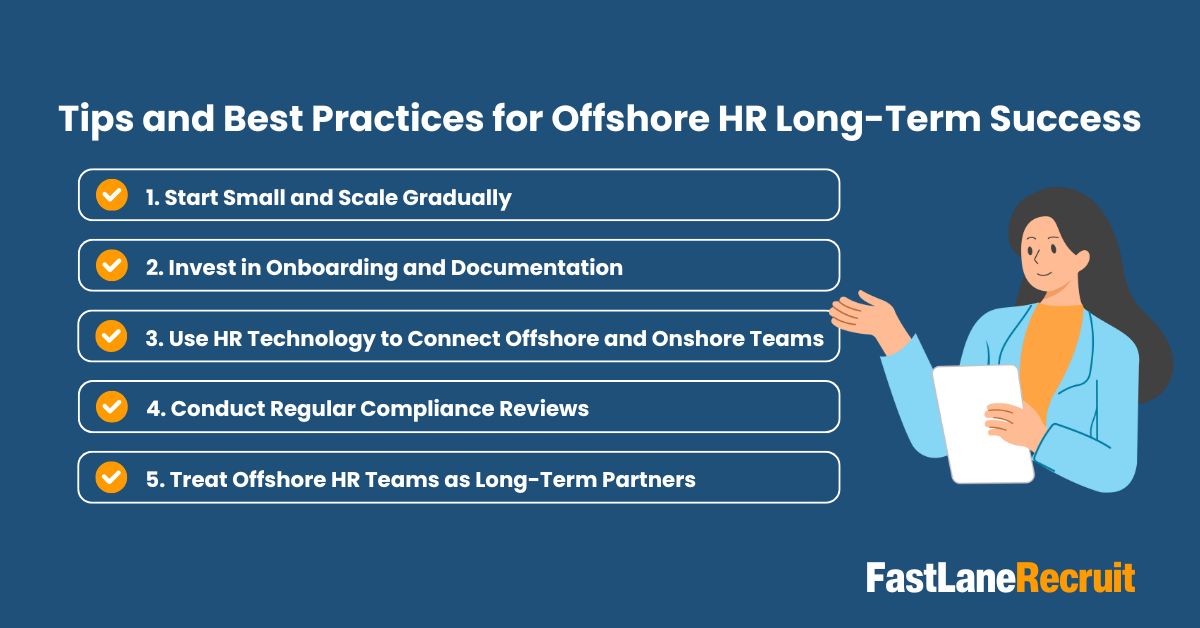
Tips and Best Practices for Offshore HR Long-Term Success
Building an offshore HR team is not just a setup exercise; long-term success depends on how well the team is integrated, supported, and managed over time. The following best practices help ensure stability, performance, and compliance as your offshore HR operations grow.
1. Start Small and Scale Gradually
Begin with a small offshore HR setup focused on clearly defined tasks, such as payroll administration or onboarding support. This allows you to test workflows, refine processes, and build trust before expanding the team or scope of responsibilities.
2. Invest in Onboarding and Documentation
A well-onboarded offshore HR team performs better and makes fewer mistakes. Provide clear SOPs, role expectations, and access to training materials so the team understands your policies, systems, and compliance standards from day one.
3. Use HR Technology to Connect Offshore and Onshore Teams
Shared HR systems, collaboration tools, and secure document platforms help offshore and onshore teams work as one. This improves visibility, reduces errors, and keeps communication consistent across locations.
4. Conduct Regular Compliance Reviews
Employment laws, payroll rules, and data protection requirements can change. Regular compliance reviews help identify gaps early and ensure your offshore HR operations remain aligned with local regulations and internal policies.
5. Treat Offshore HR Teams as Long-Term Partners
Offshore HR teams deliver the best results when they are treated as an extension of your organization, not a short-term cost-saving measure. Investing in communication, feedback, and career development leads to higher engagement, lower turnover, and more reliable HR support.
Step-by-Step: How to Build an Offshore HR Administration Team in Malaysia
1. Define a Clear Business Case
Start by clarifying why you’re building an offshore HR team. Common goals include cost optimisation, scaling HR capacity, or standardising HR operations across regions. Clear objectives help determine the right structure and hiring model.
2. Identify Suitable HR Roles for Offshoring
Not all HR roles should be offshore. Operational and documentation-heavy roles work best, while sensitive employee relations or leadership roles may remain onshore.
Good candidates for offshore HR include:
- HR administrators
- Payroll coordinators
- Recruitment coordinators
- HR data and reporting specialists
3. Decide on the Right Engagement Model
Companies typically choose between direct employment or an Employer of Record (EOR) arrangement.
| Model | Setup Speed | Compliance Responsibility | Best For |
| Direct hire via local entity | Slow | Fully on company | Long-term regional presence |
| Employer of Record (EOR) like FastLaneRecruit | Fast | Managed by the provider | Faster, lower-risk entry |
Setting up a legal entity in Malaysia requires time, local directors, tax registration, and ongoing compliance. For many companies, this is not the most efficient starting point.
4. Address Compliance from Day One
Malaysia has strict employment, payroll, and data protection requirements under the Employment Act 1955 and Personal Data Protection Act (PDPA). Missteps can result in penalties or reputational risk.
A compliant setup must cover:
- Correct employee classification
- Statutory contributions (EPF, SOCSO, EIS)
- Employment contracts aligned with local law
- Secure handling of employee data
5. Put Strong Processes and Controls in Place
Documented SOPs, secure IT access, and clear reporting lines help offshore HR teams operate efficiently while maintaining data and IP security.
Also Read: How to Build a Help Desk Technician Team in Malaysia: Skills & Requirements
FastLaneRecruit’s EOR for Hiring an Offshore HR Team in Malaysia
For global companies and remote-first teams, building an in-house offshore HR administration team in Malaysia can deliver long-term value, but it also comes with legal, payroll, and compliance responsibilities that take time and local expertise to manage. For organizations that want to move faster, stay flexible, and reduce risk, FastLaneRecruit’s Employer of Record (EOR) service offers a practical and compliant alternative.
Instead of setting up a local entity in Malaysia, FastLaneRecruit acts as the legal employer on your behalf, allowing you to engage skilled Malaysian HR professionals quickly while remaining fully compliant with local regulations.
How FastLaneRecruit’s EOR Model Works
Under FastLaneRecruit’s EOR arrangement:
- FastLaneRecruit becomes the legal employer in Malaysia
FastLaneRecruit employs your offshore HR team locally, ensuring all employment contracts align with Malaysian labour laws and regulations. - Payroll, statutory contributions, and compliance are fully managed
FastLaneRecruit handles payroll processing, statutory contributions (EPF, SOCSO, EIS), income tax reporting, and mandatory filings with the relevant Malaysian authorities. This removes the administrative burden and reduces compliance risk for your business. - You retain day-to-day control over work and performance
While FastLaneRecruit manages the legal and administrative aspects of employment, you continue to oversee daily tasks, workflows, performance expectations, and team integration. Your offshore HR team works as an extension of your internal function, following your systems and processes.
Why Global Companies Choose FastLaneRecruit’s EOR
FastLaneRecruit’s EOR service is designed specifically for companies building distributed and remote teams. It enables businesses to access Malaysian HR talent without long setup timelines or ongoing regulatory complexity.
Key advantages include:
- Faster market entry
Hire Malaysian HR professionals in weeks rather than months, without incorporating a local entity. - Lower legal and compliance risk
Employment contracts, statutory contributions, and payroll practices are handled in line with Malaysian law, reducing exposure to penalties or disputes. - Scalability for remote teams
Whether you’re hiring one HR administrator or building a full offshore HR admin team, the EOR model scales with your needs. - Cost-efficient global expansion
Avoid entity setup costs, local director requirements, and ongoing corporate compliance expenses.
Example: Building an Offshore HR Team for a Remote Workforce
Consider a technology company with a remote workforce across Asia-Pacific and Europe. The company needs reliable HR administration support for onboarding, payroll coordination, and employee records, but doesn’t want to establish a Malaysian entity.
By using FastLaneRecruit’s EOR service:
- The company hires Malaysian HR administrators quickly
- FastLaneRecruit manages employment contracts, payroll, and statutory compliance
- The offshore HR team supports global employees while reporting directly to the company’s HR manager
- The business gains a compliant offshore HR setup without long-term legal commitments
When FastLaneRecruit’s EOR Is the Right Choice
FastLaneRecruit’s EOR model is particularly well-suited for:
- Global companies entering Malaysia for the first time
- Remote-first organizations building distributed HR operations
- Businesses testing offshore HR before committing to entity setup
- Companies that want compliance assurance without internal HR complexity
A Smarter Way to Build an Offshore HR Team
FastLaneRecruit’s EOR service allows companies to access offshore HR talent in Malaysia with speed, confidence, and compliance. By managing the legal and administrative responsibilities, FastLaneRecruit enables your team to focus on performance, collaboration, and growth, not paperwork.
For organizations exploring offshore HR solutions or building remote HR teams, FastLaneRecruit’s EOR model provides a flexible, lower-risk pathway to scale in Malaysia.
Conclusion
Building an offshore HR administration team in Malaysia can be a strategic move for companies seeking scalable, cost-efficient, and reliable HR operations. With the right structure, compliance framework, and talent strategy, offshore HR teams can become a seamless extension of your global HR function.
However, setting up and managing offshore HR operations internally isn’t always the simplest path. For organizations that want to move faster and minimize risk, partnering with an Employer of Record offers a flexible and compliant alternative.
Looking for a Faster, Lower-Risk Option to Expand Globally?
FastLaneRecruit’s EOR service enables global companies to hire and manage Malaysian employees legally and compliantly, without entity setup, payroll complexity, or regulatory headaches. From contracts and statutory contributions to ongoing HR administration, FastLaneRecruit handles the operational details so you can focus on growth.
If you’re exploring hiring offshore HR talents in Malaysia, FastLaneRecruit’s EOR model may be the smarter starting point. Contact us for a free consultation!
