
Why FastLaneRecruit Is Your Strategic Partner
Web applications and online experiences can make or break business success. To stay competitive, forward-thinking companies are building or scaling remote engineering teams. Malaysia is becoming an increasingly attractive destination for offshore and nearshore talent, especially in front-end development. But how do you find, vet, and manage a top-tier Malaysian front-end team from afar?
That’s where FastLaneRecruit steps in. With recruitment, Employer of Record (EOR), and RPO services, we specialize in helping global companies build high-performing remote teams in Malaysia.
In this post, we’ll walk through:
- Why Malaysia is emerging as a compelling choice for front-end outsourcing
- Core skills and roles you should look for
- Real-world cost benchmarks
- Trustworthy hiring channels
- Interviewing questions and red flags
- Tips and recommendations
- How FastLaneRecruit can simplify your hiring and employment operations
Content Outline
Key Summary
Why Malaysia
Government-backed, English-fluent, cost-effective talent hub for front-end teams.
Core Roles
Team leads, developers, UI/UX designers, accessibility experts, QA, and optional DevOps.
Must-Have Skills
HTML, CSS, JS/TypeScript, modern frameworks, responsive design, debugging, collaboration.
Cost Benchmarks
Hourly rates range USD 26–80+ depending on role and seniority.
Talent Sourcing
Recruitment agencies, EOR partners, job boards, universities, remote platforms, and government programs.
Interview Tips
Ask about projects, frameworks, debugging, accessibility; watch for vague answers or poor communication.
FastLaneRecruit Advantage
End-to-end recruitment, payroll, benefits, and compliance via EOR for seamless offshore hiring.
Why Malaysia Makes Sense for Offshore Front-End Teams
Before diving into roles and skills, let’s look at Malaysia’s strengths as a destination:
1. Government backing & digital economy initiatives
The Malaysian government has prioritized the digital transformation agenda through programs like Malaysia Digital (via MDEC) to attract ICT investment and foster local talent. (MDEC) The MyDIGITAL blueprint and state-backed tech parks (e.g. MSC Malaysia, Technology Park Malaysia) provide infrastructure and incentives for tech firms. (National Human Resource Centre)
These policies bolster confidence in long-term stability and ecosystem support.
2. Balanced cost-to-talent ratio
Malaysia tends to offer more favorable rates than Western markets while maintaining strong technical capacity. Outsourcing analyses list Malaysia among competitive destinations in Southeast Asia. According to one estimate, Malaysian IT outsourcing rates range from USD 30 to 80+ / hour depending on seniority and specialization.
Compared to hiring in the U.S. or Europe, that’s a considerable cost saving allowing you to redirect budget into innovation, marketing, or more engineering bandwidth.
3. Favorable location and culture
Malaysia sits in a time zone (GMT+8) that overlaps well with Asia-Pacific, and has cultural fluency in English (business is widely conducted in English). Global giants like Google, Microsoft, ByteDance, and others are investing in Malaysian infrastructure and tech presence.
Taken together, these factors make Malaysia a compelling hub for building remote engineering functions.
Also Read: Top Professional SEO Services in the US
Key Roles for a Front-End Team
Building a high-performing front-end team requires more than just technical know-how. It’s about combining creative design, efficient coding, and seamless collaboration to deliver responsive, modern web applications. Whether you’re setting up an in-house team or outsourcing front-end developers from Malaysia, understanding the key roles and must-have skills is essential to achieving consistent quality and scalability.
Below is a breakdown of the main roles, responsibilities, and tools that shape a successful front-end team.
| Role | Responsibilities | Core Skills / Tools |
| Front-End Team Lead / Manager | Oversees technical direction, manages architecture decisions, mentors developers, and communicates with stakeholders to align technical goals with business needs. | Deep expertise in JavaScript frameworks (React, Vue, Angular), strong leadership, project planning, and code review capabilities. |
| Front-End Developer | Translates UI/UX designs into functional code, ensures cross-browser compatibility, and maintains responsive design standards. | HTML5, CSS3 (Flexbox / Grid), JavaScript / TypeScript, frameworks like React or Vue, and CSS preprocessors (Sass/Less). |
| JavaScript / UI Specialist | Focuses on dynamic elements like animations, transitions, and interactive components to enhance user experience. | Advanced JavaScript, state management tools (Redux, Vuex), asynchronous programming, and performance tuning. |
| UI / UX Designer | Designs user-friendly interfaces, prototypes, and wireframes to ensure intuitive digital experiences. | Tools such as Figma, Sketch, or Adobe XD; understanding of user psychology, usability testing, and design systems. |
| Accessibility Expert | Ensures inclusivity and compliance with international standards like WCAG 2.1 for users with disabilities. | Screen reader testing, ARIA roles, keyboard navigation, and accessibility audits. |
| QA / Front-End Tester | Validates the front-end for functionality, performance, and user experience through manual and automated testing. | Jest, Cypress, Puppeteer, and browser compatibility testing tools. |
| DevOps / Front-End Build Engineer (optional) | Manages build pipelines, deployment, and performance monitoring for smoother delivery cycles. | Webpack, Babel, Vite, CI/CD tools (GitHub Actions, Jenkins), and cloud platforms (AWS, Azure, GCP). |
Example: A Malaysian e-commerce company outsourcing its front-end development might start with a small team of a UI/UX Designer, one Front-End Developer, and a QA Tester. As the project grows, a Team Lead and Build Engineer can be added to support scaling needs.
Note:
In smaller or early-stage projects, roles often overlap. For example, a Front-End Lead might handle both architecture and DevOps responsibilities when there’s no dedicated engineer, a setup that’s common in Malaysian startups or offshore outsourcing teams that prioritize lean efficiency.
Also Read: How to Successfully Outsource Data Engineering
Skills You Cannot Skip for Front-end Talent
Beyond job titles, certain technical and soft skills are non-negotiable if you want your front-end team to deliver consistently high-quality results. Here’s what to prioritize when evaluating candidates or partners:
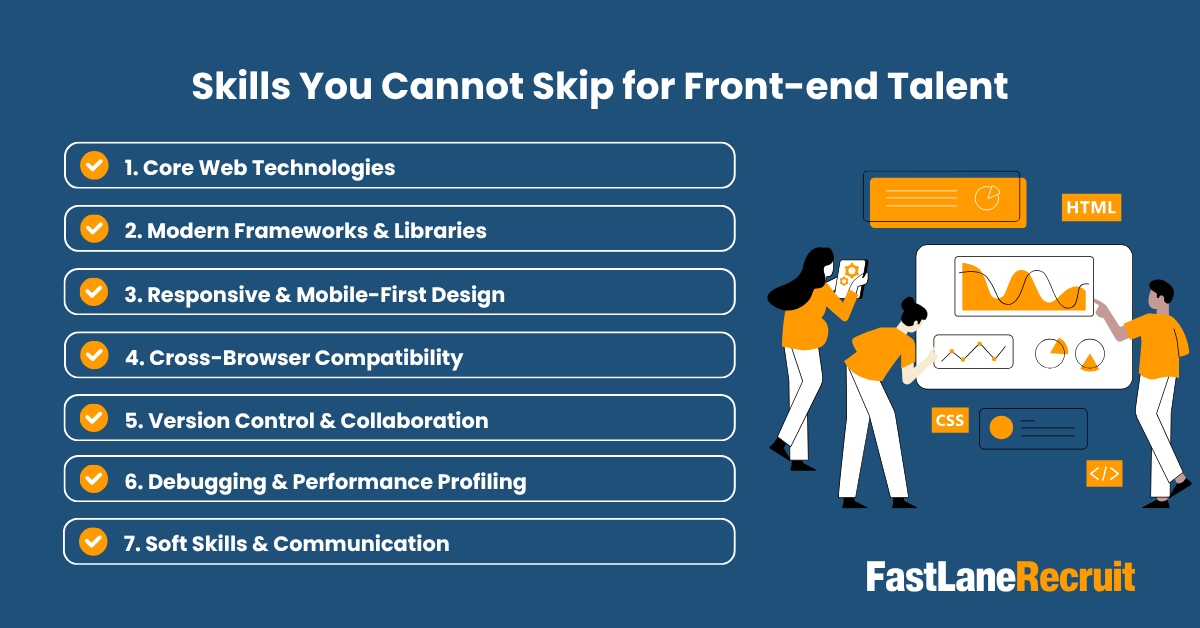
1. Core Web Technologies
Mastery of HTML5, CSS3, and JavaScript (or TypeScript) is the backbone of front-end development. These skills ensure your web applications are structured, styled, and interactive across all modern browsers.
Example: When outsourcing to Malaysia, developers often specialize in TypeScript, which improves scalability and maintainability in larger projects.
2. Modern Frameworks & Libraries
Knowledge of frameworks like React, Vue, or Angular allows for efficient, component-based development. Teams should also understand supporting tools like Next.js (for React) or Nuxt.js (for Vue) to optimize performance and SEO.
3. Responsive & Mobile-First Design
Users expect seamless experiences across all devices. Developers should build with mobile-first principles, ensuring content looks and performs perfectly on phones, tablets, and desktops.
According to StatCounter, over 60% of global web traffic now comes from mobile devices, making responsive design a top priority.
4. Cross-Browser Compatibility
Front-end teams must ensure consistent performance across major browsers (Chrome, Safari, Firefox, Edge). Techniques like progressive enhancement and graceful degradation help maintain functionality even on older browsers.
5. Version Control & Collaboration
Efficient use of Git, pull requests, and branching strategies keeps team collaboration organized especially for distributed teams. This is particularly important for remote front-end teams in Malaysia working with clients overseas.
6. Debugging & Performance Profiling
Developers should be proficient in tools like Chrome DevTools, Lighthouse, and WebPageTest to monitor and improve loading times and user experience.
7. Soft Skills & Communication
A great front-end team isn’t just about technical skill, it’s also about communication and collaboration. Offshore developers must be able to clearly explain design choices, understand project goals, and integrate smoothly with global teams.
Also Read: Data Engineering Salary Guide 2025
How Much Does It Cost to Hire a Malaysian Front-End Team?
Costs vary widely based on seniority, complexity, and the region in Malaysia (e.g., Kuala Lumpur vs. Penang vs. smaller cities). Below is a sample cost outlook based on market data:
| Role / Seniority | Estimated Monthly Salary (MYR) |
| Junior Front-End Developer | 3,592 |
| Mid-Level Developer | 8,500 – 14,333 |
| Senior / Lead Developer | 14,000 – 17,000 |
| UI/UX Designer | 5,500 – 9,000 |
| QA / Front-End Tester | 4,557 – 5,500 |
| DevOps / Build Engineer | 9,000 |
Please note that these figures represent median monthly salaries and may vary depending on experience, company, and location within Malaysia.
Hidden costs to watch out for
- Onboarding & training time
- Communication overhead or misalignment
- Legal, HR, and compliance overhead for foreign employment
- Contractor-to-employee conversion, IP clauses, local benefits
As an example, a U.S. company saved over USD 50,000 annually by hiring offshore talent instead of local hires, while maintaining quality. (Analogous stories exist in other case studies.)
Given Malaysia’s cost advantages and strategic incentives, that saving becomes plausible without sacrificing quality.
Also Read: Hiring Data Engineer in Malaysia
Where and How to Source Malaysian Front-End Talent
Building a skilled and reliable front-end development team in Malaysia starts with knowing where to look and how to attract the right professionals. Malaysia’s tech ecosystem offers a diverse pool of talent, from seasoned engineers to fresh graduates with modern digital skills. Below are the most effective sourcing channels, along with their advantages, challenges, and practical tips.
1. Specialist Recruitment Agencies & RPO Partners
When hiring from abroad, working with a specialist recruitment partner can significantly streamline your process.
FastLaneRecruit, for example, provides end-to-end recruitment, RPO (Recruitment Process Outsourcing), and Employer of Record (EOR) services across Malaysia. This allows companies to:
- Hire local developers legally and compliantly without establishing a local entity
- Manage payroll, tax, and benefits under Malaysia’s Employment Act
- Reduce hiring lead time and administrative overhead
Local tech-focused recruitment firms in Kuala Lumpur, Penang, and Johor also offer niche expertise in matching developers with specific JavaScript frameworks (React, Angular, Vue).
Tip: Use an EOR solution like FastLaneRecruit if you’re hiring Malaysian front-end developers remotely, it helps ensure compliance and smooth onboarding while you focus on scaling your project.
2. Remote Developer Hiring Platforms
For companies seeking flexible or project-based hires, global remote work platforms are excellent options.
Examples include:
- Upwork and Freelancer.com – suitable for short-term or freelance UI/UX and front-end tasks.
- Toptal and Arc.dev – ideal for sourcing vetted, senior-level JavaScript developers.
- GitHub Jobs and StackOverflow Jobs – trusted spaces for connecting directly with active developer communities.
Pros: Access to a broad global pool, fast hiring cycles.
Cons: Quality and reliability can vary; always vet candidates through coding tests or trial projects.
Example: A U.S. startup could test a React developer through a short-term Upwork project, then engage FastLaneRecruit to convert that freelancer into a full-time employee through its EOR service.
3. Local Job Boards & Tech Communities
Malaysia’s domestic hiring platforms are highly effective for tapping into verified and available talent.
Some trusted options include:
- JobStreet Malaysia – the country’s largest online recruitment platform
- WOBB (Hiredly) – popular for startups and creative roles
- MyStarJob – used by established enterprises and SMEs
Pro Tip: Advertise roles with clear skill requirements (e.g., “React.js Front-End Developer – Remote Friendly”) and emphasize international exposure or competitive compensation in USD to attract top candidates.
You can also engage local developer meetups, tech hackathons, and coding bootcamps, especially in tech hubs like Kuala Lumpur and Cyberjaya, to identify rising stars.
4. University Career Centers & Academic Partnerships
Malaysia produces thousands of IT graduates annually from leading institutions such as:
Partnering with these universities’ career development centers allows companies to recruit entry-level developers or interns with up-to-date skills in frameworks like Vue.js and React Native.
Example: FastLaneRecruit can help design graduate recruitment programs that include training modules, onboarding support, and payroll setup through its EOR platform.
5. Government & Public Sector Programs
Malaysia’s government actively supports the growth of its digital workforce. Partnering with trusted institutions can enhance credibility and access to high-quality talent.
- Malaysia Digital Economy Corporation (MDEC) promotes digital transformation and provides resources for companies expanding tech operations in Malaysia.
- Technology Park Malaysia (TPM) fosters innovation and connects companies with tech startups and developer communities.
Tip: Collaborating with government-backed incubators or accelerators helps you identify vetted, industry-ready front-end professionals.
Also Read: Data Engineer Hiring Guide
6. Freelancing & Contractor Networks
Freelancer platforms such as Upwork, Fiverr, and PeoplePerHour are excellent for testing candidates before committing long-term. This “try before you hire” model is especially effective when you want to gauge technical and communication skills in a live environment.
Recommendation: Once you find a good fit, partner with FastLaneRecruit’s EOR service to transition the freelancer into a compliant full-time employee, ensuring tax, payroll, and benefits are properly handled under local employment law.
Example: Building a Front-End Team via FastLaneRecruit
Here’s what the process typically looks like:
| Step | Action | FastLaneRecruit Role |
| 1. Define Requirements | Identify tech stack, experience level, and project goals | Consultation & job description alignment |
| 2. Source Candidates | Leverage Malaysia’s recruitment network | Pre-screening and shortlisting |
| 3. Interview & Selection | Client conducts technical interviews | Scheduling & coordination |
| 4. Hiring & Compliance | Employment contract and local onboarding | EOR management (payroll, tax, benefits) |
| 5. Ongoing Support | Performance reviews, role scaling | HR and payroll continuity |
This model minimizes hiring risk and accelerates your global scaling strategy.
Final Tip: Combine Local Expertise with Global Standards
The best results come when international companies leverage Malaysia’s cost-effective tech talent through trusted local partners. Whether you’re hiring one React developer or an entire front-end team, combining strong local sourcing channels with an EOR provider ensures speed, compliance, and quality.
Interview Questions & Red Flags: How to Choose Wisely
Hiring a front-end developer team in Malaysia goes beyond checking off technical skills; it’s about finding professionals who can collaborate effectively, solve problems creatively, and deliver user-focused experiences. Whether you’re a global employer expanding your team or a Malaysian candidate preparing for interviews, asking the right questions and spotting warning signs early can make all the difference.
Smart Interview Questions to Ask Front-End Developers
These questions help evaluate both technical proficiency and soft skills, offering insight into a candidate’s real-world thinking, debugging habits, and teamwork approach.
1. Walk me through a recent front-end feature you built. What challenges did you face?
This question uncovers the developer’s problem-solving process. Look for candidates who can clearly explain their architecture choices, tools used, and how they overcame performance or UX hurdles.
Example: A strong candidate might describe how they optimized a React dashboard by lazy-loading components and reducing bundle size using Webpack.
Tip for Employers: Ask follow-up questions about trade-offs. This shows how deeply they understand scalability and maintainability.
2. Which frameworks or libraries do you prefer and why?
Candidates who can justify their preference between React, Vue, or Angular demonstrate not just experience but also architectural understanding.
Example: A front-end developer explaining why they used Vue for rapid prototyping versus React for enterprise-grade scalability reveals adaptability.
Tip for Candidates: Always connect your framework choice to project goals, not just personal preference; this reflects professional maturity.
3. How do you approach responsive design for mobile-first?
Front-end developers should be fluent in CSS Grid, Flexbox, and media queries. Ask how they test across devices and handle browser inconsistencies.
Example: The best candidates mention using BrowserStack or Chrome DevTools for cross-device simulation.
4. Describe a time you fixed a tricky browser compatibility bug.
This question highlights debugging ability and patience. Candidates who can reference real-world fixes (e.g., resolving layout shifts between Safari and Chrome) show hands-on experience.
5. How do you measure performance, and what tools do you use?
Front-end optimization affects both SEO and user experience. Candidates should know about Core Web Vitals — Largest Contentful Paint (LCP), Total Blocking Time (TBT), and Cumulative Layout Shift (CLS).
Tools to Listen For: Lighthouse, Chrome DevTools, or GTmetrix.
6. When would you use web workers or service workers?
This tests depth in asynchronous JavaScript and Progressive Web App (PWA) development.
Example: A candidate who uses service workers for offline caching in an e-commerce app shows advanced technical knowledge.
7. Explain your version control flow — how do you branch, merge, and resolve conflicts?
Strong candidates are comfortable using Git branching strategies (e.g., Git Flow). Team-based collaboration requires discipline here, especially for remote environments.
Tip for Employers: Look for developers who mention code review tools (GitHub, Bitbucket, GitLab) — it indicates process awareness.
8. How do you stay up to date with front-end trends?
Front-end technology evolves fast. Active learners who follow CSS-Tricks, Smashing Magazine, or the Mozilla Developer Network (MDN) often perform better long-term.
9. Tell me about accessibility (a11y) work you’ve done.
Accessibility compliance (e.g., WCAG 2.1) is increasingly non-negotiable. Developers should mention techniques like semantic HTML, ARIA roles, and contrast testing.
Example: A developer who audits accessibility using tools like axe DevTools demonstrates inclusivity and user empathy.
10. How do you communicate design trade-offs with UX or stakeholders?
Technical brilliance is useless without clear communication. Candidates who can balance developer constraints with design intent are team players.
Tip for Employers: Prioritize those who use design collaboration tools like Figma or Zeplin, as they often bridge the gap between design and implementation effectively.
Common Red Flags When Interviewing Front-End Developers
Spotting early warning signs can save you from costly mis-hires:
| Red Flag | What It Indicates | Recommendation |
| Vague answers about project roles | Exaggerated experience or unclear contribution | Ask for specific examples and code samples |
| No experience with performance tools | Limited exposure to real-world debugging | Assign a short coding test involving optimization |
| Theoretical talk, no demos | Weak hands-on experience | Request a GitHub repo or working project link |
| Poor communication skills | Remote collaboration risk | Use asynchronous interviews (email or chat) to test clarity |
| No portfolio or public code | Lack of proof of skill | Review GitHub, CodePen, or personal website |
| Resistant to testing or code reviews | Difficulty in team collaboration | Probe their previous workflow and feedback process |
Pro Tip: Always evaluate both hard skills (technical) and soft skills (communication, teamwork) especially when hiring remotely.
Recommendations & Best Practices
1. Start Small
Begin with a pilot project or a short-term contract to assess collaboration, delivery speed, and coding quality. Once confident, transition them into full-time employment through an EOR partner like FastLaneRecruit.
2. Define Clear KPIs and Code Quality Standards
Set performance metrics from day one, such as LCP below 2.5s, minimal console errors, and consistent pull request reviews.
3. Encourage Collaboration and Transparency
Use pair programming, regular code reviews, and tools like Slack or Notion for communication. Remote teams thrive on clarity.
4. Prioritize Documentation and Scalability
Encourage developers to maintain component libraries, style guides, and readme files for better handovers and team scalability.
5. Leverage Employer of Record (EOR) Services
Foreign companies can avoid legal and payroll complexities by using an EOR. FastLaneRecruit’s EOR solution manages:
- Local employment contracts
- Payroll and statutory contributions (e.g., EPF, SOCSO, EIS – Malaysia Government Info)
- Employee benefits and tax compliance
This ensures a compliant, seamless hiring experience for both employers and employees.
Also Read: Why Should You Hire Data Engineers in Malaysia?
Example: A Scalable Hiring Strategy in Action
A U.S.-based SaaS startup hired a small Malaysian offshore front-end team through FastLaneRecruit. They began with two developers for a 3-month trial, using FastLaneRecruit to handle onboarding, payroll, and compliance. After successful project delivery, the startup scaled the team to five full-time developers, all under FastLaneRecruit’s EOR model, saving over 60% in administrative and operational costs.
Final Tip
Great front-end developers aren’t just coders; they’re creative problem solvers who understand design, accessibility, and performance. By combining structured interviews with trial projects and reliable local partnerships, global employers can confidently build a world-class Malaysian front-end team.
Conclusion
Building a high-performing front-end team in Malaysia gives you access to high-caliber talent at a fraction of Western hiring costs, supported by a robust policy ecosystem and a growing digital economy. But the toughest part is making it seamless from recruitment to compliance. That’s where FastLaneRecruit shines.
Build Your Dream Front-End Team in Malaysia — The Easy Way
Our end-to-end recruitment, RPO, and Employer of Record (EOR) solutions take the hassle out of hiring so you can focus on what truly matters: growing your business.
From sourcing skilled Malaysian front-end developers to managing payroll, benefits, and full legal compliance, we handle every step with precision and transparency. No more HR headaches. No more red tape. Just skilled developers delivering exceptional results.
Ready to get started?
Book your free consultation call with FastLaneRecruit today and discover how we can help you build your offshore front-end team in Malaysia with zero HR overhead and complete peace of mind.
