A Step-by-Step Guide
Companies are increasingly turning to offshore teams to boost efficiency, access specialized talent, and scale operations without the constraints of local hiring. Malaysia, with its skilled workforce, strong regulatory compliance, and English proficiency, has emerged as a top destination for businesses looking to hire corporate services officers remotely.
Whether you’re expanding your existing operations or exploring offshore options for the first time, this guide will show you how to build a high-performing offshore corporate services team in Malaysia, smoothly, efficiently, and with minimal risk.
Content Outline
Key Summary
Strategic Offshoring Benefits
Offshoring corporate services officers to Malaysia boosts operational efficiency, provides access to skilled talent, and ensures compliance with local regulations.
Corporate Functions Suitable for Offshoring
Finance, HR, legal, and administrative roles are ideal for offshore teams, allowing onshore staff to focus on strategic priorities.
Approaches to Build Your Offshore Team
Businesses can choose between direct setup, shared providers, or partnering with an EOR like FastLaneRecruit for streamlined recruitment, compliance, and management.
Step-by-Step Framework: Discover, Build, Scale
Identify offshorable functions, recruit and onboard talent, and scale teams efficiently while integrating offshore staff with onshore operations.
Best Practices for Team Management
Set clear objectives, invest in collaboration tools, foster trust and team bonding, provide continuous training, monitor performance, and ensure compliance.
Overcoming Common Challenges
Address language, cultural, time zone, talent quality, and recruitment control challenges with structured onboarding, EOR support, and ongoing communication.
FastLaneRecruit EOR Advantage
FastLaneRecruit handles legal employment, payroll, and compliance, provides vetted talent, and enables rapid, scalable offshore team growth without administrative burdens.
Why Offshore Corporate Services Officers to Malaysia?
Offshoring corporate services officers to Malaysia is far more than a cost-saving measure, it’s a strategic business decision that can enhance efficiency, ensure compliance, and support global growth. Many companies are discovering that Malaysia offers the perfect combination of talent, operational support, and business-friendly regulations for building high-performing remote teams. Here’s a closer look at why Malaysia stands out as an offshore destination:
1. Access to Skilled Talent
Malaysia has a well-educated, highly skilled workforce capable of handling complex corporate functions. Corporate services officers in Malaysia often have backgrounds in finance, human resources, legal compliance, and administration, making them well-equipped to manage both routine tasks and specialized processes.
- Example: A finance team in Malaysia can handle payroll processing, bookkeeping, and monthly financial reporting while ensuring accuracy and compliance with local regulations.
- Benefit: Businesses gain access to expertise that might be hard to find or expensive in their home country, without compromising quality.
2. Operational Efficiency
Offshore teams in Malaysia can help streamline business operations, allowing your onshore teams to focus on strategic initiatives rather than administrative work. By delegating repetitive or time-consuming tasks to a qualified offshore team, companies can:
- Reduce administrative overhead and operational bottlenecks.
- Improve turnaround times for routine tasks like HR onboarding, document preparation, or payroll.
- Maintain continuity during peak periods or when local teams face resource constraints.
- Example: An HR team in Malaysia can process employee onboarding and benefits administration for multiple countries simultaneously, freeing local HR staff to focus on employee engagement and strategy.
3. Regulatory Compliance
Malaysia’s workforce is well-versed in local labor laws, corporate regulations, and international best practices. By hiring corporate services officers locally, companies can:
- Ensure accurate reporting for corporate governance and regulatory filings.
- Minimize the risk of non-compliance penalties when operating in Asia.
- Navigate complex tax, labor, and employment regulations efficiently.
- Example: A legal compliance officer can manage contracts, ensure adherence to statutory reporting requirements, and guide your business through regulatory updates in Malaysia.
Also Read: Payroll and Statutory Compliance for Hiring Payroll Specialists in Malaysia
4. English Proficiency
Clear communication is crucial for remote teams to collaborate effectively with onshore management and global stakeholders. Malaysia is an English-proficient country, with English widely used in business, higher education, and corporate environments. This ensures that:
- Offshore teams understand instructions accurately.
- Miscommunications are minimized.
- Collaboration between onshore and offshore teams is seamless.
- Example: A corporate services officer can liaise directly with onshore finance managers or HR directors without requiring additional language training, reducing delays and errors.
Corporate Services Functions Suitable for Offshoring
Below is a breakdown of corporate services roles commonly offshored to Malaysia, along with examples of the tasks they can handle:
| Function | Example Tasks | Benefits of Offshoring |
| Finance & Accounting | Payroll management, bookkeeping, financial reporting, invoicing | Ensures accurate, timely financial data while freeing local teams for strategic tasks |
| Human Resources | Employee onboarding, benefits administration, HR compliance, performance tracking | Streamlines HR operations and ensures compliance with local labor laws |
| Legal & Compliance | Corporate governance, regulatory reporting, contract management | Reduces risk of legal penalties and ensures adherence to statutory requirements |
| Administrative Support | Data entry, scheduling, document preparation, report generation | Saves time for onshore teams, allowing focus on decision-making and core business functions |
Pro Tip: Offshore corporate services officers in Malaysia can often handle multi-country responsibilities for regional operations, making them a valuable asset for companies expanding across Southeast Asia. For example, a single HR officer can manage payroll and benefits compliance for employees in Malaysia, Singapore, and Thailand, leveraging local knowledge with minimal oversight.
Three Approaches to Building Your Offshore Team
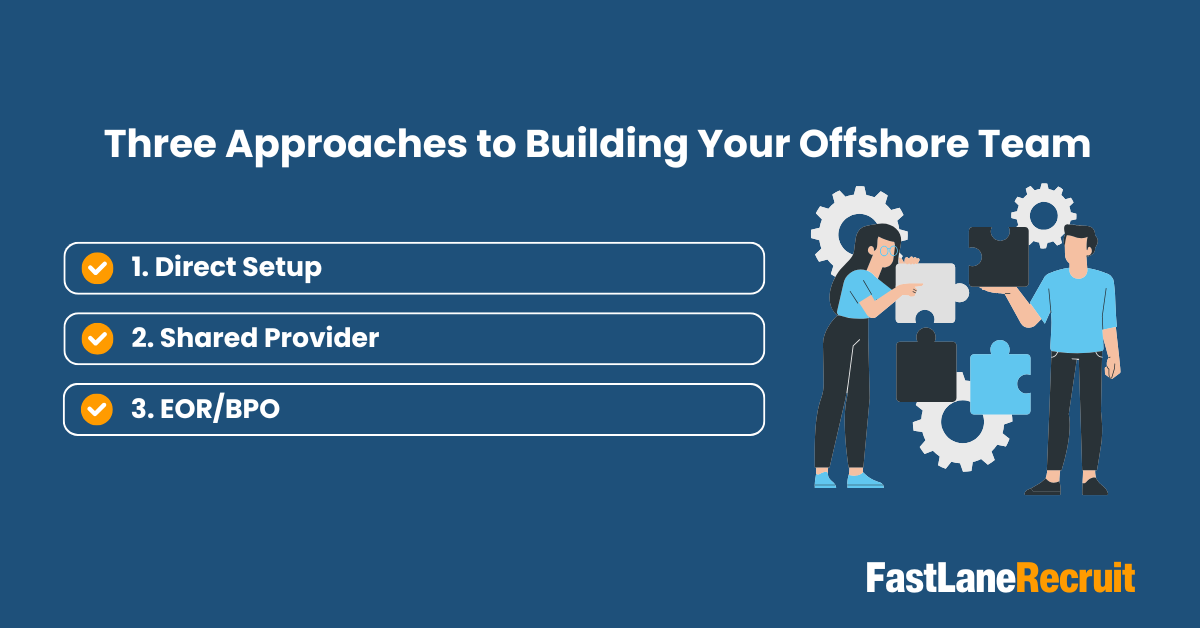
When building an offshore corporate services team in Malaysia, businesses generally follow one of three approaches. Each approach has its advantages, challenges, and ideal use cases depending on your company’s size, resources, and goals.
1. Direct Setup
The direct setup approach involves researching the Malaysian market, hiring employees locally, setting up an office, and managing the team internally.
Pros:
- Full control over operations and processes.
- Direct management of staff ensures alignment with company culture and standards.
- Ability to tailor workflows exactly to your business needs.
Cons:
- Complex and time-intensive. Setting up a legal entity, office, payroll, and HR operations requires significant investment.
- High compliance risk if local labor laws, taxes, or corporate regulations are not fully understood.
Example:
A multinational company opening a regional finance hub in Malaysia chooses to set up its own office. While they have complete control over hiring and internal processes, it takes several months to navigate legal registrations, payroll setup, and recruiting qualified corporate services officers.
Best For:
Large organizations with dedicated resources and experience managing international HR and compliance.
2. Shared Provider
The shared provider approach involves outsourcing tasks to pre-existing offshore teams or service providers who already have staff and infrastructure in place.
Pros:
- Quick setup and immediate access to experienced personnel.
- Low management effort, much of the administration is handled by the provider.
Cons:
- Limited customization; the team may serve multiple clients simultaneously.
- Less control over processes and company culture alignment.
Example:
A company outsources HR and accounting tasks to an offshore service provider in Malaysia. They gain immediate support but must work within the provider’s existing team structure, limiting flexibility and control over task prioritization.
Best For:
Businesses seeking speed and efficiency over full customization, or those needing short-term offshore support.
Also Read: Outsource Payroll Specialist Teams: A Guide for Global Employers
3. EOR/BPO
The Employer of Record (EOR) or Business Process Outsourcing (BPO) approach involves partnering with a trusted provider like FastLaneRecruit, which legally employs your offshore staff while you manage their day-to-day work.
Pros:
- Ensures smooth compliance with Malaysian labor laws, taxes, and regulations.
- Provides end-to-end support, from recruitment to payroll and benefits management.
- Access to vetted, high-quality talent, minimizing hiring risk.
- Minimal setup time and administrative burden.
Cons:
- Slightly higher cost compared to a DIY direct setup, but often offset by time saved and reduced legal risk.
Example:
A growing SME wants to build a finance and HR team in Malaysia. By partnering with FastLaneRecruit, they hire three corporate services officers in under a month, fully onboarded and legally compliant, without needing to establish a local entity.
Best For:
SMEs, first-time offshore businesses, or companies that want a hassle-free, low-risk solution to access Malaysian talent.
Tip:
For most businesses, especially SMEs, the EOR approach with FastLaneRecruit provides the fastest, safest, and most reliable way to build a Malaysian offshore team. You gain high-quality staff, full compliance, and operational efficiency, without the headaches of setting up a local entity or managing complex legal requirements.
Why an EOR is Often the Best Option
While all three approaches have their place, many companies, especially small and medium-sized businesses (SMEs), find that using an EOR like FastLaneRecruit offers the smoothest path to building a Malaysian offshore team. Here’s why:
- Simplified Compliance: The EOR handles all legal responsibilities as the official employer, including payroll, taxes, labor law compliance, and benefits administration. This removes the risk of non-compliance or penalties for your company.
- Quick Team Setup: With access to a pre-vetted talent pool, you can hire qualified corporate services officers faster than going through the full recruitment and office setup process yourself.
- Flexible Scaling: As your business grows, the EOR can quickly add team members or adjust roles without the hassle of renegotiating contracts or managing additional administrative processes.
- Focus on Core Business: Your management team can focus on strategy and growth, while the EOR ensures your offshore team operates efficiently and legally.
- Regional Expertise: FastLaneRecruit understands Malaysian labor regulations, corporate requirements, and cultural nuances, reducing the learning curve for foreign companies.
Step-by-Step Framework for Success
Building a successful offshore corporate services team in Malaysia is more than just hiring talent, it requires careful planning, structured processes, and ongoing management to ensure long-term productivity and collaboration. Here’s a proven framework to guide you through each phase:
1. Discover
The first step is to understand which business functions are suitable for offshoring and evaluate whether Malaysia is the right fit for your needs.
Key Actions:
- Identify offshorable functions: Determine which tasks or departments can be handled offshore without disrupting core business operations. Corporate services functions often include finance, HR, legal compliance, and administrative support.
- Understand operational requirements: Assess your business processes, workflows, and tools. Identify which tasks require specialized skills and which can be streamlined offshore.
- Evaluate regulatory compliance: Research Malaysian labor laws, payroll regulations, taxation, and corporate governance requirements.
- Assess talent availability: Explore the local workforce in Malaysia to ensure you can access qualified professionals with relevant experience.
Example:
A mid-sized company wants to offload payroll, employee onboarding, and HR compliance. During the Discover phase, they map out all HR-related processes, identify the roles needed, and check Malaysian employment laws to ensure smooth legal compliance.
Also Read: Why Outsourcing HRIS Administration Is a Smart Move for Global Companies
Tip:
Partnering with an EOR like FastLaneRecruit at this stage can help you navigate local laws and quickly identify suitable candidates, saving weeks of research and setup.
2. Build
Once you’ve identified the functions to offshore, it’s time to assemble your team and integrate them with your business processes.
Key Actions:
- Recruit qualified corporate services officers: Look for professionals with expertise in finance, HR, compliance, or administration. Prioritize candidates with experience handling similar functions and familiarity with global business practices.
- Onboarding and training: Provide thorough onboarding, introduce company policies, and invest in cultural sensitivity training to align offshore staff with your business norms.
- Define roles, responsibilities, and objectives: Set clear expectations for each team member and outline performance metrics to ensure accountability.
- Implement collaboration tools: Equip your team with project management, communication, and document-sharing tools to bridge distance and maintain workflow efficiency.
Example:
A company hires three corporate services officers in Malaysia for payroll, HR compliance, and reporting. They run a two-week onboarding program including workflow training, compliance procedures, and weekly check-ins to ensure alignment with the onshore team.
Tip:
Regular virtual meetings and feedback sessions help build trust, clarify expectations, and prevent miscommunication between onshore and offshore teams.
3. Scale
Once your team is fully operational, the focus shifts to monitoring performance, expanding the team, and maintaining collaboration.
Key Actions:
- Monitor performance using KPIs: Track key metrics like task completion rates, error rates, and turnaround time. Use dashboards and regular reviews to maintain quality standards.
- Gather regular feedback: Encourage both onshore and offshore teams to provide feedback on workflows, collaboration, and operational challenges.
- Expand efficiently: Hire additional staff as business needs grow, ensuring new hires are seamlessly integrated into existing processes.
- Foster a collaborative culture: Promote a sense of belonging by including offshore staff in strategy meetings, virtual team activities, and company updates.
Example:
A finance team in Malaysia initially handles payroll for 50 employees. After six months, the company expands the team to also manage financial reporting for regional offices. KPIs, regular performance reviews, and collaboration tools ensure consistency and productivity as the team grows.
Tip:
Using an EOR service like FastLaneRecruit can simplify scaling by quickly hiring vetted candidates and handling all local compliance, allowing you to focus on team integration and business strategy.
By following the Discover → Build → Scale framework, companies can systematically build an offshore corporate services team that is productive, compliant, and fully integrated with onshore operations. This approach minimizes risk, maximizes efficiency, and ensures your offshore team contributes real value to your business.
Also Read: How to Hire HRIS Administrators in Malaysia
Best Practices for Offshore Team Management
Managing an offshore corporate services team requires more than assigning tasks, it’s about creating structure, trust, and collaboration so your team can operate efficiently across borders. Here’s a detailed look at the best practices for successfully managing offshore teams in Malaysia:
1. Set Clear Objectives
Why it matters: Clear objectives give your team direction and reduce misunderstandings. Without well-defined roles and responsibilities, offshore teams may struggle to prioritize tasks or align with your company’s goals.
How to do it:
- Define the scope of work for each corporate services officer.
- Set measurable performance benchmarks for tasks such as payroll accuracy, HR onboarding speed, or report generation.
- Share your company’s vision, mission, and business goals to help the offshore team understand how their work contributes to the bigger picture.
Example:
For a finance team in Malaysia, objectives might include processing payroll for all employees by the 5th of every month with zero errors, and completing monthly financial reporting within three business days of month-end.
2. Invest in Collaboration Tools
Why it matters: Offshore teams are geographically separated from onshore teams, making collaboration tools essential for smooth communication and workflow management.
How to do it:
- Use project management software like Asana, Trello, or Monday.com to track tasks and deadlines.
- Implement communication platforms such as Slack or Microsoft Teams for day-to-day messaging.
- Schedule regular video calls for team meetings, updates, and cross-functional discussions.
Example:
A corporate services officer handling HR compliance in Malaysia can track tasks in Trello while reporting updates via weekly Zoom calls to the onshore HR manager. This ensures everyone is aligned and reduces delays caused by email chains.
3. Foster Trust & Team Bonding
Why it matters: Offshore teams are most effective when they feel valued and included. Building trust improves collaboration, morale, and productivity.
How to do it:
- Hold regular virtual team meetings to discuss progress, challenges, and achievements.
- Organize team-building activities, such as online games or virtual brainstorming sessions.
- Encourage open and transparent communication where team members feel safe to voice ideas and concerns.
Example:
Monthly virtual lunch-and-learn sessions can help corporate services officers in Malaysia interact with onshore managers, discuss new processes, and build personal connections.
Also Read: How Outsourcing HR Operations Can Streamline Business Efficiency
4. Continuous Training
Why it matters: Corporate services roles often involve compliance, finance, and administrative tasks that are subject to evolving laws and industry standards. Continuous training ensures your team stays competent and effective.
How to do it:
- Provide onboarding programs covering your company policies, tools, and workflows.
- Schedule regular training on Malaysian labor laws, corporate governance, and finance regulations.
- Share updates on best practices and industry trends relevant to your corporate services functions.
Example:
An HR officer in Malaysia can receive quarterly updates on changes to labor laws or employee benefits regulations to ensure compliance and minimize risk for your business.
5. Monitor & Measure Performance
Why it matters: Regular monitoring ensures your offshore team meets performance standards and helps identify areas for improvement.
How to do it:
- Implement Key Performance Indicators (KPIs) tailored to each role, such as payroll accuracy, onboarding completion rate, or report timeliness.
- Conduct monthly or quarterly performance reviews to provide constructive feedback.
- Recognize and reward outstanding performance to motivate the team.
Example:
A finance officer who consistently delivers accurate monthly reports ahead of schedule could receive recognition in company meetings or a performance bonus.
6. Ensure Compliance
Why it matters: Legal compliance is critical when managing an offshore team. Missteps in labor law, tax obligations, or data privacy can be costly and damaging to your business.
How to do it:
- Partner with a trusted EOR provider like FastLaneRecruit to handle employment contracts, payroll, taxes, and benefits.
- Ensure offshore staff understand company policies and regulatory requirements.
- Keep records of all compliance activities, audits, and approvals to minimize risk.
Example:
FastLaneRecruit ensures that your corporate services officers in Malaysia are fully compliant with local labor laws, payroll obligations, and data protection requirements, so you can focus on managing your business rather than legal administration.
Pro Tip: Combining clear objectives, the right tools, trust-building, ongoing training, performance monitoring, and EOR-backed compliance creates a structured, motivated, and highly productive offshore team. This approach not only reduces errors but also maximizes efficiency and allows your onshore teams to focus on strategic priorities.
Also Read: How to Build an Offshore HR Administration Team in Malaysia
Overcoming Common Challenges When Offshoring to Malaysia
While offshoring corporate services officers to Malaysia offers many benefits, it also comes with a few challenges that businesses need to address. With the right planning and support, these challenges can be easily overcome.
1. Language & Communication
The Challenge: Clear communication is essential for offshore teams to perform effectively. Misunderstandings can lead to errors, missed deadlines, and frustration on both sides.
The Solution: Malaysia has a high level of English proficiency, especially among educated professionals in corporate roles. For client-facing or cross-team communication, it’s important to require fluency in English.
Tips:
- Include English language proficiency as a requirement during recruitment.
- Use clear, written instructions for complex tasks.
- Encourage regular check-ins via video calls to clarify expectations.
Example:
A Malaysian HR officer communicates directly with an Australian onshore team using Microsoft Teams and emails in English, ensuring payroll and compliance tasks are completed accurately and on time.
2. Cultural Differences
The Challenge: Cultural differences in communication styles, work ethics, or business norms can create friction or misunderstandings between onshore and offshore teams.
The Solution: Provide cultural sensitivity training to both onshore and offshore teams and leverage the expertise of your EOR provider to navigate local customs and workplace expectations.
Tips:
- Educate your onshore team on Malaysian workplace norms, holidays, and communication styles.
- Encourage open dialogue about cultural expectations and preferences.
- Include team-building activities to foster understanding and rapport.
Example:
FastLaneRecruit provides guidance on local holidays, employee etiquette, and workplace practices, helping offshore corporate services officers integrate smoothly into the company’s workflow.
3. Time Zones
The Challenge: Coordinating work across different time zones can make real-time collaboration difficult, potentially slowing down decision-making.
The Solution: Malaysia’s time zone aligns well with many APAC regions, making scheduling easier for companies in Australia, Singapore, or other nearby countries. Plan work schedules strategically to maximize overlap when needed.
Tips:
- Align critical tasks and meetings to overlapping working hours.
- Use asynchronous communication for non-urgent updates.
- Consider flexible hours for offshore staff if your business requires real-time interaction with other regions.
Example:
An Australian company schedules finance reporting and HR check-ins during overlapping work hours with their Malaysian offshore team, ensuring smooth handoffs and collaboration.
4. Talent Quality Concerns
The Challenge: Businesses may worry that offshore staff won’t meet their standards for skills or experience.
The Solution: Partner with an EOR provider like FastLaneRecruit to access vetted, highly skilled candidates with specialized expertise relevant to corporate services roles.
Tips:
- Use detailed job descriptions to attract qualified candidates.
- Conduct interviews to assess skills, experience, and cultural fit.
- Utilize probationary periods or trial projects to evaluate performance.
Example:
A company needed a corporate services officer skilled in finance and payroll. FastLaneRecruit provided three pre-screened candidates with prior experience in multinational companies, allowing for quick hiring and immediate productivity.
5. Control Over Recruitment
The Challenge: Some businesses worry they won’t have enough control over recruitment or team development when outsourcing offshore.
The Solution: Work with an EOR to customize recruitment and onboarding processes according to your company culture and operational needs.
Tips:
- Collaborate with the EOR to define role responsibilities, workflows, and onboarding steps.
- Participate in interviews to select the right candidates.
- Provide your offshore team with clear guidelines, training, and feedback mechanisms to ensure alignment.
Example:
A growing SME worked with FastLaneRecruit to design a tailored onboarding program for corporate services officers, including company policy training, workflow familiarization, and regular check-ins with onshore managers.
Pro Tip: Most offshoring challenges are manageable with clear communication, structured onboarding, cultural awareness, and EOR support. By proactively addressing these areas, your Malaysian offshore team can become a fully integrated and high-performing extension of your onshore operations.
Step-by-Step Guide: How to Build an Offshore Corporate Services Team in Malaysia
Building an offshore corporate services team in Malaysia can help your business scale efficiently, reduce operational overhead, and access highly skilled talent. While it may seem complex, breaking it into a structured, step-by-step approach makes the process manageable and successful. Here’s a proven roadmap:
Step 1: Define Your Goals and Scope
Before hiring offshore staff, clearly define what you want to achieve and which functions to offshore.
Actions:
- List business functions suitable for offshoring, such as finance, HR, legal compliance, and administrative support.
- Identify specific tasks within each function, e.g., payroll management, contract administration, or employee onboarding.
- Determine success metrics, like accuracy, turnaround time, or compliance adherence.
Tip: Think about both short-term efficiency gains and long-term business objectives when deciding which roles to offshore.
Step 2: Choose the Right Offshore Model
Select the approach that fits your business needs:
- Direct Setup: Hire locally, set up an office, and manage the team in-house.
- Shared Provider: Outsource to pre-existing offshore teams or service providers.
- EOR/BPO (Recommended): Partner with an Employer of Record like FastLaneRecruit, which handles legal, payroll, and compliance responsibilities while you manage the day-to-day work.
Tip: For most SMEs and first-time offshoring companies, the EOR approach offers a smooth, low-risk path with fast access to qualified talent.
Step 3: Recruit Qualified Corporate Services Officers
Finding the right people is critical to your offshore team’s success.
Actions:
- Work with an EOR or recruitment partner to access a vetted talent pool.
- Screen candidates based on skills, experience, and cultural fit.
- Prioritize candidates who understand global business practices and local Malaysian regulations.
Example: A finance officer should have experience handling payroll and reporting for multinational companies, while an HR officer should be familiar with both Malaysian labor laws and global HR policies.
Step 4: Onboard and Train Your Team
Effective onboarding ensures offshore staff are productive quickly and aligned with your business processes.
Actions:
- Introduce company policies, tools, and workflows.
- Provide cultural sensitivity training to bridge differences between onshore and offshore teams.
- Set clear objectives, roles, and KPIs.
- Conduct training on local compliance, industry standards, and specific business practices.
Tip: Structured onboarding reduces errors, increases confidence, and helps build a sense of belonging for remote staff.
Step 5: Implement Collaboration Tools
Remote teams rely on the right technology for smooth communication and workflow management.
Actions:
- Use project management software (Asana, Trello, Monday.com) to track tasks and deadlines.
- Use communication platforms (Slack, Microsoft Teams) for daily interaction.
- Schedule regular video calls for team meetings, updates, and feedback sessions.
Tip: Encourage asynchronous communication for non-urgent tasks and overlapping schedules for tasks requiring real-time collaboration.
Step 6: Monitor Performance and Provide Feedback
Maintaining productivity and quality requires ongoing monitoring and feedback.
Actions:
- Define Key Performance Indicators (KPIs) for each role.
- Review performance regularly, offering constructive feedback.
- Recognize and reward outstanding contributions.
Example: Track payroll accuracy, HR onboarding completion rates, or report delivery timelines to ensure your offshore team meets performance expectations.
Step 7: Scale Your Team Strategically
As your business grows, expand your offshore team without compromising quality or compliance.
Actions:
- Hire additional corporate services officers based on operational needs.
- Integrate new team members using the same onboarding and training processes.
- Foster collaboration between onshore and offshore teams through regular check-ins and virtual team-building activities.
Tip: An EOR partner like FastLaneRecruit simplifies scaling by providing rapid access to vetted talent while handling all legal and regulatory requirements.
Step 8: Ensure Compliance and Legal Security
Offshoring to Malaysia requires adherence to local labor laws, taxation, and data privacy regulations.
Actions:
- Work with an EOR or local legal expert to ensure contracts, payroll, and benefits comply with Malaysian law.
- Keep documentation and compliance records up-to-date.
- Monitor regulatory changes and adjust processes accordingly.
Tip: Partnering with an EOR not only ensures compliance but also reduces your legal risk and administrative burden, allowing your business to focus on strategy and growth.
Pro Tip: The success of your offshore corporate services team depends on planning, structured onboarding, effective communication, performance monitoring, and compliance management. By following this step-by-step guide, you can build a high-performing, reliable offshore team in Malaysia that adds real value to your business.
FastLaneRecruit’s EOR: Simplifying Offshore Team Building in Malaysia
Building an offshore corporate services team can be a game-changer for businesses, but navigating legal, compliance, and administrative requirements in a new country can be complex. That’s where FastLaneRecruit’s Employer of Record (EOR) service comes in. By acting as the legal employer for your offshore staff, FastLaneRecruit allows you to focus on managing your team and driving business growth, while we handle the rest.
What FastLaneRecruit’s EOR Offers
1. Legal and Compliance Expertise
Malaysia has its own labor laws, tax regulations, and corporate governance requirements. FastLaneRecruit ensures your offshore corporate services officers are fully compliant, handling everything from employment contracts and payroll to benefits and tax obligations. This minimizes risk and protects your business from potential legal issues.
2. Access to Skilled and High Quality Talent
Finding the right corporate services officers is crucial for efficiency and business continuity. FastLaneRecruit provides access to a pool of highly skilled professionals with experience in finance, HR, legal compliance, and administrative functions. This means you can quickly onboard talented staff who match your company’s requirements.
3. End-to-End Team Management Support
FastLaneRecruit manages the administrative aspects of your offshore team, including payroll processing, benefits administration, and compliance reporting. This allows your onshore team to focus on strategic priorities rather than day-to-day administrative tasks.
4. Flexible and Scalable Solutions
Whether you’re hiring one corporate services officer or building a full offshore department, FastLaneRecruit makes it easy to scale. As your business grows, you can expand your offshore team seamlessly without worrying about local employment regulations or HR infrastructure.
5. Cultural and Operational Guidance
Integrating an offshore team requires understanding local business culture and work practices. FastLaneRecruit provides guidance on cultural norms, team integration, and workflow alignment, ensuring that your Malaysian offshore team works efficiently alongside your onshore staff.
Why Choose FastLaneRecruit’s EOR for Malaysia?
- Smooth Setup: Skip the months of administrative work involved in setting up a local entity.
- Reduced Risk: FastLaneRecruit ensures legal, tax, and labor law compliance.
- Time and Cost Efficiency: Focus on growth and operations while the EOR handles HR and payroll tasks.
- High-Quality Talent: Hire skilled corporate services officers who meet your company’s standards.
- Scalable Growth: Easily expand or adjust your team as business needs evolve.
Example:
A growing tech company wanted to establish a finance and HR team in Malaysia. Using FastLaneRecruit’s EOR service, they hired three corporate services officers within weeks, fully onboarded and legally compliant, without setting up a local entity or handling complex payroll and tax compliance.
Pro Tip: Partnering with FastLaneRecruit’s EOR allows you to build a high-performing offshore team quickly and confidently, ensuring compliance, operational efficiency, and access to top talent in Malaysia. It’s the most seamless way to offshore corporate services officers without the administrative headache.
Conclusion
Offshoring corporate services officers to Malaysia offers businesses a unique opportunity to build a resilient, high-performing team while maintaining compliance and operational efficiency. By following a structured framework, Discover, Build, Scale and leveraging best practices for remote management, companies can seamlessly integrate offshore teams and achieve tangible business results.
Looking to build a skilled offshore corporate services team in Malaysia without the headaches of legal compliance and payroll? FastLaneRecruit’s EOR service manages everything, from recruitment to payroll, taxes, and compliance, so you can focus on growing your business with peace of mind. Book a Free Discovery Call to start hiring in Malaysia!