
A Practical Guide for Global Businesses Scaling Finance Teams
Hiring accounting talent is no longer constrained by geography. Global companies are increasingly building offshore finance teams in Malaysia to strengthen reporting accuracy, improve operational efficiency, and scale without the complexity of setting up a local entity.
If you are exploring how to hire an offshore accountant in Malaysia, this guide will walk you through:
- Why Malaysia is a strategic accounting talent hub
- What qualifications and compliance standards to look for
- Step-by-step hiring framework
- Cost and scalability considerations
- How an Employer of Record (EOR) simplifies the process
Let’s break it down clearly and practically.
Content Outline
Key Summary
Malaysia Offers Regulatory Confidence
Malaysia operates within a structured statutory and regulatory environment overseen by bodies such as the Companies Commission of Malaysia (SSM), Inland Revenue Board (LHDN), and Malaysian Institute of Accountants (MIA). This structured system gives global employers clarity and compliance certainty.
Internationally Certified Accounting Talent
Many Malaysian accounting professionals hold qualifications such as ACCA, CPA, or ICAEW, and eligible professionals may be registered with MIA. They are trained in MFRS/IFRS, and many also support group reporting under US GAAP or other GAAP frameworks depending on employer needs.
Technology-Ready Finance Workforce
Malaysian accountants are experienced with platforms like Xero, QuickBooks, SAP, and NetSuite. Cloud accounting and remote collaboration are already standard practice.
Multiple Hiring Models Available
Companies can hire through: Direct local entity, Accounting firm engagement and Employer of Record (EOR). Each model differs in compliance responsibility, scalability, and operational risk.
Employer of Record (EOR) Reduces Compliance Burden
An EOR legally employs your accountant on your behalf, handling payroll administration, statutory contributions (EPF/SOCSO), required employee tax deductions/reporting, and employment law compliance. This enables faster onboarding without setting up a Malaysian entity.
Scalability Supports Business Growth
Hiring in Malaysia allows businesses to scale finance teams during peak reporting cycles while maintaining structured governance and consistent reporting quality.
Strategic Planning Prevents Operational Risk
Verifying certifications, ensuring payroll compliance, implementing data security measures, and planning for scalability are essential steps for long-term offshore success.
Why Hire an Offshore Accountant in Malaysia?
When companies think about building an offshore finance team, they usually look for three things: reliability, professionalism, and compliance certainty.
Malaysia stands out because it offers all three.
Over the past decade, Malaysia has grown into a trusted hub for global accounting and finance hiring. This is largely due to its well-structured regulatory system, internationally trained professionals, and strong adoption of digital accounting tools.
Let’s look at why this matters for your business.
1. Strong and Transparent Regulatory Ecosystem
One of the biggest concerns when hiring internationally is compliance. You want to know that financial reporting, payroll, and tax matters are handled under a clear legal framework.
Malaysia operates under a structured financial governance system that provides clarity and accountability.
Key regulatory bodies include:
- Companies Commission of Malaysia (SSM)
Oversees company incorporation, statutory filings, and corporate compliance.
https://www.ssm.com.my - Inland Revenue Board of Malaysia (LHDN)
Manages corporate income tax, withholding tax, and tax compliance.
https://www.hasil.gov.my - Malaysian Institute of Accountants (MIA)
Regulates the accounting profession and sets professional standards.
https://www.mia.org.my - Employees Provident Fund (EPF)
Mandatory retirement contributions for employees.
https://www.kwsp.gov.my - Social Security Organisation (SOCSO)
Provides social security protection for employees.
https://www.perkeso.gov.my
What does this mean for you as an employer?
It means your offshore accountant operates within a regulated and transparent system. There are defined reporting standards, structured statutory contributions, and professional oversight. This reduces uncertainty and builds confidence when expanding your finance operations into Malaysia.
2. Internationally Qualified and Well-Trained Professionals
Malaysian accountants are widely recognized for holding internationally respected qualifications. Many professionals are certified under:
- ACCA
- CPA (Australia, US, or Malaysia)
- ICAEW
- Membership with the Malaysian Institute of Accountants (MIA)
These certifications require rigorous training and examinations, ensuring strong technical knowledge and ethical standards.
In terms of reporting standards, Malaysian accountants are trained in:
- Malaysian Financial Reporting Standards (MFRS)
- International Financial Reporting Standards (IFRS)
- GAAP (for multinational and US-based reporting needs)
This makes them especially suitable for:
- Multinational corporations
- Regional finance hubs
- US, UK, and Australian-based companies
- Companies preparing consolidated group reports
In short, you are not just hiring bookkeeping support. You are gaining access to professionals who understand global reporting requirements.
3. Technology-Ready and Digitally Adaptable Workforce
Modern accounting is digital. Malaysian accountants are highly familiar with cloud-based platforms and remote collaboration tools.
Common systems used include:
- Xero
- QuickBooks Online
- SAP
- Oracle NetSuite
Cloud accounting, automated reconciliations, real-time dashboards, and remote ERP access are already standard practice in Malaysia.
This means:
- Faster onboarding into your systems
- Minimal training time
- Smooth integration with your global finance team
- Real-time financial visibility
For companies operating across time zones, Malaysian professionals are also comfortable with remote workflows, shared drives, virtual meetings, and secure access protocols.
Also Read: Offshore Vs Local: Accountants 2025 Salary Benchmark Report (Australia Vs Malaysia Edition)
Why This Combination Matters
When you hire an offshore accountant in Malaysia, you benefit from:
- A clearly regulated financial environment
- Globally trained professionals
- Strong English proficiency
- Digital accounting expertise
- A stable and business-friendly ecosystem
This combination makes Malaysia a strategic location for building a reliable and scalable offshore finance team.
If your goal is to strengthen reporting accuracy, improve operational efficiency, and expand globally with confidence, Malaysia offers a well-balanced and dependable solution.
What Roles Can You Hire Offshore in Malaysia?
Depending on your needs, you can build a dedicated finance team that includes:
| Role | Key Responsibilities | Suitable For |
| Bookkeeper | Daily transactions, reconciliations | Startups & SMEs |
| Accounts Executive | AP/AR, payroll support | Growing companies |
| Senior Accountant | Financial reporting, compliance | Multinationals |
| Tax Specialist | Corporate tax filing, advisory | Cross-border firms |
| Financial Analyst | Forecasting, budgeting | Scaling businesses |
Step-by-Step: How to Hire an Offshore Accountant in Malaysia
Step 1: Define Your Internal Needs
Before hiring, clarify:
- Are you delegating bookkeeping or full financial reporting?
- Do you need local Malaysian tax compliance?
- Will this person support regional or global reporting?
Clear scope reduces hiring friction later.
Step 2: Verify Professional Credentials
Look for:
- MIA registration (for practicing accountants)
- ACCA or CPA certification
- Experience with regulated industries if applicable
You can verify membership via the Malaysian Institute of Accountants website.
Step 3: Assess Compliance Knowledge
Your offshore accountant should understand:
- Corporate tax filing with LHDN
- Statutory reporting to SSM
- Payroll contributions to EPF and SOCSO
- MFRS compliance
This ensures your company avoids penalties and maintains reporting accuracy.
Step 4: Evaluate Data Security Standards
Financial data protection is critical.
Ensure your hiring partner provides:
- Secure cloud systems
- Role-based access control
- Encrypted communication
- Two-factor authentication
If working with a hiring provider, ask about documented data protection policies.
Step 5: Consider Communication & Time Zone Alignment
Malaysia operates in GMT+8. Many companies benefit from:
- Partial time zone overlap with Australia and Asia
- Overnight productivity for US and Europe-based firms
Clear communication structure (weekly reporting, performance metrics, workflow tools) makes integration seamless.
Also Read: Building a High-Performing Offshore Accounting Team in Malaysia (Singapore Edition)
Hiring Models: Direct Hire vs Accounting Firm vs Employer of Record (EOR)
When hiring an offshore accountant in Malaysia, the structure you choose matters just as much as the candidate you hire.
Each model comes with different levels of control, compliance responsibility, flexibility, and risk.
Let’s break them down in practical terms.
1. Direct Hire Through Your Own Malaysia Entity
This means you set up a legal company in Malaysia and hire the accountant as your direct employee.
What You Handle:
- Company registration with the Companies Commission of Malaysia (SSM)
- Corporate tax registration with the Inland Revenue Board of Malaysia (LHDN)
- Payroll processing
- Statutory contributions to Employees Provident Fund (EPF) and Social Security Organisation (SOCSO)
- Employment contracts compliant with Malaysian labor law
- Ongoing regulatory filings
Pros:
- Full control over operations
- Strong local market presence
- Long-term expansion strategy
Considerations:
- Requires upfront setup time and cost
- Ongoing compliance obligations
- Administrative complexity
Best suited for:
Companies that already have or plan to build, a long-term physical presence in Malaysia.
2. Engaging an Accounting Firm
In this model, you hire a Malaysian accounting firm to handle specific financial tasks for you.
This could include:
- Bookkeeping
- Payroll processing
- Tax filing
- Financial reporting
You are not hiring an individual employee. Instead, you are contracting a service provider.
Pros:
- Quick to start
- Low employment risk
- No payroll or statutory responsibilities
Considerations:
- Less direct control over individual team members
- May be project-based rather than dedicated
- Limited integration into your internal systems
Best suited for:
Companies needing support for specific tasks or short-term financial projects.
3. Employer of Record (EOR)
An Employer of Record (EOR) is a third-party organization that legally employs your chosen Malaysian accountant on your behalf.
You manage the accountant’s daily work and performance.
The EOR manages all legal employment responsibilities.
Here’s a simple comparison:
| Model | You Handle Compliance? | Scalability | Risk Level | Best For |
| Direct Local Entity | Yes | Medium | Higher | Companies with Malaysia presence |
| Accounting Firm Engagement | Limited control | Flexible | Low | Project-based support |
| Employer of Record (EOR) | No | Highly scalable | Low | Global companies without local entity |
Why Consider an Employer of Record (EOR)?
For many global companies, EOR is the most practical and flexible solution.
Instead of setting up a local company in Malaysia, the EOR becomes the legal employer of your offshore accountant while the accountant works exclusively for your business.
What This Means for You
- No need to incorporate a local entity
- No need to manage Malaysian payroll regulations
- Statutory contributions (EPF, SOCSO) handled compliantly
- Employment contracts aligned with Malaysian labor law
- Reduced legal exposure
- Faster onboarding timelines
The EOR ensures compliance with:
- Malaysian employment regulations
- Statutory contribution requirements
- Tax documentation
- Termination procedures (if ever required)
All of this happens while your accountant operates as a dedicated extension of your internal finance team.
Also Read: Building a High-Performing Offshore Accounting Team in Malaysia (Hong Kong Edition)
Why EOR Works Well for Global Companies
An EOR model is especially helpful if you:
- Want to test the Malaysian market before expanding fully
- Need to hire quickly without months of entity setup
- Prefer to avoid long-term administrative obligations
- Are building a distributed or remote-first finance team
- Want scalability without compliance risk
For example:
A UK-based company wants to hire a Malaysian senior accountant to manage APAC reporting. Instead of incorporating locally, they engage an EOR. Within weeks, the accountant is onboarded, payroll is compliant, and statutory contributions are managed automatically.
No corporate registration. No payroll complexity. No regulatory guesswork.
A Simpler Way to Think About It
- Direct hire: Maximum control, maximum responsibility
- Accounting firm: Minimum responsibility, shared control
- EOR: High control, low compliance burden
For businesses focused on growth, efficiency, and risk management, EOR often provides the best balance.
It allows you to build a dedicated offshore accounting team in Malaysia while keeping compliance structured, predictable, and professionally managed.
Example Scenario
US SaaS Company Expanding to APAC
- Needs a senior accountant to manage regional reporting
- Does not have a Malaysian entity
- Requires compliance with local statutory rules
Instead of setting up a subsidiary, the company hires through an EOR in Malaysia. The accountant is dedicated to the company, integrated into their ERP system, and fully compliant with Malaysian employment laws.
Result:
- Faster market entry
- Controlled operational cost
- Structured compliance
Cost & Scalability Considerations
When companies explore hiring offshore accountants in Malaysia, the discussion often starts with cost. But in reality, the value goes far beyond payroll comparisons.
Hiring in Malaysia allows businesses to build a structured, scalable finance function while maintaining strong reporting standards.
Let’s break this down.
1. Optimize Operational Expenditure (Without Sacrificing Quality)
Building an in-house finance team in markets like the US, UK, or Australia can significantly increase overhead due to:
- Higher salary benchmarks
- Office space and infrastructure costs
- Local employment taxes and benefits
- Recruitment and onboarding expenses
Hiring in Malaysia enables companies to:
- Reallocate budget toward strategic growth initiatives
- Build a larger finance team within the same budget
- Invest in better tools and automation
- Maintain strong reporting accuracy
This is not about reducing quality. Malaysian accountants are internationally trained and experienced in global reporting standards such as IFRS and GAAP. The result is cost optimization while maintaining professional output.
Also Read: Building a High-Performing Offshore Accounting Team in Malaysia (Australia Edition)
2. Scale During Peak Reporting Cycles
Finance workloads are rarely constant.
Companies often face spikes during:
- Month-end and year-end closing
- Audit preparation
- Tax filing periods
- Fundraising or investor reporting cycles
Malaysia’s talent pool allows companies to scale their finance team when needed. With the right hiring structure, especially under an EOR model, you can:
- Add additional accountants during peak seasons
- Expand into new regional reporting functions
- Adjust team size as your business grows
This flexibility helps avoid burnout in your core team and ensures reporting deadlines are consistently met.
3. Maintain Consistent Reporting Quality
One common concern with offshore hiring is quality consistency.
However, Malaysian accounting professionals operate within a structured regulatory framework governed by bodies such as the Malaysian Institute of Accountants (MIA) and reporting standards aligned with international best practices.
When offshore accountants are:
- Embedded into your internal systems
- Integrated into your reporting calendar
- Given clear KPIs and performance expectations
They function as a true extension of your in-house team.
Consistency comes from structure, not geography.
4. Strong Retention and Long-Term Engagement
Stability matters in finance roles. Frequent turnover can disrupt reporting continuity and increase risk.
Malaysian professionals are known for long-term engagement, particularly when:
- Given clear career progression pathways
- Integrated into global teams
- Provided with structured workflows and accountability
When accountants feel embedded rather than isolated, retention improves. This creates operational stability and protects institutional knowledge within your finance function.
Best Practices When Hiring Offshore Accountants
Hiring offshore should be structured and intentional. A clear framework ensures smoother onboarding and long-term success.
Here are practical best practices to follow.
1. Conduct Structured Interviews Using Real Reporting Scenarios
Instead of asking only theoretical questions, present practical scenarios such as:
- “How would you handle a month-end close with missing invoices?”
- “How would you reconcile discrepancies between bank statements and ERP records?”
- “What steps would you take during audit preparation?”
This helps assess:
- Technical accuracy
- Logical thinking
- Problem-solving ability
- Communication clarity
Finance roles require precision. Scenario-based interviews reveal real capability.
2. Test Software Proficiency
Modern accounting is digital. Confirm hands-on familiarity with platforms such as:
- Xero
- QuickBooks Online
- SAP
- Oracle NetSuite
Ask candidates to explain:
- How they perform reconciliations
- How they generate financial reports
- How they manage user permissions
If possible, include a short practical task. This ensures smoother onboarding and reduces training time.
Also Read: Types Of Accounting Services That Can Be Outsourced
3. Define KPIs Before Onboarding
Clarity prevents confusion later.
Before your offshore accountant starts, define:
- Reporting deadlines
- Accuracy expectations
- Month-end closing timelines
- Communication frequency
- Escalation procedures
Clear KPIs create accountability and alignment from day one.
4. Align Reporting Deadlines and Approval Workflows
Your offshore accountant should be fully integrated into your reporting calendar.
Ensure clarity around:
- Who approves financial statements
- When drafts must be submitted
- How revisions are tracked
- Which tools are used for collaboration
Integration prevents bottlenecks and duplicated work.
5. Use Secure Collaboration Platforms
Financial data protection is critical.
Best practice includes:
- Cloud-based accounting systems with access controls
- Role-based permissions
- Encrypted communication tools
- Two-factor authentication
- Secure document storage
A structured digital environment ensures both efficiency and compliance.
Final Thought on Cost and Scalability
Hiring offshore accountants in Malaysia works best when treated as a long-term strategic move, not just a short-term staffing solution.
With proper structure, clear KPIs, and compliance support, companies can:
- Strengthen financial governance
- Improve reporting turnaround times
- Scale responsibly
- Maintain high professional standards
When done correctly, offshore hiring becomes a growth accelerator rather than just a cost decision.
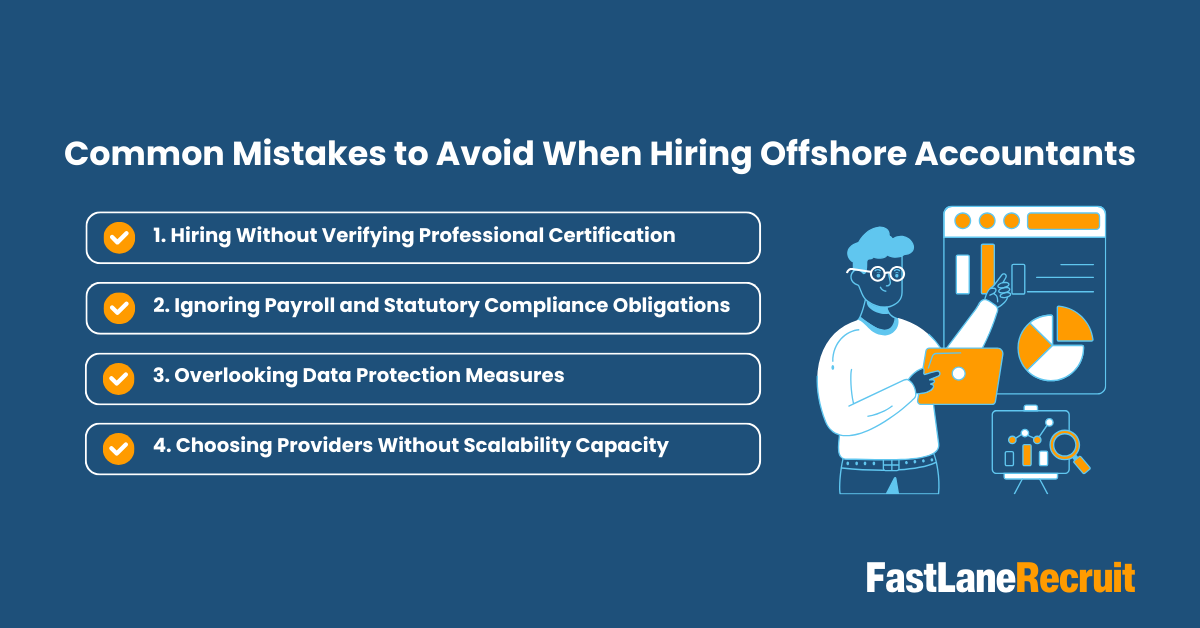
Common Mistakes to Avoid When Hiring Offshore Accountants
Hiring offshore can deliver strong results, but only if it’s done thoughtfully. Many operational issues arise not because offshore hiring doesn’t work, but because important steps were skipped.
Here are common mistakes to avoid.
1. Hiring Without Verifying Professional Certification
Accounting is a regulated profession. Not every person with accounting experience holds recognized professional credentials.
Before hiring, always verify:
- ACCA, CPA, or ICAEW certification (if required for the role)
- Membership with the Malaysian Institute of Accountants (MIA) for practicing accountants
- Years of relevant reporting experience
- Industry specialization, if applicable
Skipping this step can lead to:
- Errors in statutory reporting
- Inconsistent financial statements
- Increased audit adjustments
Verification protects your reporting integrity and reduces compliance risk.
2. Ignoring Payroll and Statutory Compliance Obligations
Even if your offshore accountant works remotely, Malaysian employment laws still apply.
Employers must comply with statutory contributions such as:
- Retirement contributions through the Employees Provident Fund (EPF)
- Social protection through the Social Security Organisation (SOCSO)
- Income tax reporting to the Inland Revenue Board of Malaysia (LHDN)
Failure to comply can result in penalties, legal complications, and reputational damage.
This is why many global companies choose structured hiring models such as Employer of Record (EOR), where statutory compliance is professionally managed.
3. Overlooking Data Protection Measures
Accounting professionals handle sensitive financial information, payroll records, tax filings, bank data, and internal reports.
Without proper safeguards, businesses risk:
- Unauthorized access
- Data leaks
- Regulatory breaches
- Loss of client trust
Best practices include:
- Secure cloud accounting systems
- Role-based access permissions
- Encrypted communication channels
- Two-factor authentication
- Documented internal data protection policies
Data security should be built into your hiring process, not added later as an afterthought.
4. Choosing Providers Without Scalability Capacity
Some companies hire based on immediate needs without considering future growth.
Questions to ask:
- Can the team expand during tax season or audit periods?
- Can additional finance roles be added easily?
- Is there backup support if your primary accountant is unavailable?
- Can reporting scope increase as your company grows?
A partner or hiring structure that lacks scalability may create bottlenecks later. Your finance function should grow with your business, not slow it down.
Why a Strategic Approach Matters
When offshore hiring is rushed or unstructured, small issues compound over time.
However, when you:
- Verify qualifications
- Ensure compliance
- Secure your systems
- Plan for scalability
You build a stable and dependable offshore finance function. A strategic approach prevents operational disruption and protects long-term growth.
Why Malaysia Remains a Strategic Accounting Talent Hub
Malaysia combines:
- Regulatory clarity
- Internationally certified professionals
- Strong English proficiency
- Advanced digital adoption
- Structured statutory system
This makes it one of Southeast Asia’s most stable destinations for building offshore finance teams.
How FastLaneRecruit Supports Your Offshore Hiring Through EOR
If your company wants to hire an offshore accountant in Malaysia without setting up a local entity, FastLaneRecruit’s Employer of Record (EOR) service provides:
- Compliant employment contracts
- Payroll and statutory contribution management
- Tax and labor law compliance
- Dedicated accountant fully aligned with your internal systems
- Flexible scaling based on business growth
You focus on performance and strategy. We handle the employment complexity.
Conclusion
Hiring an offshore accountant in Malaysia is not just about expanding your team. It is about strengthening financial governance, improving reporting accuracy, and building scalable operations in a globally connected economy.
With proper due diligence, credential verification, compliance awareness, and the right hiring model, Malaysian accounting professionals can become a seamless extension of your finance function.
If you are planning to hire offshore accountants in Malaysia, FastLaneRecruit can help you build a compliant, scalable finance team through our EOR framework.
