

Malaysia vs Global Markets
Accountants protect the financial integrity of a business. They support accurate reporting, reliable controls, cashflow visibility, audit readiness, and tax compliance—so leadership can make decisions with confidence.
As companies expand across regions, the demand for accounting talent continues to rise. The role is no longer limited to bookkeeping and close cycles; high-performing accountants strengthen forecasting discipline, reduce operational risk, and reinforce financial governance.
For employers and accounting firms in the United States, Singapore, Hong Kong, and Australia, understanding cross-border salary benchmarks has become a strategic planning exercise and not merely an HR reference point.
This guide compares 2026 accountant salary ranges across Malaysia and major global markets, helping finance leaders evaluate where to build accounting capacity while maintaining quality, control, and operational efficiency.
Content Outline
Key Summary
Malaysia Provides High-Value Accounting Talent
Accountants in Malaysia provide strong technical skills, compliance knowledge, and business insights at a lower payroll cost compared to global markets.
U.S. Salaries Reflect Labor Costs and Expertise
Accountant salaries in the U.S. are higher due to complex tax laws, regulatory requirements, and a competitive labor market.
Singapore Provides Structured, Competitive Compensation
Singapore offers stable pay for accountants, especially in finance, corporate, and multinational environments.
Hong Kong Salaries Vary by Industry
Accounting salaries in Hong Kong depend on company size, industry, and technical expertise.
Australia Rewards Experience and Compliance Knowledge
Australia’s wages reflect demand for compliance, reporting accuracy, and structured accounting support.
Access Skilled, English-Speaking Accounting Talent in Malaysia
Hiring in Malaysia provides access to professionals experienced in regional and global accounting standards.
EOR Streamlines Payroll and Compliance
FastLaneRecruit’s Employer of Record solution handles payroll, contracts, and compliance while you retain full operational control.
Accountants Salary Breakdown by Country (2026)
Malaysia
| Level | Salary (MYR) | Salary (USD approx) |
| Entry (0–2 yrs) | 60,000–75,000 | 12,500–15,500 |
| Mid (3–5 yrs) | 75,000–100,000 | 15,500–20,500 |
| Senior (6+ yrs) | 100,000–130,000 | 20,500–26,500 |
Market Insight:
Malaysia remains highly cost-efficient while offering accountants skilled in bookkeeping, tax compliance, and financial reporting.
United States
| Level | Salary (USD) |
| Entry (0–2 yrs) | 55,000–65,000 |
| Mid (3–5 yrs) | 65,000–80,000 |
| Senior (6+ yrs) | 80,000–100,000+ |
Market Insight:
U.S. salaries are higher due to labor laws, cost of living, and broader accounting scope and regulatory responsibilities, including tax planning and regulatory compliance.
Singapore
| Level | Salary (SGD) | Salary (USD approx) |
| Entry (0–2 yrs) | 45,000–55,000 | 33,000–40,000 |
| Mid (3–5 yrs) | 55,000–70,000 | 40,000–51,000 |
| Senior (6+ yrs) | 70,000–90,000+ | 51,000–66,000+ |
Market Insight:
Singapore provides structured pay for accountants, especially in regulated industries and multinational organizations.
Also Read: Offshore Vs Local: Accountants 2025 Salary Benchmark Report (Australia Vs Malaysia Edition)
Hong Kong
| Level | Salary (HKD) | Salary (USD approx) |
| Entry (0–2 yrs) | 320,000–380,000 | 41,000–49,000 |
| Mid (3–5 yrs) | 380,000–450,000 | 49,000–58,000 |
| Senior (6+ yrs) | 450,000–550,000+ | 58,000–71,000+ |
Market Insight:
Accounting roles in Hong Kong vary widely, with higher salaries in finance, audit, and multinational corporations.
Australia
| Level | Salary (AUD) | Salary (USD approx) |
| Entry (0–2 yrs) | 70,000–80,000 | 46,000–52,500 |
| Mid (3–5 yrs) | 80,000–95,000 | 52,500–62,500 |
| Senior (6+ yrs) | 95,000–115,000+ | 62,500–75,500+ |
Market Insight:
Australia offers competitive wages for accountants experienced in compliance, financial reporting, and internal controls.
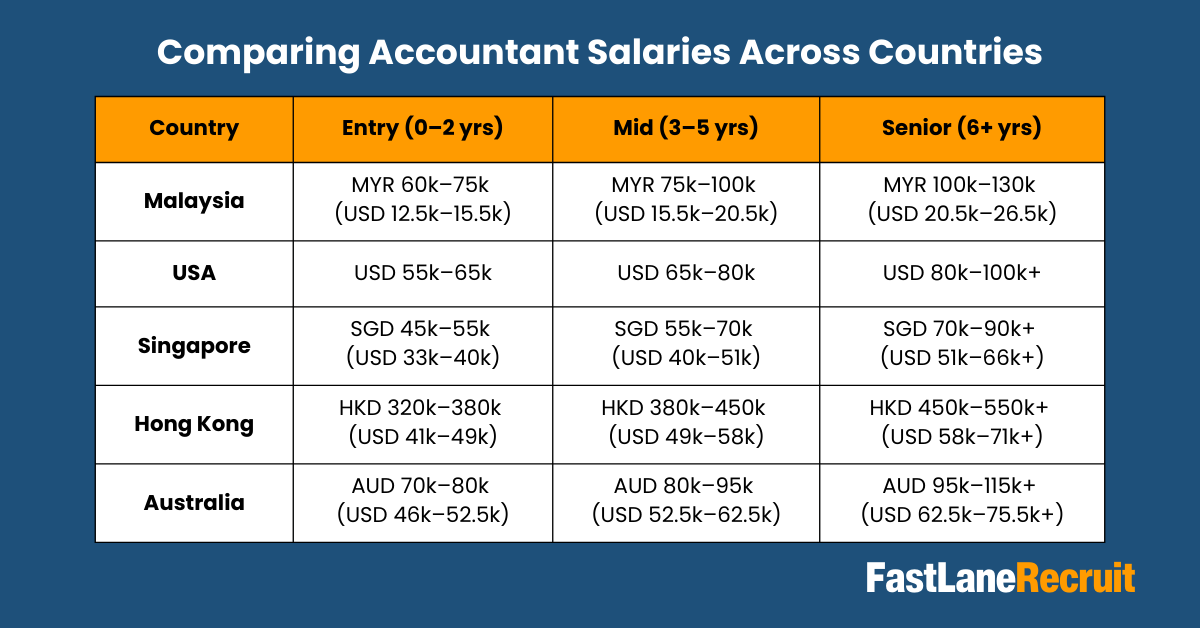
Comparing Accountant Salaries Across Countries
| Country | Entry (0–2 yrs) | Mid (3–5 yrs) | Senior (6+ yrs) |
| Malaysia | MYR 60k–75k (USD 12.5k–15.5k) | MYR 75k–100k (USD 15.5k–20.5k) | MYR 100k–130k (USD 20.5k–26.5k) |
| USA | USD 55k–65k | USD 65k–80k | USD 80k–100k+ |
| Singapore | SGD 45k–55k (USD 33k–40k) | SGD 55k–70k (USD 40k–51k) | SGD 70k–90k+ (USD 51k–66k+) |
| Hong Kong | HKD 320k–380k (USD 41k–49k) | HKD 380k–450k (USD 49k–58k) | HKD 450k–550k+ (USD 58k–71k+) |
| Australia | AUD 70k–80k (USD 46k–52.5k) | AUD 80k–95k (USD 52.5k–62.5k) | AUD 95k–115k+ (USD 62.5k–75.5k+) |
Key Insight:
Malaysia remains the most payroll-efficient location for accountants while maintaining quality, technical skills, and reliability.
Why These Salaries Differ
Accountant salaries can vary significantly across countries, even when the job title is the same. Differences arise from factors like local cost of living, scope of responsibilities, regulatory requirements, operational complexity, and market demand. Understanding these factors helps companies set realistic salary expectations, plan payroll budgets, and attract the right talent globally.
Also Read: Building a High-Performing Offshore Accounting Team in Malaysia (Singapore Edition)
1. Cost of Living & Local Expenses
One of the biggest drivers of salary differences is the local cost of living. Countries like the United States, Singapore, Australia, and Hong Kong have higher housing costs, transportation expenses, healthcare fees, and general day-to-day living expenses. Employers in these regions offer higher salaries to ensure accountants can maintain a reasonable standard of living.
Malaysia, on the other hand, has a much lower cost of living. This allows companies to offer competitive salaries that attract skilled professionals without inflating payroll budgets. For example, an accountant earning USD 22,000 in Kuala Lumpur can enjoy a similar lifestyle to someone earning USD 50,000 in Singapore, considering rent, groceries, transportation, and other essentials.
Lower living costs in Malaysia also make it easier for companies to invest in employee development, benefits, and incentives, improving retention without breaking the budget.
2. Scope of Accounting Responsibility
Not all accounting roles are the same. Some focus primarily on day-to-day bookkeeping, reconciling accounts, and preparing standard financial reports. Others take on higher-level responsibilities, such as managing regional finance teams, conducting audits, preparing management reports, or handling corporate tax and compliance for multiple jurisdictions.
The broader and more complex the responsibilities, the higher the salary required. For example, a senior accountant managing multiple subsidiaries and overseeing compliance across APAC markets will command a higher salary than a junior accountant focused on local bookkeeping.
Understanding the scope of the role is essential for benchmarking salaries accurately and ensuring candidates feel fairly compensated for the work expected.
3. Systems & Process Knowledge
Accountants who are proficient with advanced financial systems, ERP platforms (like SAP or Oracle), and reporting tools are in higher demand. Familiarity with compliance platforms, tax reporting software, and workflow automation tools adds significant value to the organization.
Companies are willing to pay more for accountants who can efficiently navigate complex systems, streamline reporting processes, and reduce errors. Technical expertise ensures faster onboarding, more accurate reporting, and compliance with internal and external audits, which directly impacts salary levels.
4. Remote Work & Global Teams
The rise of remote and hybrid work has expanded hiring options beyond local markets. Companies can now hire accountants from markets such as Malaysia to support global teams while maintaining quality and improving payroll efficiency.
Malaysian accountants often have strong English proficiency and familiarity with international accounting standards, allowing them to communicate effectively with overseas teams and adapt to global workflows. This flexibility makes Malaysia an attractive market for cost-efficient talent, especially for businesses that need regional coverage across time zones.
5. Compliance & Documentation Requirements
Accounting is closely tied to compliance, financial reporting, and audit obligations. Countries with stricter tax laws, labor regulations, and reporting requirements naturally pay higher salaries to mitigate risk.
Accountants who understand these regulations, maintain accurate documentation, and ensure compliance help protect companies from fines, penalties, and reputational damage. Roles that require expertise in multi-jurisdictional reporting, corporate tax, or internal audits are often rewarded with higher pay due to the higher stakes involved.
6. Retention & Business Continuity
Experienced accountants hold valuable institutional knowledge. They understand internal systems, workflows, vendor relationships, and historical financial decisions, which are difficult to replace.
Companies often offer higher salaries, bonuses, and growth opportunities to retain this knowledge and minimize operational disruption. Retention is particularly important for senior or specialized roles where turnover could lead to delays in reporting, errors in compliance, or gaps in strategic decision-making.
Investing in retention ensures continuity, maintains efficiency, and protects the company’s financial health over the long term.
Summary Insight
Salary differences across countries are influenced by a combination of factors:
- Local cost of living and living expenses
- Scope and complexity of accounting responsibilities
- Technical expertise and systems knowledge
- Ability to support remote and global teams
- Compliance and documentation obligations
- Retention and business continuity considerations
Malaysia stands out as a strategic location for accountants, offering skilled professionals with strong technical expertise, disciplined processes, and reliable performance, all at a more efficient payroll cost compared to many global markets.
Also Read: Building a High-Performing Offshore Accounting Team in Malaysia (Hong Kong Edition)
Why Outsource Accounting Roles to Malaysia
Outsourcing accounting roles to Malaysia is more than just a cost-saving strategy. It’s a smart business decision that provides high-quality financial support, ensures compliance with local regulations, and allows global companies to scale their accounting teams efficiently. By leveraging Malaysia’s skilled workforce, companies can focus on growth while minimizing administrative and compliance burdens.
1. Cost Efficiency Without Compromising Quality
Malaysia offers highly skilled accountants at competitive payroll rates compared to the U.S., Singapore, Australia, or Hong Kong. These professionals are trained in accounting principles, corporate tax compliance, financial reporting, and ERP systems.
Despite lower salaries, Malaysian accountants deliver work that meets international standards. For example, a company can hire a mid-level accountant in Kuala Lumpur for roughly USD 18,000–20,500, while paying USD 65,000–80,000 for the same level of expertise in the United States. This cost efficiency allows companies to invest in larger teams, technology, or employee benefits without compromising quality.
2. Reduced Payroll & Compliance Risk
Managing payroll and compliance for international hires can be complex. Each country has its own labor laws, statutory contributions, and tax obligations. Errors in payroll or reporting can result in fines, penalties, or legal disputes.
FastLaneRecruit simplifies this process by managing:
- Legally compliant employment contracts
- Monthly payroll processing and salary disbursement
- Statutory contributions, including EPF, SOCSO, and EIS
- Tax deductions and ongoing compliance reporting
By outsourcing these responsibilities, companies reduce administrative risks and ensure that their accounting team is fully compliant from day one.
3. Strategic Time Zone Coverage
Malaysia’s time zone is well-positioned for regional and global operations. It overlaps with key APAC markets like Singapore, Hong Kong, and Australia, and provides partial overlap with European working hours.
This makes real-time reporting, vendor coordination, and cross-team collaboration easier. For example, an accountant in Kuala Lumpur can complete financial reports in time for review by headquarters in Singapore or coordinate with European offices during overlapping hours, ensuring faster decision-making and fewer delays.
4. EOR Simplifies Local Employment
Setting up a legal entity in a new country can be costly and time-consuming. FastLaneRecruit’s Employer of Record (EOR) service removes this barrier entirely.
With an EOR:
- FastLaneRecruit becomes the legal employer in Malaysia
- Employment contracts, payroll, and statutory contributions are handled for you
- Your company retains full control over daily operations, workflows, and reporting
This allows companies to hire accountants quickly, remain fully compliant, and focus on operational efficiency without the administrative burden of entity setup.
5. English-Speaking Workforce
Communication is crucial for cross-border finance teams. Malaysia has a large pool of English-speaking accountants who are familiar with international accounting standards and reporting practices.
This ensures smooth collaboration with global teams, reduces miscommunication, and minimizes errors in financial documentation. For example, accountants can prepare reports, reconciliations, or tax submissions that are immediately understandable to overseas management, saving time and preventing costly mistakes.
6. Easy Scalability
Outsourcing to Malaysia provides the flexibility to scale your accounting team as business needs evolve. Whether your company requires a single accountant or a full offshore finance team, FastLaneRecruit enables rapid expansion or downsizing without the burden of legal entity registration or HR administration.
This flexibility is ideal for businesses with seasonal demands, rapid growth, or international expansion. Companies can add new team members as needed, maintain operational continuity, and adjust staffing levels efficiently.
Summary Insight
Outsourcing accounting roles to Malaysia offers a strategic combination of:
- Cost efficiency: Lower payroll without sacrificing quality
- Skilled professionals: Knowledgeable accountants experienced in global standards
- Compliance support: Reduced legal and payroll risks
- Time zone advantage: Smooth coordination with APAC and Europe
- English-speaking workforce: Clear cross-border communication
- Scalability: Easy expansion or adjustment of teams
For global companies, Malaysia provides a reliable, flexible, and cost-effective solution for building high-performing accounting teams. By partnering with FastLaneRecruit’s EOR, businesses can hire confidently, stay compliant, and scale their accounting operations efficiently.
Also Read: Building a High-Performing Offshore Accounting Team in Malaysia (Australia Edition)
How to Hire Accountants in Malaysia
Hiring accountants in Malaysia is straightforward when you follow a clear process and understand local employment requirements. With the right approach, companies can build a skilled, reliable finance team while staying fully compliant with Malaysian labor laws.
1. Define Clear Responsibilities
Before beginning the hiring process, it’s essential to clearly outline the accountant’s responsibilities. Accounting roles can vary widely depending on the company and the level of experience required.
Some common responsibilities include:
- Bookkeeping: Managing day-to-day financial transactions, reconciling accounts, and maintaining accurate ledgers.
- Financial Reporting: Preparing monthly, quarterly, and annual reports for internal and external stakeholders.
- Tax Compliance: Handling corporate tax filings, payroll taxes, and statutory reporting obligations.
- Audit Support: Assisting with internal and external audits, maintaining documentation, and ensuring compliance with local and international standards.
- Financial Management: Budget planning, forecasting, and providing insights to guide business decisions.
Clearly defining responsibilities also helps distinguish between entry-level, mid-level, and senior positions. Entry-level accountants may focus primarily on bookkeeping and reporting, while senior accountants often manage audits, tax planning, or cross-border financial reporting. This clarity ensures candidates understand expectations and reduces misalignment once hired.
2. Choose the Right Hiring Model
Selecting the appropriate hiring model depends on whether your company already has a presence in Malaysia, how quickly you need to hire, and how flexible your workforce needs to be.
| Hiring Model | Best For | How FastLaneRecruit Helps |
| Direct Hire | Companies with a Malaysian entity | Manages payroll processing, statutory contributions, and compliance while you control operations. |
| Contract Hire | Short-term or project-based needs | Provides legally compliant contracts, ensures timely payments, and handles local regulatory support. |
| Employer of Record (EOR) | Companies without a local entity | Acts as the legal employer, managing contracts, payroll, statutory contributions, and compliance while your team retains operational control. |
For many global companies, the EOR model is the fastest and lowest-risk option. It allows you to hire qualified accountants in Malaysia without the need to set up a local legal entity while maintaining full control over daily operations.
3. Set Competitive Salaries
Even though Malaysia offers cost advantages, candidates expect fair and market-aligned compensation. Offering competitive salaries is key to attracting reliable accountants and reducing turnover.
When determining salaries, consider:
- Experience Level: Entry-level, mid-level, or senior roles.
- Scope of Responsibilities: Complexity of bookkeeping, reporting, tax, audit, or financial management duties.
- System Knowledge: Familiarity with ERP platforms (SAP, Oracle), accounting software, and compliance tools.
- Regional or Global Exposure: Experience supporting international teams or cross-border reporting requirements.
Offering slightly above the local market rate can improve retention and attract candidates who value stability, career growth, and long-term opportunities.
Also Read: Types Of Accounting Services That Can Be Outsourced
4. Ensure Compliance from Day One
Compliance is a critical requirement in Malaysia. Employment contracts, payroll processing, statutory contributions, and tax filings must all adhere to local labor laws from the first day of employment.
FastLaneRecruit ensures compliance by handling:
- Legally compliant employment contracts tailored to Malaysian labor laws.
- Monthly payroll processing and timely salary disbursements.
- Statutory contributions, including EPF, SOCSO, EIS, and monthly tax deductions.
- Ongoing monitoring and reporting to ensure regulatory obligations are met.
This removes administrative burden from your internal HR or finance teams and minimizes the risk of payroll errors, fines, or legal issues.
5. Support Onboarding & Scaling
Hiring is only the first step. Proper onboarding ensures accountants become productive quickly and perform at high standards.
An effective onboarding process may include:
- Training on internal systems, tools, and financial workflows.
- Clear documentation, guidelines, and process manuals.
- Defined performance expectations, KPIs, and reporting structures.
- Regular check-ins during the first few months to address questions and provide feedback.
As your business grows, operational needs may change. FastLaneRecruit enables scalable hiring, allowing you to expand your accounting team quickly or adjust headcount without disrupting payroll, compliance, or workflow continuity.
Summary Insight
Hiring accountants in Malaysia is efficient, flexible, and low-risk when you:
- Define clear responsibilities for each role.
- Choose a hiring model that fits your company’s structure and goals.
- Offer competitive salaries aligned with 2026 market rates.
- Ensure compliance from day one with local labor laws.
- Support onboarding and team scaling for long-term success.
FastLaneRecruit’s EOR solution simplifies global hiring, allowing you to hire top accounting talent in Malaysia quickly, maintain compliance, and scale your finance team as your business grows.
Conclusion
Accountant salaries in 2026 vary across global markets. Malaysia stands out as a cost-efficient, talent-rich market with skilled professionals in finance, compliance, and reporting.
With the right hiring strategy and payroll support, businesses can build reliable accounting teams while keeping costs under control.
Ready to Hire Accountants with Confidence?
FastLaneRecruit’s Employer of Record (EOR) Service allows you to hire accountants in Malaysia without setting up a local entity. We handle:
- Compliant employment contracts
- Payroll and statutory contributions
- Ongoing compliance management
- Fast onboarding and scalable hiring
You maintain full operational control while we manage complexity. Contact FastLaneRecruit today for a free consultation and start building your global accounting team with confidence.
