
Handling multiple clients while keeping service quality high can quickly become overwhelming for any accounting firm. Outsourced accounting is a smart solution; it gives you access to experienced professionals without needing to hire more in-house staff. Choosing the right outsourcing partner isn’t just about operations; it affects your firm’s reputation too. The right partner will follow compliance rules, fit smoothly into your workflows, scale with your business, and use technology to make processes faster and more accurate.
This guide covers everything you need to know: why outsourcing helps accounting firms grow, the main services an outsourced partner can offer, how to pick the right provider, common mistakes to avoid, onboarding tips, and ways to measure success. Whether you’re considering offshore accountants or Malaysian teams through a compliant EOR setup, this article will help you make confident decisions that strengthen your firm and improve client service.
Content Outline
Key Summary
Outsourcing Drives Growth
Modern accounting firms outsource not just to save costs but to scale efficiently, access expertise, and focus on high-value client services.
Comprehensive Services Matter
Outsourced partners handle bookkeeping, payroll, tax preparation, industry-specific accounting, and cloud integration, freeing your team to focus on advisory work.
Choose Based on Expertise, Not Price
Look for industry-specific knowledge, multi-client experience, and proven track records. Don’t be swayed by the lowest bid alone.
Staffing and Scalability Are Crucial
Ensure the provider has the right mix of juniors, seniors, and reviewers, and the ability to scale smoothly during busy periods.
Security and Compliance Are Non-Negotiable
MFA, secure cloud platforms, GDPR/ISO compliance, and documented procedures protect your clients’ sensitive financial data.
Structured Communication Enhances Collaboration
Regular updates, clear escalation paths, and cultural alignment ensure smooth workflows and reduce errors across time zones.
Technology Enables Efficiency
Cloud integration, dashboards, and automation tools improve accuracy, real-time reporting, and operational efficiency, critical for multi-client firms.
How Outsourced Accounting Helps Accounting Firms Grow
Outsourced accounting is no longer just a way to save money; it’s becoming a smart strategy for growth. By partnering with experienced professionals outside your firm, you can manage financial tasks more efficiently and focus on what matters most: your clients and your business. Here’s why more accounting firms are making the switch:
1. Access to Expertise
When you outsource, you’re not just hiring someone to enter numbers. You gain access to certified professionals who understand complex workflows, industry-specific regulations, and multi-client management. This means your financial records, tax filings, and reports are handled by people with specialized knowledge, reducing errors and improving quality.
2. Scalability
Outsourcing allows you to adjust your accounting resources as needed. During busy periods, like tax season or when taking on new clients, an outsourced team can scale up to handle the extra workload. Conversely, during quieter months, you can scale down without paying for unused staff time. This flexibility keeps your operations efficient and cost-effective.
3. Focus on Core Services
By letting an outsourced team handle routine tasks like bookkeeping, payroll, and reconciliations, your in-house staff can focus on higher-value activities. This includes providing advisory services, building stronger client relationships, and growing your firm. Essentially, outsourcing gives your team the freedom to work smarter, not harder.
4. Advanced Technology
Top outsourced accounting firms use cloud-based platforms and automation tools to streamline processes. This reduces manual work, improves accuracy, and allows real-time access to financial data. With dashboards and automated reporting, you can see your firm’s financial health instantly, even if your team is working remotely.
Example: A UK-based accounting firm outsources payroll and bookkeeping to a team of skilled Malaysian accountants. The firm reduces the operational workload on its in-house staff while maintaining compliance with UK regulations. Meanwhile, the outsourced team handles daily transactions, reconciliations, and payroll processing efficiently, freeing up the firm to focus on client advisory and strategic growth.
Also Read: Why Malaysia Is a Strategic Hub for Offshore Accountants
Key Services Offered by an Outsourced Accounting Partner
A professional outsourced accounting firm does much more than simple bookkeeping. They provide a full suite of services designed to keep your firm running smoothly, improve accuracy, and free up your time to focus on clients. Here’s what a comprehensive outsourced accounting service can offer:
| Service | What It Includes | Benefits |
| Bookkeeping & Reconciliation | Managing accounts payable (AP) and accounts receivable (AR), reconciling bank statements, and keeping your general ledger accurate. | Ensures all financial records are correct and up to date. Provides real-time insights into your cash flow and overall financial health. Reduces errors that can affect client reporting. |
| Payroll Management | Calculating employee salaries, withholding taxes, managing vendor payments, and ensuring compliance with local labor laws. | Saves time for your in-house team, ensures accurate and compliant payroll, and reduces risk of penalties from missed filings. Employees and clients are paid on time, every time. |
| Financial Reporting & Tax Support | Preparing profit & loss statements, balance sheets, VAT filings, and supporting tax submissions. | Helps you make smarter business decisions with accurate, timely reports. Simplifies audits and ensures you meet local tax regulations. |
| Industry-Specific Accounting | Handling specialized workflows for industries such as restaurants, retail, or multi-client firms, including inventory tracking, daily sales reconciliation, and KPI monitoring. | Offers tailored insights relevant to your industry. For example, a restaurant accountant can track prime cost, labor ratios, and daily revenue trends, helping you optimize profitability. |
| Technology Integration | Connecting your accounting processes to cloud platforms like Xero, QuickBooks, MYOB, and providing secure dashboards for data access. | Improves efficiency through automation, reduces manual errors, and gives secure, real-time access to your financial data from anywhere in the world. |
Why These Services Matter for Accountants
By leveraging these services, your firm can:
- Maintain accurate and timely financial records across multiple clients
- Stay compliant with local tax regulations and reporting standards
- Reduce operational workload and administrative stress
- Gain insights through dashboards and analytics to improve client advisory services
Example: A UK accounting firm partners with a Malaysian offshore accounting team to manage payroll, bookkeeping, and VAT reporting. The outsourced team integrates directly with the firm’s cloud software, ensuring data accuracy, compliance, and efficiency, while the in-house team focuses on strategic advisory and client relationships.
Also Read: How to Hire an Offshore Accountant in Malaysia
5 Key Criteria to Choose the Right Outsourced Accounting Partner
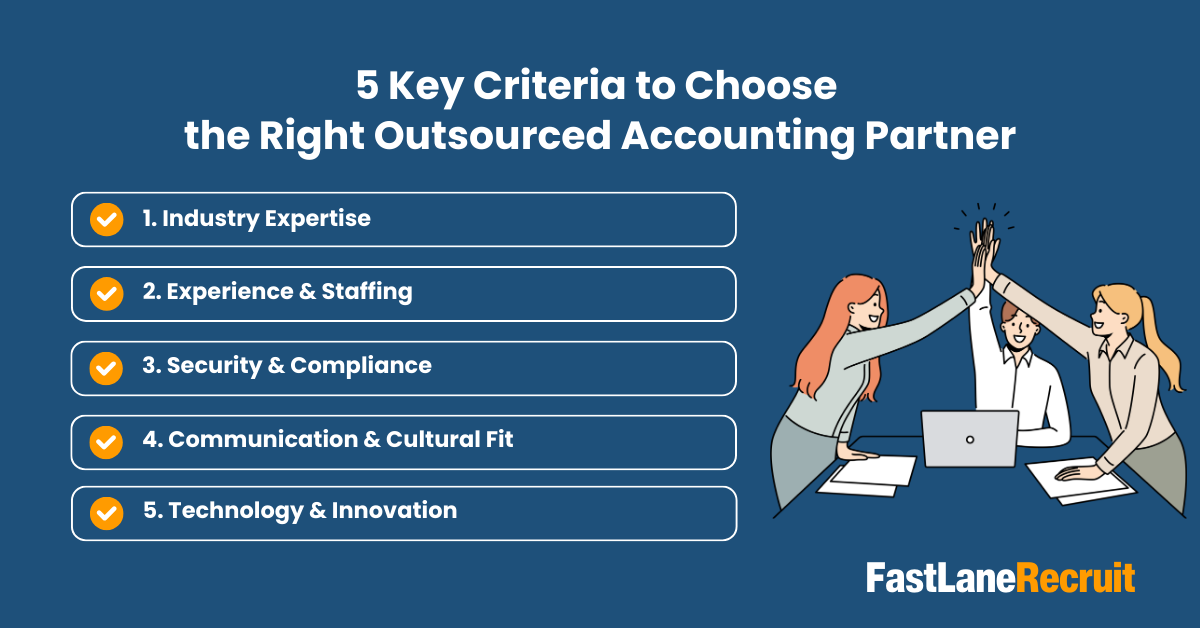
Choosing an outsourced accounting partner is about much more than price or a smooth sales pitch. The right partner becomes an extension of your firm, helping you scale efficiently while maintaining high standards. Here are five essential factors to evaluate before committing:
1. Industry Expertise
Not all accounting outsourcing providers are created equal. Your partner should understand the specific workflows and challenges of your industry.
- For CPA firms: They should be familiar with multi-client accounting, audit workpapers, tax filings, and compliance deadlines.
- For restaurants or hospitality: They should understand prime cost, daily sales tracking, inventory management, and tips reporting.
Tip: Ask for case studies or client examples. For instance, a provider who has successfully handled multiple restaurant clients will know how to reconcile daily POS transactions efficiently.
Benefit: Industry expertise ensures your outsourced accountant can handle tasks accurately and proactively, reducing errors and improving turnaround times.
2. Experience & Staffing
A capable team requires the right mix of skills and experience:
- Junior staff: Handle routine bookkeeping and data entry.
- Senior staff: Manage reconciliations, reporting, and higher-level accounting tasks.
- Reviewers: Conduct quality checks before submissions.
Tip: Confirm training programs, onboarding processes, and capacity for scaling. Ask: “Can you add experienced staff during peak season without sacrificing quality?”
Benefit: Proper staffing ensures your team focuses on strategic work, while the outsourced partner handles the operational load efficiently.
3. Security & Compliance
Financial data is highly sensitive. Look for a partner with robust security protocols:
- Multi-Factor Authentication (MFA): Protects accounts from unauthorized access.
- Secure cloud environments: Prevents data from being downloaded or accessed on personal devices.
- Regulatory compliance: GDPR, ISO certifications, or local accounting standards.
- Documented data-handling procedures: Clear policies for onboarding, offboarding, and monitoring access.
Tip: Ask for specifics, not marketing claims. Request a walkthrough of their security systems and audit logs.
Benefit: Ensures client data is protected and compliant, reducing risk for your firm.
4. Communication & Cultural Fit
Clear, structured communication is crucial for smooth collaboration, especially across time zones.
- Structured updates: Weekly or biweekly check-ins, task tracking, and progress dashboards.
- Defined escalation paths: Quick resolution of urgent issues without delays.
- Cultural alignment: Work style, responsiveness, and approach should match your firm’s standards.
Tip: Ask how the partner handles urgent errors or time-sensitive tasks. Do they have a dedicated account manager or team lead?
Benefit: Proper communication prevents workflow delays, misalignment, and misunderstandings, ensuring seamless collaboration.
5. Technology & Innovation
Modern outsourcing relies on cloud platforms and automation. Your partner should:
- Integrate with your accounting software (Xero, QuickBooks, MYOB, etc.)
- Use dashboards for real-time financial reporting
- Apply automation tools to reduce manual work
- Stay up-to-date with compliance-related tech changes (e.g., Making Tax Digital in the UK)
Tip: Ask about software compatibility, data migration, and whether they provide training for your team on dashboards and reporting tools.
Benefit: Leveraging technology improves accuracy, efficiency, and accessibility, allowing your firm to scale without bottlenecks.
Pro Tip: Consider conducting a pilot project before a full-scale partnership. This helps assess expertise, communication, and technology integration without committing long-term.
Example: A UK accounting firm hires Malaysian accountants through an outsourced partner. The partner uses Xero for bookkeeping, integrates payroll and tax reporting, and provides weekly dashboards. The firm experiences improved efficiency, reduced errors, and better client advisory time, all while maintaining compliance with UK regulations.
Also Read: Types Of Accounting Services That Can Be Outsourced
Common Mistakes to Avoid When Outsourcing Accounting
Outsourcing can bring tremendous benefits, but mistakes in selecting or managing a partner can undermine your efforts. Here are the most common pitfalls and how to avoid them:
1. Choosing Based on Price Alone
The cheapest option is rarely the best. While cost is important, selecting a provider solely for low pricing often leads to errors, rework, and lost time.
Tip: Evaluate the provider based on expertise, track record, technology, and compliance, not just cost. A slightly higher fee for a skilled, reliable partner often saves money in the long run.
2. Overlooking Industry-Specific Expertise
Not every accounting partner understands the nuances of your industry. A generalist may struggle with restaurant KPIs, multi-client CPA workflows, or retail inventory reconciliation, leading to mistakes.
Tip: Ask for case studies or references specific to your industry. For example, a partner familiar with restaurant accounting knows how to track daily sales, labor ratios, and tip reporting accurately.
3. Ignoring Security Protocols
Outsourcing involves sharing sensitive financial data. Skipping security checks can result in data breaches, compliance violations, and reputational damage.
Tip: Verify that your provider uses MFA, secure cloud environments, encryption, and follows GDPR/ISO-compliant protocols. Ask for details on how access is granted, monitored, and revoked.
4. Failing to Establish Structured Communication
Ad hoc communication leads to missed deadlines, misunderstandings, and frustration. Simply relying on emails or reactive messaging is not enough.
Tip: Set clear expectations upfront: weekly updates, defined escalation paths, and task-tracking dashboards. Ensure there’s a dedicated account manager or team lead who coordinates work and maintains accountability.
5. Skipping a Pilot Project Before Scaling
Jumping straight into full-scale outsourcing without testing the waters can backfire. It increases the risk of errors, workflow mismatches, and misaligned expectations.
Tip: Start with a pilot project for one or two client accounts. Evaluate quality, communication, technology integration, and turnaround times before expanding to the entire practice.
Also Read: Offshore Vs Local: Accountants 2025 Salary Benchmark Report (Australia Vs Malaysia Edition)
How to Onboard Your Offshore Accountant
A smooth onboarding process sets the foundation for a successful partnership. Here’s a step-by-step approach:
1. Initial Assessment
Evaluate your current workflows, accounting systems, and compliance requirements. Identify which tasks can be outsourced and what level of oversight is needed.
Tip: Document pain points and areas for improvement, this helps the outsourced team understand your firm’s unique needs.
2. Secure Data Migration
Transfer financial files safely to the outsourced team. Use encrypted file-sharing platforms or secure cloud storage to protect sensitive data.
Tip: Maintain backups and limit access only to authorized team members during migration.
3. Software Integration
Connect your accounting, payroll, and point-of-sale (POS) systems to the outsourced team’s cloud platforms. Integration ensures real-time updates, automated reporting, and minimal manual data entry.
Tip: Confirm compatibility with platforms like Xero, QuickBooks, MYOB, or industry-specific software.
4. Training & Process Documentation
Provide clear guidelines, workflow documentation, and examples of expected outputs. Train the offshore team on your standard operating procedures (SOPs), client-specific requirements, and compliance rules.
Tip: Include checklists and sample reports for tasks like reconciliations, payroll, or tax filings. Regularly review the work during the first few weeks to ensure accuracy.
5. Ongoing Reporting & Communication
Set a structured cadence for updates, performance reviews, and KPI tracking. Establish clear channels for questions, issue resolution, and escalation.
Tip: Weekly or biweekly meetings, dashboards, and cloud reporting tools can keep everyone aligned. Transparent reporting builds trust and ensures your outsourced partner delivers consistent quality.
Example: A mid-sized UK accounting firm outsourced bookkeeping and payroll to Malaysian accountants. Through careful onboarding, including workflow assessment, cloud integration with Xero, and weekly KPI meetings, they reduced processing errors by 30% and freed up senior staff to focus on client advisory.
Also Read: Building a High-Performing Offshore Accounting Team in Malaysia (Singapore Edition)
Measuring Success with an Outsourced Accounting Partner
Once you’ve engaged an outsourced partner, it’s important to track their performance to ensure the partnership delivers real value. Here are key metrics to monitor:
1. Accuracy of Financial Statements
- Are balance sheets, P&L statements, and cash flow reports free from errors?
- Mistakes can lead to incorrect business decisions or compliance issues.
Tip: Conduct periodic reconciliations and review reports for consistency with internal expectations.
2. On-Time Delivery of Payroll and Tax Filings
- Payroll and tax deadlines are critical. Late submissions can result in fines, penalties, or unhappy employees.
- Track if your outsourced partner consistently meets deadlines for payroll, VAT, GST, or tax filings.
Tip: Set up shared calendars and reminders with automated alerts to monitor timeliness.
3. Reduction in Operational Overhead
- Compare costs of in-house staffing versus outsourced services.
- Consider savings on salaries, benefits, training, and office infrastructure.
Tip: Measure efficiency improvements by calculating time saved for your internal team and the reduction in administrative workload.
4. Client Satisfaction Scores
- For accountants serving multiple clients, monitor client feedback related to reporting accuracy, timeliness, and responsiveness.
- High satisfaction indicates the outsourced partner supports your firm’s reputation.
Tip: Use surveys or client check-ins to capture feedback and identify areas for improvement.
5. Efficiency in Workflow and Automation Adoption
- Evaluate whether the partner is effectively using cloud platforms, dashboards, and automation tools to streamline processes.
- Efficient workflows reduce errors, speed up reporting, and improve scalability during peak periods.
Tip: Review dashboards, audit trails, and automated processes regularly to ensure best practices are followed.
Example: A mid-sized firm outsourcing bookkeeping to Malaysian accountants noticed faster month-end reporting and fewer reconciliation errors, freeing senior accountants to provide advisory services instead of routine data entry.
Also Read: Building a High-Performing Offshore Accounting Team in Malaysia (Hong Kong Edition)
Why Consider a Malaysian Accountant or Offshore Accountant?
Outsourcing to Malaysia has become a popular option for accounting firms looking to scale operations efficiently and access skilled talent. Here’s why:
1. Reduced Operational Cost
Hiring an offshore accountant allows firms to achieve operational efficiency without compromising quality. Firms save on salaries, office infrastructure, and recruitment costs while maintaining access to certified professionals.
2. Skilled Talent Pool
Malaysia offers a growing pool of experienced accountants familiar with international accounting standards, multi-client workflows, and industry-specific practices.
Tip: Look for accountants with CPA or equivalent certifications, experience with cloud accounting software, and familiarity with your industry’s reporting requirements.
3. Rapid Scalability
Outsourced Malaysian accountants allow firms to scale quickly during busy seasons or when acquiring new clients. Additional capacity can be added without hiring full-time staff locally.
4. Tech-Enabled Workflows
Malaysian accountants often work seamlessly with cloud platforms like Xero, QuickBooks, or MYOB, using automation to improve speed, accuracy, and real-time reporting.
Tip: Ensure your outsourcing partner integrates your systems, provides dashboards, and supports automated reconciliations for maximum efficiency.
5. FastLaneRecruit EOR Service
Partnering with FastLaneRecruit allows firms to hire Malaysian accountants under a fully compliant Employer of Record (EOR) structure. This approach provides:
- Payroll management and timely employee payments
- HR support and employment compliance
- Full legal coverage without establishing a local entity
By using FastLaneRecruit, accounting firms can expand their offshore team safely and quickly, focusing on client advisory and growth while leaving operational and legal compliance to a trusted partner.
Tips for a Successful Outsourcing Relationship
Building a productive relationship with your outsourced accounting partner requires planning, communication, and ongoing management. Here are practical tips to ensure success:
1. Start with a Pilot Project
Before fully committing, test the partnership with a small-scale pilot. This allows you to evaluate the partner’s capabilities, workflow integration, and responsiveness without risking your entire operation.
Tip: Start by outsourcing a specific function, like bookkeeping for one client or payroll processing for a single department. Monitor accuracy, turnaround time, and communication.
Benefit: A pilot minimizes risk, identifies gaps early, and builds confidence in scaling up the partnership.
2. Use Dashboards and Real-Time Reporting for Visibility
Transparency is key. Using cloud-based dashboards and real-time reporting gives you instant insight into the partner’s performance, financial data, and workflow status.
Tip: Require access to reporting tools integrated with your accounting software (e.g., Xero, QuickBooks, MYOB). Set up KPIs such as reconciliation accuracy, payroll timeliness, and completion of tax filings.
Benefit: Real-time visibility reduces surprises, enables quicker decision-making, and ensures accountability.
3. Document Workflows to Reduce Errors
Clearly documented workflows standardize processes, reduce errors, and make onboarding or scaling smoother.
Tip: Create step-by-step guides for tasks such as bank reconciliation, payroll processing, invoice management, and tax filings. Include checklists, example outputs, and compliance requirements.
Benefit: Detailed documentation ensures consistency, speeds up training, and allows your partner to maintain quality even if staff changes occur.
4. Leverage the Partner’s Expertise to Improve Efficiency
Your outsourced team brings experience across multiple clients and industries. Tap into this knowledge to streamline operations, adopt best practices, and improve accuracy.
Tip: Ask your partner for suggestions on automation, reporting improvements, or workflow optimization. For example, a partner familiar with Malaysian accountants may advise on integrating cloud payroll with automated tax calculations.
Benefit: Leveraging their expertise helps you reduce operational overhead, save time, and enhance service quality.
5. Ensure High Client Retention and Expansion Rates
A provider with strong retention and expansion rates demonstrates reliability, quality, and adaptability. Low turnover of clients often reflects consistent performance and satisfaction.
Tip: Ask for metrics such as average client tenure, percentage of clients who expand services, and examples of long-term client partnerships.
Benefit: Partnering with a proven provider reduces the risk of disruptions and ensures continuity as your firm grows.
Example: A UK accounting firm engaged Malaysian accountants through an outsourced partner. They started with a pilot project for payroll, implemented real-time dashboards, and documented every workflow. Over six months, they expanded to full bookkeeping, tax filings, and financial reporting. The structured approach led to faster turnaround, fewer errors, and freed senior accountants to focus on client advisory.
Also Read: Building a High-Performing Offshore Accounting Team in Malaysia (Australia Edition)
Conclusion
Outsourced accounting isn’t just a solution; it’s a strategic advantage. The right partner brings expertise, compliance, and scalability, allowing your firm to focus on growth and client satisfaction. By carefully evaluating industry experience, staffing, security, communication, and technology, you can build a productive, long-term partnership.
Scale Your Accounting Team with FastLaneRecruit
Outsourced accounting is about unlocking your firm’s full potential. By partnering with FastLaneRecruit’s EOR Service, you gain access to skilled Malaysian accountants who can seamlessly integrate into your operations while keeping compliance and efficiency at the forefront.
With FastLaneRecruit, you can:
- Hire Experienced Malaysian Accountants Quickly and Compliantly
Access a talented pool of certified professionals familiar with international accounting standards and multi-client workflows, all under a fully compliant EOR structure. - Simplify Payroll, Taxes, and HR Management
FastLaneRecruit handles all HR administration, employment compliance, and payroll processing, so you don’t need to set up a local entity or worry about legal complexities. - Focus on Growing Your Firm
Free up your senior accountants and internal team to concentrate on client advisory, strategy, and business growth, while your offshore team manages the day-to-day operational workload. - Scale Seamlessly During Busy Seasons
Whether it’s month-end close, tax season, or onboarding new clients, FastLaneRecruit enables you to adjust capacity quickly without compromising quality or deadlines. - Leverage Technology and Efficiency
Our teams work with cloud-based accounting platforms, automation tools, and real-time dashboards, giving you visibility, accuracy, and faster reporting from anywhere in the world.
Ready to expand your accounting team effortlessly while maintaining high-quality service and compliance? Explore FastLaneRecruit’s EOR Service today and start building your global talent pipeline with confidence.