Managing finances can be a challenge, especially for businesses experiencing rapid growth. Outsourced accounting gives you access to expert financial support without the overhead of a full-time in-house team. But with multiple pricing models available, hourly, monthly retainers, or dedicated offshore teams, how do you know which is right for your business?
This guide breaks down each pricing approach, explains the factors that influence costs, and shows how to compare in-house versus outsourced accounting realistically. By understanding the options, you can make informed decisions, save on operational costs, and gain access to the right level of financial expertise for your business.
Content Outline
Key Summary
Hidden Costs Can Add Up
In-house accounting includes salaries, benefits, taxes, software, onboarding, and management time. These hidden expenses can make in-house teams 20–40% more expensive than anticipated.
Predictable Budgeting with Outsourcing
Outsourced accounting offers fixed monthly fees or dedicated offshore teams that bundle labor, software, and overhead. This makes planning and budgeting much easier.
Offshore Teams Deliver the Same Scope at Lower Costs
Malaysian or other offshore accounting teams can handle payroll, bookkeeping, and reporting with the same accuracy as in-house staff, often saving 30–70% per role.
Quality Controls Reduce Errors
Service-level agreements (SLAs), standardized processes, and automated workflows minimize errors and rework, ensuring reliable financial reporting.
Scalable and Flexible Solutions
Outsourced accounting teams can quickly scale up during busy periods, audits, or tax season, and scale down when workloads decrease, giving you agility without hiring permanent staff.
Access to Expertise on Demand
Outsourcing gives you access to CPAs, senior accountants, and fractional CFOs without the expense of full-time executives. Smaller businesses can leverage high-level financial insights without hiring locally.
Strategic Focus and Time Savings
With routine accounting tasks managed externally, your internal team can focus on strategic initiatives like growth planning, fundraising, or operational improvements.
Why Understanding Outsourced Accounting Pricing Matters
Outsourcing your accounting isn’t just about saving money; it’s about making your business run more smoothly. When you work with an external accounting team, you gain flexibility, specialized expertise, and fewer operational headaches, which can be especially helpful as your business grows.
The tricky part is that pricing for outsourced accounting can vary a lot because no two businesses are the same. The cost depends on what you need done, how often, and how complex your finances are. Here’s a breakdown:
- Small businesses often just need the basics. Think simple bookkeeping, like tracking income and expenses, reconciling bank statements, and generating monthly reports. These services are straightforward and cost less.
- Growing companies may need more than basic bookkeeping. Payroll management, tax planning, and financial forecasting become important as the business expands. These services require more time and expertise, which naturally affects the price.
- Larger operations often need full financial oversight. This could include CFO-level guidance, strategic budgeting, risk management, and detailed reporting for investors or boards. Naturally, this level of support comes at a higher cost, but it can save your business from costly mistakes in the long run.
Understanding the real cost upfront is key. When you know what each service costs and how it fits your business needs, you avoid paying for unnecessary work and ensure you get the expertise that truly matters. This makes budgeting easier and helps you plan for growth without surprises.
How Outsourced Accounting Billing Works
When outsourcing your accounting, the way you’re billed usually falls into three main models, and costs can vary depending on the country, services required, and your business size. Here’s a detailed look with USD pricing:
| Pricing Model | U.S. (USD) | UK (USD) | Singapore (USD) | Malaysia (USD) | Best Use Case |
| Hourly | $25–$150/hr | $25–$125/hr | $25–$90/hr | $20–$60/hr | Occasional bookkeeping, startups, or businesses with low transaction volume. Pay only for the hours used. |
| Monthly Retainer | $1,000–$5,000/month | $1,000–$5,000/month | $1,000–$4,500/month | $1,000–$3,500/month | Steady, predictable accounting needs. Ideal if your workload is consistent each month. |
| Dedicated Offshore Team | $3,500–$12,000/month | $3,000–$10,000/month | $3,500–$12,000/month | $2,500–$8,500/month | High-volume transactions, full financial oversight, CFO-level support, or scaling operations. Great for businesses expecting growth or with complex reporting needs. |
Choosing the Right Model
- Stable Transaction Volume: If your accounting workload is consistent, a monthly retainer or dedicated offshore team helps you budget predictably.
- Seasonal or Project-Based Work: Hourly billing works best for occasional spikes, like audits or tax season, since you only pay for the time you use.
- Scaling Across Borders: Offshore teams in Malaysia or Singapore provide quality accounting support at competitive rates while maintaining expertise. This is especially helpful for growing global businesses.
- CFO-Level Support: Dedicated offshore teams can offer fractional CFOs or senior accountants, giving strategic guidance without the expense of full-time executives.
Quick Tip:
Always check what’s included in the pricing, software, payroll support, reporting, audit prep, and communication. Sometimes a slightly higher monthly fee covers everything you need, making it more cost-effective than paying for extras separately.
Also Read: Why Malaysia Is a Strategic Hub for Offshore Accountants
What Influences Outsourced Accounting Costs?
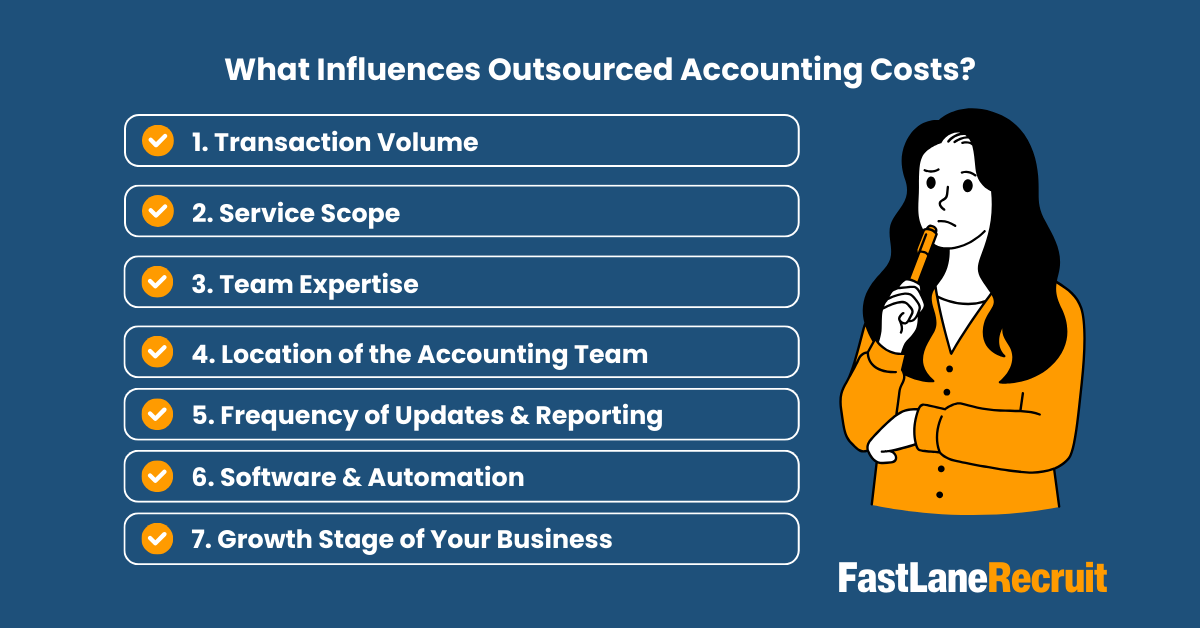
The cost of outsourced accounting isn’t one-size-fits-all. Several key factors determine what you’ll pay, and understanding them helps you budget wisely while getting the right level of expertise for your business.
1. Transaction Volume
The more financial activity your business has, the higher the accounting workload and the higher the cost.
- Example: A small business processing 50 invoices a month may only need a few hours of bookkeeping, while a growing company with 500+ invoices, multiple payroll runs, and regular reconciliations will require more time and resources.
- Tip: Track your average monthly transactions to choose a billing model that fits your workload.
2. Service Scope
Outsourced accounting services range from basic bookkeeping to full financial management, including forecasting, budgeting, payroll, tax planning, and audit support.
- Basic bookkeeping covers transaction recording and reconciliations—costs are lower.
- Full-service packages include strategic insights like CFO-level planning, which naturally increases pricing.
- Tip: Define what services you truly need now and what can be added later as your business grows.
3. Team Expertise
Highly qualified accountants, CPAs, or fractional CFOs bring experience and skills that reduce errors, improve compliance, and provide strategic guidance, but they come at a premium.
- Example: Hiring a fractional CFO from an offshore team in Malaysia may cost less than a local U.S. CFO, yet still deliver expert-level financial advice.
- Tip: Consider the long-term value of expertise; paying a bit more upfront often saves costly mistakes later.
4. Location of the Accounting Team
Where your outsourced team is based can influence costs. Offshore teams in countries like Malaysia offer competitive pricing for routine accounting work while maintaining high-quality output.
- Example: A U.S. business can reduce operational costs by outsourcing day-to-day bookkeeping and payroll tasks to a Malaysian team while keeping strategic oversight in-house.
- Tip: Ensure strong communication and overlapping work hours for smooth collaboration with offshore teams.
5. Frequency of Updates & Reporting
How often you need reports or check-ins affects pricing.
- Daily updates or weekly reports require more hours and ongoing monitoring.
- Monthly or quarterly updates reduce time and cost.
- Tip: Choose a reporting frequency that balances your need for insight with your budget.
6. Software & Automation
Accounting providers often include cloud accounting platforms, payroll tools, or automated OCR (Optical Character Recognition) systems.
- Automation reduces manual work and errors, which can save money in the long run.
- Tip: Check what software is included and whether it integrates with your existing systems to avoid extra subscription fees.
Also Read: How to Hire an Offshore Accountant in Malaysia
7. Growth Stage of Your Business
Your business lifecycle impacts the type of services needed:
- Startups or small businesses may only need basic bookkeeping.
- Growing companies may require payroll management, tax planning, and forecasting.
- Large or multi-location operations often need full financial oversight or CFO-level support.
- Tip: Plan for scalability. Flexible outsourcing agreements let you add services as your business grows without hiring full-time staff.
By considering these factors, you can estimate the right budget, choose the right billing model, and select a provider that delivers both quality and value.
In-House vs Outsourced Accounting: Cost Comparison
When deciding whether to keep accounting in-house or outsource it, it’s crucial to look beyond base salaries. Many businesses underestimate the hidden costs associated with in-house staff, which can make outsourcing an attractive alternative, especially for growing companies or those scaling across borders.
Key Cost Elements by Country
| Cost Element | In-House Accounting (USD) | Outsourced Accounting (USD) | Explanation |
| Salary / Compensation | US: $50K–$80KUK: $40K–$65KSingapore: $45K–$70KMalaysia: $15K–$30K | Included in fixed fee (all countries) | Outsourced providers include labor costs in the agreed fee, eliminating separate salaries. |
| Benefits & Taxes | US: $10K–$20KUK: $8K–$15KSingapore: $7K–$12KMalaysia: $3K–$5K | Included | Health insurance, pension, and payroll taxes are bundled with outsourcing. |
| Software & Equipment | US: $2K–$5KUK: $1.5K–$3KSingapore: $1.5K–$3KMalaysia: $1K–$2K | Often included | Accounting software, laptops, and other tools are provided by outsourced providers at no extra cost. |
| Recruiting & Onboarding | US: $2K–$5KUK: $1.5K–$3KSingapore: $1.5K–$3KMalaysia: $500–$1K | Minimal | Outsourced teams handle internal onboarding, saving recruitment and training costs. |
| Management & Oversight | US: 1–2 hrs/weekUK: 1–2 hrs/weekSingapore: 1–2 hrs/weekMalaysia: 1–1.5 hrs/week | 0.5–1 hr/week | Managers spend less time overseeing outsourced teams due to structured SLAs and reporting. |
| Rework & Errors | US: 2–5% of hoursUK: 2–5% of hoursSingapore: 2–5% of hoursMalaysia: 1–3% of hours | Controlled by SLAs | Outsourced teams have processes and quality controls to minimize errors, reducing costly rework. |
Mini Example – U.S. Staff Accountant Equivalent
| Model | Annual Cost (USD) |
| In-House | $103,480 |
| Outsourced | $87,200 |
| Savings | $16,280 |
Mini Example – UK AP Specialist Equivalent
| Model | Annual Cost (USD) |
| In-House | $50,000 (≈£40,456) |
| Outsourced | $39,500 (≈£31,980) |
| Savings | $10,500 (≈£8,476) |
Mini Example – Malaysia Accounting Specialist Equivalent
| Model | Annual Cost (USD) |
| In-House | $22,000 (≈RM94,000) |
| Outsourced | $15,500 (≈RM66,000) |
| Savings | $6,500 (≈RM28,000) |
Key Takeaways
- Hidden Costs Add Up: In-house accounting isn’t just salary; it includes benefits, taxes, software, onboarding, equipment, and management time. These costs can make in-house accounting 20–40% more expensive than it appears at first glance.
- Outsourcing Provides Predictable Costs: Fixed monthly fees or dedicated offshore teams include most of the above expenses, making budgeting easier and more predictable.
- Same Scope, Lower Cost: Offshore teams can handle the same transaction volume, payroll, and reporting tasks as in-house staff, often at a significant savings.
- Quality Controls Reduce Errors: Service-level agreements (SLAs) and automated workflows keep outsourced accounting work accurate, reducing costly rework.
- Flexible Scalability: As your business grows, outsourced teams can quickly scale up, adding more hours, payroll support, or CFO-level guidance without hiring additional in-house staff.
Tip: Use cost calculators like the US & UK Fully-Loaded Accounting Cost Calculator to get a realistic, like-for-like comparison for your business. Consider including Malaysia or Singapore offshore teams for high-quality accounting at a lower operational cost.
Also Read: Types Of Accounting Services That Can Be Outsourced
Key Benefits of Outsourcing Accounting
- Predictable Costs
Outsourcing gives you control over your budget. You can pay hourly for occasional bookkeeping, use a monthly retainer for steady workloads, or hire a dedicated offshore team for full-scale financial management. This flexibility ensures you’re only paying for the services your business actually needs. - Access to Expertise
Outsourced accounting firms provide on-demand access to highly qualified professionals, including CPAs, financial analysts, and fractional CFOs. This means even smaller businesses can benefit from strategic financial guidance without hiring full-time senior staff. - Scalability & Flexibility
Outsourced teams can quickly adapt to seasonal spikes, audits, tax deadlines, or fundraising campaigns. For example, a Malaysian offshore accounting team can handle high-volume payroll during peak months and scale down when workloads stabilize. - Reduced Overhead
No need to manage office space, software licenses, or employee benefits internally. Outsourcing reduces hidden in-house costs, from hardware and cloud accounting tools to training and onboarding. - Transparency & Credibility
Professional accounting management improves trust with investors, clients, and regulators. Outsourced services often provide clear reports, dashboards, and audit trails, ensuring your financials are reliable and easy to verify. - Time Savings
Free your internal team from routine bookkeeping and reporting tasks so they can focus on strategic business growth, operations, or client-facing work. - Risk Reduction
Service-level agreements (SLAs), compliance oversight, and experienced accountants reduce the likelihood of errors, missed filings, and regulatory penalties. Offshore teams often follow international standards, ensuring accuracy while maintaining cost efficiency.
Tips for Choosing the Right Outsourced Accounting Solution
- Define Scope Clearly
List all financial activities you want to outsource: transaction processing, payroll, reconciliations, reporting, and forecasting. A clear scope prevents hidden costs and ensures the provider meets expectations. - Check Expertise
Confirm that your provider has certified accountants, CPAs, or fractional CFOs available. This is especially important if you need strategic guidance for budgeting, tax planning, or investor reporting. - Compare Pricing Models
Evaluate hourly, monthly, and dedicated offshore team options. For example, hourly may suit startups with low transaction volume, while dedicated Malaysian offshore teams work well for growing companies with consistent workflows. - Review Technology & Security
Ensure your provider uses cloud accounting platforms, automation tools, and secure audit trails. This improves efficiency, protects sensitive data, and allows real-time visibility of your finances. - Ask About SLAs
Check for service-level agreements covering accuracy, reporting frequency, and response times. SLAs provide accountability and ensure consistent quality. - Run Sensitivity Checks
Model different scenarios such as growth, seasonal spikes, or error reduction. This helps forecast costs and ensures the outsourced solution can handle your business as it scales.
Also Read: Offshore Vs Local: Accountants 2025 Salary Benchmark Report (Australia Vs Malaysia Edition)
Why Businesses Are Choosing Malaysian Offshore Accounting Teams
Many global businesses are successfully combining local oversight with offshore teams in Malaysia, and it’s easy to see why:
- Cost Efficiency
Outsourcing routine accounting tasks such as bookkeeping, accounts payable/receivable, and payroll to a Malaysian team can significantly reduce operational costs. Companies save not only on salaries but also on benefits, software licenses, and office space. These savings can then be reinvested into growth initiatives. - Quality & Expertise
Malaysian offshore accountants are highly skilled and trained to meet international accounting and compliance standards. From routine bookkeeping to tax planning and financial forecasting, they provide high-quality support comparable to in-house teams without the full-time overhead. - Time Zone Advantage
With dedicated points of contact, offshore teams can coordinate seamlessly with local management. For example, updates can be prepared overnight and reviewed first thing in the morning, speeding up decision-making and ensuring continuity even during busy periods. - Scalable Packages
Outsourcing to Malaysia allows businesses to scale their accounting support up or down depending on needs. Seasonal spikes, audits, or fundraising events can be handled without the need to hire additional permanent staff. This flexibility keeps costs predictable while providing access to the right level of expertise. - Practical Example
A growing tech startup that outsources monthly payroll and bookkeeping to a Malaysian offshore accounting team can save 30%–50% compared to hiring in-house staff. At the same time, they maintain access to fractional CFO-level guidance for strategic financial decisions, combining cost savings with high-level expertise. - Additional Benefits
- Reduced Recruitment Hassle: No need to spend time hiring, training, and retaining accounting staff.
- Enhanced Compliance: Offshore teams stay updated on international and local regulations, reducing risk.
- Focus on Growth: Your internal team can concentrate on business strategy rather than daily financial administration.
By leveraging offshore accounting teams in Malaysia, businesses enjoy a balanced approach, cost efficiency, high-quality expertise, and the flexibility to adapt as operations evolve.
Also Read: Building a High-Performing Offshore Accounting Team in Malaysia (Singapore Edition)
How to Budget for Outsourced Accounting
Creating a clear budget for outsourced accounting helps you avoid surprises and ensures you get the support your business truly needs. Here’s a step-by-step approach:
1. List All Transactions & Services Needed
Start by outlining exactly what tasks you want your outsourced accounting team to handle. This can include:
- Accounts payable and receivable (invoices, payments, and reminders)
- Payroll processing for employees and contractors
- Bank reconciliations and month-end close activities
- Financial reporting and key performance indicators (KPIs)
- Tax preparation, forecasting, and budgeting
- Audit support or compliance checks
Clearly defining your scope ensures your provider can quote accurately and prevents paying for unnecessary services.
2. Estimate Volume
Next, predict how much work will be involved:
- How many invoices do you process each month?
- How many payroll runs will there be?
- How many bank accounts or journals need reconciling?
- Will you require weekly, biweekly, or monthly reporting?
Volume directly affects pricing, especially if you choose an hourly or per-transaction model.
3. Choose the Right Pricing Model
Different businesses benefit from different billing structures:
- Hourly: Flexible, ideal for startups or seasonal spikes. You only pay for the time spent.
- Monthly Retainer: Predictable costs for consistent workloads and growing operations.
- Dedicated Offshore Team: Best for high-volume transactions or when you want ongoing CFO-level support.
Tip: If your operations are stable, a monthly retainer or dedicated offshore team often offers the most predictable budgeting.
4. Add Contingencies
Business growth, seasonal changes, or unexpected projects can increase workload. Include a buffer in your budget—typically 10%–20% of your planned costs—to cover these fluctuations without stress.
5. Monitor & Adjust Regularly
Outsourced accounting isn’t “set and forget.” Review your service levels and spending every quarter:
- Are you underutilizing or overusing services?
- Do you need to scale the team up or down?
- Are there any new services or reports required as your business evolves?
Adjusting your plan keeps costs predictable while ensuring you always have the expertise you need.
6. Use Tools to Track Budget
Consider using simple spreadsheets or dashboards to track:
- Monthly fees and hours spent
- Transaction volumes
- Scope creep or additional services
This visibility helps prevent surprises and informs smarter decisions on scaling services.
Example: A mid-sized company outsourcing its Malaysian offshore accounting team may start with a monthly retainer of $2,500 for bookkeeping and payroll. If business grows and more reporting or CFO-level guidance is needed, they can scale up to $4,000–$5,000/month without changing providers.
Conclusion
Outsourced accounting is no longer just a cost-cutting measure, it’s a strategic solution for global businesses seeking flexibility, expertise, and operational efficiency. Whether you start with basic bookkeeping or a dedicated offshore accounting team, you can save costs, improve accuracy, and scale your business without adding overhead.
Tip: Companies that combine a local manager with an offshore Malaysian team often achieve the best balance of control, quality, and savings.
Scale Your Finance Team with FastLaneRecruit EOR
Building a high-performing finance team offshore doesn’t have to be complicated. FastLaneRecruit allows you to hire and manage a Malaysian offshore accounting team seamlessly without the need to set up a local company. Through our fully compliant Employer of Record (EOR) structure, you gain access to professional accounting talent and operational support while reducing administrative headaches.
Here’s what you can achieve with FastLaneRecruit:
1. Hire Top Malaysian Talent
Tap into a skilled workforce trained to international accounting standards, including CPAs, accountants, and fractional CFOs. You can assemble a team tailored to your business needs, from bookkeeping to high-level financial strategy.
2. Reduce Operational Costs
Avoid the overhead of in-house hires, no office space, payroll taxes, or software licenses to manage. By outsourcing routine and high-value accounting tasks to Malaysia, you can reduce costs by up to 30%–70% while maintaining top-quality output.
3. Access Scalable Accounting Expertise
FastLaneRecruit provides flexible engagement models. Scale your team up during busy periods, such as tax season or audits, and scale down when workloads are lighter. Get access to dedicated offshore accountants and CFO-level guidance exactly when you need it.
4. Focus on Growing Your Business
With your financial operations handled efficiently and reliably, your internal team can focus on strategic growth initiatives, launching new products, expanding to new markets, or enhancing customer experience, without worrying about day-to-day accounting tasks.
5. Compliance and Peace of Mind
FastLaneRecruit ensures that your offshore team operates under a fully compliant EOR framework, covering local labor laws, statutory benefits, and payroll obligations. You can hire confidently, knowing that legal and regulatory requirements are taken care of.
Cost Comparison: US vs Malaysian Accounting Talent
| Role | United States* | Malaysia* | Cost Saving |
| Accountant | USD 50,000 – USD 70,000 | USD 12,000 – USD 20,000 | Up to 70% |
| Senior Accountant | USD 70,000 – USD 90,000 | USD 20,000 – USD 30,000 | Up to 65% |
| Finance Manager | USD 90,000 – USD 120,000 | USD 30,000 – USD 45,000 | Up to 60% |
| Accounts Payable Specialist | USD 45,000 – USD 60,000 | USD 10,000 – USD 18,000 | Up to 70% |
| Payroll Specialist | USD 55,000 – USD 75,000 | USD 15,000 – USD 25,000 | Up to 65% |
| Financial Analyst | USD 70,000 – USD 100,000 | USD 18,000 – USD 28,000 | Up to 70% |
| Fractional CFO (Part-Time) | USD 120,000 – USD 180,000 | USD 35,000 – USD 55,000 | Up to 70% |
| Bookkeeper | USD 40,000 – USD 55,000 | USD 8,000 – USD 15,000 | Up to 75% |
*Costs are annual fully-loaded estimates including salary, benefits, payroll taxes, software, and basic overhead for in-house in the US, and fully managed EOR costs for Malaysia.
Key Notes:
- The savings are largest for entry-level roles like bookkeepers and accountants (up to 75%).
- Mid-level and managerial positions save 60–65% compared to US in-house staffing.
- Even fractional CFO or high-level financial roles see up to 70% savings.
- Combining local oversight with an offshore team allows cost-efficient scaling while retaining access to expertise.
Get Started Today: Start building your offshore accounting team with FastLaneRecruit and unlock flexible, cost-effective financial management for your business.
Contact us now for a FREE consultation and discover how we can help you scale your finance team with the right talent and structure.