Managing finances is one of the most important responsibilities for any organization. From bookkeeping and payroll to financial reporting and tax preparation, accounting tasks are essential for maintaining accurate records and making informed decisions.
However, handling all accounting responsibilities internally can become challenging as businesses grow. Hiring and maintaining a full in-house finance team requires significant resources, time, and ongoing management. That is why many companies today choose to outsource accounting functions to external professionals. By doing so, businesses gain access to specialized expertise, modern technology, and flexible support while keeping operations efficient.
In this article, we will explore six key reasons why outsourcing accounting can benefit your organization, along with practical tips on how to implement it successfully.
Content Outline
Key Summary
Outsourced Accounting Supports Efficient Financial Management
Outsourced accounting allows businesses to delegate financial tasks such as bookkeeping, payroll, and reporting to external professionals while maintaining visibility through cloud systems.
Businesses Can Optimize Operational Costs
Organizations can reduce the overhead associated with hiring, training, and maintaining a full in-house accounting team while still maintaining high-quality financial management.
Access to Specialized Financial Expertise
Outsourcing provides access to experienced professionals including bookkeepers, tax specialists, and financial analysts who stay updated on accounting standards and compliance requirements.
Flexible and Scalable Finance Support
Companies can easily scale their accounting support as business needs grow, whether expanding into new markets or managing seasonal workloads.
Improved Data Security and Financial Controls
Professional accounting providers use secure systems, encrypted platforms, and strong internal controls to protect financial data and reduce fraud risks.
Leadership Can Focus on Strategic Growth
By outsourcing routine accounting tasks, business leaders can dedicate more time to strategic priorities such as product development, market expansion, and customer experience.
What Is Outsourced Accounting?
Outsourced accounting is when a business delegates its financial and accounting responsibilities to an external team of professionals instead of handling everything internally. Rather than building and maintaining a full in-house accounting department, companies partner with accounting specialists who manage these tasks remotely.
Today, outsourcing accounting is much easier thanks to secure cloud-based accounting systems. These systems allow authorized professionals to access financial data safely from anywhere, update records in real time, and generate reports without needing to be physically present in the office.
Many businesses use platforms such as QuickBooks or Xero to collaborate with outsourced accountants. These platforms enable companies to share financial information securely while maintaining full visibility over their financial records.
Outsourced accounting can support businesses of all sizes, from startups that need basic bookkeeping help to growing companies that require a full finance team.
Common Accounting Services That Can Be Outsourced
Below are some of the most common accounting functions businesses choose to outsource:
| Accounting Function | Typical Tasks | Example |
| Bookkeeping | Recording daily financial transactions and maintaining financial records | A retail company hires an outsourced bookkeeper to record sales, expenses, and supplier payments every day. |
| Accounts Payable | Processing vendor invoices and managing payments to suppliers | A manufacturing business outsources invoice processing so suppliers are paid accurately and on time. |
| Accounts Receivable | Managing invoices and collecting payments from customers | A service company outsources billing and payment tracking to ensure steady cash flow. |
| Payroll Processing | Calculating salaries, deductions, and ensuring payroll compliance | A growing startup outsources payroll to ensure employees are paid correctly each month and tax deductions are handled properly. |
| Financial Reporting | Preparing monthly, quarterly, or annual financial reports | A company receives monthly profit-and-loss statements from an outsourced accounting team to track performance. |
| Tax Preparation | Preparing and filing corporate tax returns while ensuring compliance with regulations | A global company works with outsourced accountants to prepare tax filings and ensure deadlines are met. |
Example of How Outsourced Accounting Works
Imagine a growing eCommerce company selling products internationally. The founder spends hours every week managing receipts, tracking invoices, and preparing financial reports. As the business expands, these tasks become overwhelming.
Instead of hiring several in-house employees, the company partners with an outsourced accounting team. The team manages bookkeeping, payroll, and financial reporting through cloud accounting software.
This allows the business owner to focus on product development, marketing, and expanding into new markets, while financial experts ensure that the company’s books remain accurate and compliant.
Also Read: Offshore Vs Local: Accountants 2025 Salary Benchmark Report (Australia Vs Malaysia Edition)
Another Example: Startups Scaling Efficiently
A startup planning to expand into new regions may need financial reporting and tax support in multiple jurisdictions. Instead of building a large finance department immediately, the company can outsource accounting functions to experienced professionals who already understand global compliance requirements.
This flexible approach allows the startup to scale financial support as the business grows, without the challenges of constant hiring and training.
In short, outsourced accounting helps businesses maintain accurate financial management while allowing internal teams to focus on strategic growth.
6 Reasons You Should Outsource Accounting
1. Reduce Operational Costs
Maintaining a full in-house accounting team involves more than just salaries. Organizations must also account for benefits, payroll taxes, training, office infrastructure, and accounting software.
Outsourcing helps businesses optimize operational costs by paying only for the services they need.
Instead of building a full finance department, companies can access professional support on a flexible basis.
Examples of cost savings may include:
| In-House Accounting Costs | Outsourced Accounting Approach |
| Recruitment and onboarding | Handled by the service provider |
| Employee benefits and payroll taxes | Not required |
| Office space and equipment | Minimal or not needed |
| Training and software updates | Managed by provider |
This model allows organizations to maintain high-quality financial management while allocating resources more strategically.
2. Access to Experienced Financial Professionals
Accounting requires specialized knowledge in areas such as financial reporting, tax regulations, and compliance.
Outsourcing provides access to professionals who work with multiple businesses across industries. This exposure helps them stay updated on changing regulations and best practices.
Organizations such as the International Federation of Accountants highlight the importance of professional expertise in ensuring transparent and reliable financial reporting.
Instead of relying on a single in-house accountant, outsourced teams often include:
- bookkeepers
- tax specialists
- financial analysts
- compliance experts
This collective expertise helps businesses maintain accurate financial records and stronger financial planning.
Also Read: Building a High-Performing Offshore Accounting Team in Malaysia (Singapore Edition)
3. Improve Accuracy and Standardize Financial Processes
Financial errors can lead to compliance risks and poor decision-making.
Outsourced accounting providers typically use standardized processes and proven financial frameworks, helping businesses maintain consistency and accuracy.
Well-structured accounting processes can improve:
- financial reporting timelines
- transaction accuracy
- audit readiness
- regulatory compliance
Organizations that streamline their finance processes can close their books faster and gain better financial visibility.
4. Easily Scale Your Accounting Support
Business growth often leads to increased financial complexity.
For example, expanding into new markets or launching new products may require additional accounting support.
Outsourcing makes it easier to scale your finance operations without going through lengthy hiring processes.
| Business Situation | Outsourcing Advantage |
| Business expansion | Quickly increase accounting capacity |
| Seasonal workload | Adjust services based on demand |
| New markets | Access professionals familiar with international regulations |
This flexibility helps companies remain agile while maintaining financial stability.
5. Strengthen Data Security and Fraud Prevention
Financial data is one of the most sensitive assets of any organization.
Professional accounting service providers invest in secure systems and compliance frameworks to protect client data.
Best practices often align with cybersecurity standards recommended by the National Institute of Standards and Technology.
Common security measures include:
- encrypted financial data storage
- multi-layer authentication
- secure cloud accounting platforms
- restricted access to sensitive records
Additionally, having multiple financial professionals review financial transactions can reduce the likelihood of fraud and errors.
The Association of Certified Fraud Examiners reports that strong financial controls significantly reduce fraud risks in organizations.
6. Free Up Time to Focus on Business Growth
Accounting tasks such as bookkeeping, payroll processing, and reconciliations require significant time and attention.
When business owners and leaders spend too much time managing financial administration, they may have less time to focus on strategic priorities.
Outsourcing allows internal teams to concentrate on:
- product development
- customer experience
- market expansion
- business strategy
This shift helps leadership teams focus on growth while ensuring financial operations remain professionally managed.
Tips for Successful Outsourcing Accounting
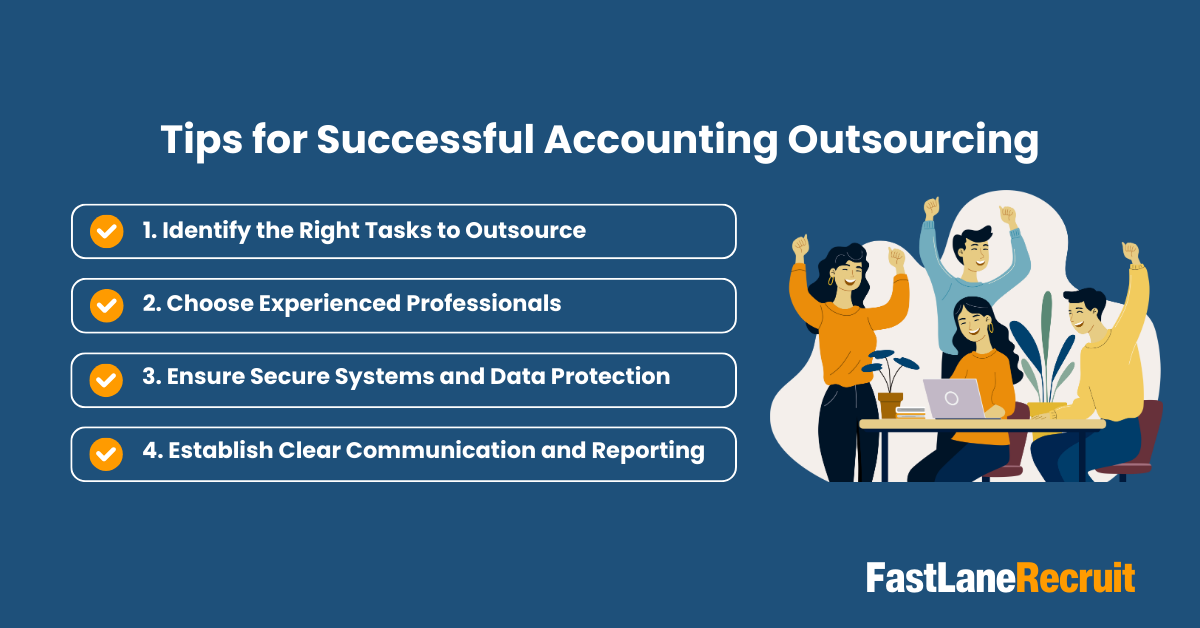
Outsourcing accounting can bring significant benefits to an organization, but the success of the arrangement depends on choosing the right approach and partners. When businesses plan carefully and establish clear processes, outsourcing can improve financial efficiency while maintaining full visibility over financial operations.
If your organization is considering outsourcing accounting, the following tips can help ensure a smooth and successful transition.
1. Identify the Right Tasks to Outsource
The first step is to determine which accounting tasks would benefit most from external support. Many businesses begin by outsourcing routine and time-consuming tasks that take up valuable internal resources.
Common accounting tasks suitable for outsourcing include:
| Accounting Task | Why Businesses Outsource It |
| Bookkeeping | Daily transaction recording can be repetitive and time-consuming. Outsourcing ensures records remain accurate and updated. |
| Payroll Processing | Payroll requires careful calculation of salaries, taxes, and deductions. Outsourcing reduces errors and ensures compliance. |
| Accounts Payable | Managing vendor invoices and payments can take significant time. Outsourced teams help streamline payment cycles. |
| Accounts Receivable | External accountants can manage invoicing and payment tracking to maintain healthy cash flow. |
| Financial Reporting | Businesses receive structured financial reports that support better decision-making. |
For example, a small business owner might spend several hours each week updating financial records. By outsourcing bookkeeping, those hours can instead be spent on customer relationships, marketing, or product development.
Also Read: Building a High-Performing Offshore Accounting Team in Malaysia (Hong Kong Edition)
2. Choose Experienced Professionals
Selecting the right outsourcing partner is one of the most important decisions in the process. Experienced accounting professionals bring both technical expertise and industry knowledge that can strengthen financial operations.
When evaluating providers, consider the following factors:
- experience with businesses in your industry
- knowledge of international accounting standards
- familiarity with modern accounting tools and automation
- strong client testimonials or references
Many professional accountants follow best practices recommended by organizations such as the International Federation of Accountants, which helps ensure high-quality financial management.
Working with experienced professionals can help businesses maintain accurate financial records, comply with regulations, and gain valuable financial insights.
3. Ensure Secure Systems and Data Protection
Financial data is highly sensitive, so security should always be a top priority when outsourcing accounting. Reputable accounting providers invest in secure technology and follow strict data protection protocols.
Before partnering with an outsourcing provider, confirm that they use:
- encrypted cloud accounting systems
- secure data storage and backups
- restricted access to financial records
- multi-factor authentication for user access
Many outsourced accounting teams use secure platforms such as QuickBooks or Xero to manage financial data safely.
Security guidelines from organizations like the National Institute of Standards and Technology emphasize the importance of protecting financial data through strong cybersecurity practices.
By choosing providers that prioritize security, businesses can confidently share financial information while maintaining full control over their data.
4. Establish Clear Communication and Reporting
Effective communication plays a crucial role in any outsourcing relationship. Setting clear expectations from the beginning helps both parties stay aligned and ensures financial tasks are completed accurately and on time.
Best practices include:
- scheduling regular check-ins with the accounting team
- establishing reporting timelines (monthly or quarterly)
- defining responsibilities for both internal teams and external accountants
- using shared dashboards or accounting software for transparency
For example, a company might schedule monthly financial review meetings with its outsourced accounting team. During these meetings, they review financial reports, discuss cash flow, and identify areas for improvement.
Clear communication ensures that outsourced accountants function as an extension of the organization’s finance team rather than a separate external service.
Building a Strong Outsourcing Partnership
When businesses identify the right tasks, choose experienced professionals, prioritize security, and maintain open communication, outsourcing accounting becomes a powerful tool for improving financial management.
A well-structured outsourcing partnership not only helps keep financial records accurate but also allows internal teams to focus on strategy, innovation, and long-term business growth.
Also Read: Building a High-Performing Offshore Accounting Team in Malaysia (Australia Edition)
Why Many Companies Outsource Accounting to Malaysia
In recent years, Malaysia has emerged as a strong destination for global outsourcing, especially for finance and accounting services. Many international companies choose Malaysia when expanding their finance teams because the country offers a combination of skilled professionals, modern infrastructure, and a supportive business environment.
Malaysia’s growing reputation in outsourcing is supported by government initiatives, strong universities, and a workforce trained in international accounting standards. Organizations that outsource accounting to Malaysia often benefit from reliable expertise while maintaining efficient financial operations.
Below are some of the main reasons companies consider Malaysia for accounting outsourcing.
| Advantage | Explanation |
| Skilled talent pool | Malaysia produces a large number of accounting and finance graduates every year. Many professionals are trained in internationally recognized standards such as IFRS and have experience working with multinational companies. |
| Global communication | English is widely used in Malaysia’s business environment, making communication smooth for international companies. This helps ensure clear financial reporting and collaboration with global teams. |
| Digital infrastructure | Malaysia has invested heavily in digital transformation and cloud technologies. This enables accounting teams to work efficiently using modern platforms such as QuickBooks and Xero for real-time financial management. |
| Business ecosystem | The country has a well-established outsourcing ecosystem with experienced service providers, modern office infrastructure, and strong professional networks. |
Strong Government Support for Digital Talent
Malaysia’s growth as an outsourcing hub is also supported by national initiatives focused on digital development and workforce training. Organizations such as the Malaysian Digital Economy Corporation actively promote the country as a regional center for technology and professional services.
These initiatives focus on:
- developing high-quality digital and finance talent
- supporting technology adoption among businesses
- strengthening Malaysia’s position in global outsourcing services
Because of these efforts, companies around the world increasingly look to Malaysia when building remote accounting teams.
Example: A Growing Company Expanding Its Finance Operations
Consider a technology startup based in Europe that is expanding into new markets. As the company grows, it needs reliable support for bookkeeping, financial reporting, and payroll management.
Instead of building a large in-house accounting department immediately, the company hires accounting professionals based in Malaysia. Using cloud accounting systems, the remote team manages daily financial operations, prepares reports, and ensures compliance with financial standards.
This approach allows the company to build a capable finance function while staying flexible as the business scales.
Also Read: Types Of Accounting Services That Can Be Outsourced
A Strategic Option for Global Businesses
For many organizations, outsourcing accounting to Malaysia provides a practical way to access qualified professionals while maintaining efficient and scalable operations. With its strong talent pipeline, digital readiness, and supportive business environment, Malaysia continues to attract companies looking for reliable global accounting support.
Hire Malaysian Accountants Through an Employer of Record (EOR)
For organizations that want a dedicated accounting team instead of a traditional outsourcing arrangement, hiring international talent can be another effective solution.
This is where FastLaneRecruit’s Employer of Record (EOR) service can help.
Through an EOR, businesses can hire skilled professionals in Malaysia without setting up a local entity. The EOR partner manages employment responsibilities such as payroll, compliance, and local regulations.
Benefits include:
- legally hire Malaysian accounting professionals
- simplify global payroll and compliance
- build a dedicated remote finance team
- scale accounting support as your business grows
FastLaneRecruit helps companies connect with qualified Malaysian accounting talent while handling administrative and compliance requirements.
Also Read: How to Hire an Offshore Accountant in Malaysia
Conclusion
Outsourcing accounting has become a strategic solution for businesses looking to improve financial efficiency while focusing on growth.
By outsourcing accounting functions, organizations can:
- optimize operational costs
- access experienced financial professionals
- improve financial accuracy and compliance
- scale accounting support easily
- strengthen data security
- focus on strategic business priorities
As businesses continue to expand globally, outsourcing and international hiring solutions provide the flexibility needed to build strong finance operations.
For companies exploring accounting outsourcing options, partnering with experienced professionals or building a global finance team through an EOR can help create a more efficient and scalable financial management system.
Build Your Accounting Team in Malaysia Without Setting Up a Local Entity
Through FastLaneRecruit’s EOR service, businesses can:
- Hire qualified accounting professionals in Malaysia quickly
- Manage global payroll and employment compliance smoothly
- Avoid the time and cost of setting up a local legal entity
- Scale your finance team as your business grows
- Focus on strategy while administrative tasks are handled for you
Malaysia has a strong pool of finance and accounting professionals who are experienced in working with international companies and modern cloud-based accounting systems.
If your organization is exploring ways to expand your finance capabilities while maintaining flexibility, building a remote accounting team in Malaysia could be the next step.
Explore how FastLaneRecruit’s EOR service can help you hire and manage Malaysian accounting talent with confidence. Contact us for a FREE call!