As businesses expand across borders, managing daily operations becomes more complex. Tasks like coordinating teams, tracking workflows, handling vendors, and keeping everything aligned across time zones can quickly overwhelm internal teams. This is where operations coordination plays a critical role.
Many global companies are now choosing to outsource operations coordination to stay organised, responsive, and scalable. Rather than stretching internal resources, outsourcing allows businesses to bring in experienced coordinators who keep operations running smoothly while leadership focuses on growth.
In this guide, we will explore the strategic benefits of outsourcing operations coordination, practical examples (including Malaysia), key risks to consider, and when an Employer of Record (EOR) solution from FastLaneRecruit may be a stronger long-term alternative.
Content Outline
Key Summary
Improve Operational Efficiency
Outsourced coordinators reduce delays, prevent bottlenecks, and keep teams aligned, helping businesses run more smoothly and respond faster.
Optimize Costs and Resources
Flexible outsourcing models reduce fixed overhead, allow scalable support, and free internal teams to focus on core business goals.
Access Skilled, Experienced Talent
Operations coordinators bring expertise in workflows, cross-team collaboration, multilingual communication, and global best practices.
Enhance Flexibility and Scalability
Outsourcing adapts to changing business needs, peak periods, or new markets without the burden of hiring and training in-house staff.
Strengthen Risk Management and Compliance
Experienced providers maintain documentation, quality controls, and regulatory compliance to reduce operational and legal risks.
Leverage Malaysia’s Strategic Advantages
Malaysia offers a multilingual workforce, cultural alignment, cost-effective expertise, and government-supported business frameworks.
Choose Between Outsourcing and EOR for Long-Term Needs
For deeper integration and long-term control, an EOR provides dedicated coordinators, direct oversight, and local compliance without setting up a legal entity.
What Is Operations Coordination Outsourcing?
Operations coordination outsourcing is the practice of hiring an external team or service provider to handle the day-to-day tasks that keep your business running smoothly. Instead of managing all these responsibilities in-house, you delegate them to specialists who focus entirely on making sure operations stay on track.
Some of the key tasks an outsourced operations coordinator can handle include:
- Managing workflows and timelines: Ensuring that projects, tasks, and processes stay on schedule. For example, an outsourced coordinator can track deadlines for multiple teams, remind staff of upcoming tasks, and prevent bottlenecks that slow progress.
- Coordinating internal teams and external partners: Acting as the link between your departments and external stakeholders, such as suppliers, clients, or regional offices. This helps everyone stay aligned and ensures projects move forward without miscommunication.
- Monitoring performance and reporting: Keeping an eye on how tasks are progressing, identifying issues early, and providing clear updates to leadership. This allows managers to make informed decisions without having to micromanage every step.
- Supporting compliance and documentation: Maintaining records, following regulations, and making sure procedures meet legal and industry standards. For instance, an outsourced coordinator can handle local reporting requirements in Malaysia while ensuring your operations stay compliant internationally.
- Ensuring smooth communication across departments: Acting as a central point of contact, they make sure messages, requests, and updates flow efficiently between teams. This reduces confusion and avoids delays caused by missed information.
Unlike general outsourcing, which may focus on a specific function like IT, accounting, or customer service, operations coordination outsourcing is about keeping people, processes, and projects aligned. It ensures that your business operates efficiently and consistently, even as your company grows, expands into new markets, or manages complex global teams.
In short, outsourcing operations coordination allows your internal team to focus on strategic goals and growth, while trusted experts keep the daily operations running smoothly behind the scenes.
Also Read: Why Businesses Outsource Corporate Services Functions
Strategic Benefits of Outsourcing Operations Coordination
1. Improved Operational Efficiency
Outsourced operations coordinators are trained to manage processes efficiently. They reduce delays, improve task visibility, and keep teams aligned.
With clear ownership of coordination tasks, businesses experience:
- Faster decision-making
- Fewer missed deadlines
- Better workflow consistency
Many providers also use structured tools and reporting systems, helping leadership stay informed without being involved in every detail.
2. Better Cost Control and Resource Allocation
Outsourcing operations coordination helps businesses manage expenses more effectively by shifting from fixed internal overheads to flexible service-based models.
Instead of hiring, training, and maintaining large internal coordination teams, companies can:
- Pay only for the level of support they need
- Scale coordination resources as operations grow
- Reallocate internal budgets toward core business goals
This approach supports sustainable growth while maintaining operational stability.
3. Access to Experienced Operations Talent
Operations coordination requires strong communication, organisation, and problem-solving skills. Outsourcing opens access to experienced professionals who already understand structured workflows and cross-team collaboration.
By working with external coordinators, businesses gain:
- Proven operational experience
- Exposure to global best practices
- Multilingual and cross-cultural communication skills
This is especially valuable for companies managing regional or international teams.
4. Flexibility and Scalability for Growing Businesses
As business needs change, operations coordination requirements also shift. Outsourcing offers flexibility that internal teams may struggle to match.
Businesses can:
- Scale coordination support during peak periods
- Adjust scope as projects evolve
- Enter new markets without restructuring internal teams
This scalability makes outsourcing particularly attractive for startups, expanding companies, and project-based organisations.
5. Stronger Risk Management and Compliance Support
Operations coordinators play an important role in documentation, reporting, and process consistency. Outsourcing helps businesses strengthen these areas with structured oversight.
Experienced providers often follow established compliance frameworks and quality controls, reducing operational risk. For companies operating across borders, this added layer of structure supports alignment with local regulations and internal policies.
Authoritative references such as the World Bank and OECD regularly highlight the importance of operational governance in cross-border business activities:
- World Bank – Doing Business Insights
- OECD – Responsible Business Conduct
Also Read: Why Malaysia Is a Corporate Services Hub for Regional Operations
In-House vs Outsourced Operations Coordination
When deciding whether to manage operations coordination internally or outsource it to a specialized provider, it’s helpful to compare the two approaches. The table below shows key differences, and the explanations illustrate why outsourcing can be a strategic advantage for growing businesses.
| Aspect | In-House Coordination | Outsourced Coordination |
| Hiring & Training | Building an internal team requires time and resources. You need to recruit employees, train them, and wait until they gain enough experience to handle coordination tasks effectively. | Outsourced teams are ready to deploy immediately. Experienced coordinators are already trained and familiar with best practices, so your business can start benefiting from their support right away. |
| Scalability | Internal teams can be hard to scale quickly. Hiring more staff for busy periods or new projects takes time and can strain resources. | Outsourced coordination is highly flexible. Providers can quickly scale your team up or down based on workload, seasonal demand, or project requirements, without long-term commitments. |
| Cost Structure | Maintaining an in-house team comes with fixed costs, such as salaries, benefits, training, office space, and equipment. Even during slow periods, these costs remain. | Outsourcing allows for a variable, usage-based cost model. You pay for the level of support you need, which makes it easier to control costs and allocate budgets efficiently. |
| Process Expertise | In-house coordinators may have varying levels of experience, and efficiency depends on the skills of your team. Developing process expertise internally can take months or years. | Outsourced teams are process-focused specialists. They bring proven methods, advanced tools, and industry best practices, ensuring operations run smoothly from day one. |
| Global Coverage | Internal teams are often limited to one location and time zone. Coordinating across borders can be challenging, especially for companies with international operations. | Outsourced providers are cross-border ready. They can manage teams across different countries, time zones, and languages, ensuring seamless global coordination and communication. |
Example:
Imagine a company expanding into Southeast Asia. An in-house coordination team in the home country may struggle to manage local vendors, regional offices, and time zone differences. By outsourcing operations coordination to a provider in Malaysia, the company can have experienced coordinators on the ground, ready to handle daily operations while aligning with headquarters, without hiring and training new staff locally.
Key Risks to Consider (and How to Manage Them)
Outsourcing operations coordination can bring huge benefits, but it’s important to remember that it’s a strategic decision, not a shortcut. Like any business strategy, it comes with potential risks. Understanding these risks and knowing how to manage them ensures your outsourcing arrangement is successful.
1. Loss of Visibility
When tasks are handled by an external team, you might worry about not having a clear view of ongoing operations. Without proper oversight, deadlines can slip, and issues may go unnoticed.
How to manage:
- Establish regular reporting routines. For example, weekly updates on key tasks and progress.
- Define KPIs (Key Performance Indicators) that the outsourced team must track, such as task completion rates or response times.
- Use shared dashboards or project management tools so you can monitor activities in real-time.
Example: A company outsourcing coordination to a Malaysian team can have daily progress reports uploaded to an online dashboard, ensuring leadership always sees what’s happening.
Also Read: How to Build an Offshore Corporate Services Team in Malaysia
2. Communication Gaps
Working across time zones, departments, or even countries can create misunderstandings. Miscommunication can lead to mistakes, delays, or frustration for both teams and clients.
How to manage:
- Set up clear escalation processes so that any issues are reported immediately.
- Define communication channels, such as Slack, email, or video calls, for specific types of updates.
- Schedule regular meetings to align expectations and clarify priorities.
Example: A global company outsourcing supplier coordination can set a 15-minute daily check-in to ensure the in-house and outsourced teams are aligned on priorities, deadlines, and any supply chain issues.
3. Data Handling and Security Concerns
Outsourcing involves sharing information with an external team. This can include sensitive business data, client details, or financial records. Without proper safeguards, this data could be at risk.
How to manage:
- Implement strict access controls, so coordinators can only see information relevant to their tasks.
- Use secure file-sharing systems and encryption to protect sensitive data.
- Include data handling and confidentiality clauses in contracts.
Example: A company working with an outsourced operations team in Malaysia can require all project files to be stored on a secure cloud server with restricted access, reducing the risk of data breaches.
Practical Tips to Minimise Risks
- Choose providers with proven experience: Look for coordinators who have a track record managing operations in your industry or region.
- Set clear roles and responsibilities: Make sure everyone knows exactly what tasks they are responsible for.
- Define reporting cycles and expectations: Establish how and when progress will be communicated.
- Maintain regular performance reviews: Periodically assess the outsourced team’s performance against KPIs.
- Treat outsourcing as a partnership, not a handoff: Collaborate closely with the provider, share goals, and encourage open communication rather than simply delegating tasks and stepping back.
Key Takeaway:
Outsourcing operations coordination works best when you actively manage the relationship, provide transparency, and set clear expectations. With proper planning and oversight, the risks can be minimized, allowing your business to enjoy the efficiency, flexibility, and expertise that outsourcing offers.
Why Outsource Malaysian Operations Coordinators?
Malaysia has emerged as a strategic hub for operations coordination outsourcing, and for good reason. Companies around the world are increasingly turning to Malaysian professionals to support their global operations. Here’s why:
1. Skilled and Multilingual Workforce
Malaysian operations coordinators are highly educated and often fluent in English, Mandarin, and Malay. This multilingual capability allows them to effectively communicate with teams, clients, and suppliers across Asia and beyond, ensuring smooth coordination for global businesses.
2. Strong Work Ethic and Professionalism
Malaysia’s workforce is known for reliability, discipline, and adaptability. Operations coordinators from Malaysia are trained to handle complex tasks, meet deadlines, and proactively solve operational challenges.
3. Cost-Effective Expertise
While maintaining high standards of professionalism and expertise, hiring Malaysian coordinators can help companies reduce operational costs compared to managing fully in-house teams in higher-cost countries. Businesses can achieve operational efficiency without compromising quality.
Also Read: Labour Law, Payroll & Compliance in Malaysia for Corporate Services Officer
4. Cultural and Regional Advantage
Malaysia’s diverse, multicultural environment gives coordinators a unique perspective in bridging communication gaps between teams in different regions. This is particularly valuable for businesses operating across Asia-Pacific markets.
5. Supportive Business Environment
The Malaysian government actively encourages foreign investment and outsourcing through policies and initiatives facilitated by authorities like:
- Malaysia Investment Development Authority (MIDA) – https://www.mida.gov.my/
- Ministry of Human Resources Malaysia – https://www.mohr.gov.my/
These measures ensure companies can operate smoothly and remain compliant with local employment regulations.
6. Scalability and Flexibility
Malaysian coordinators offer flexibility for scaling teams according to business needs. Whether it’s seasonal projects, new market launches, or long-term operations, Malaysian professionals can adapt quickly, making them an ideal choice for growing global businesses.
How to Outsource Malaysian Operations Coordinators
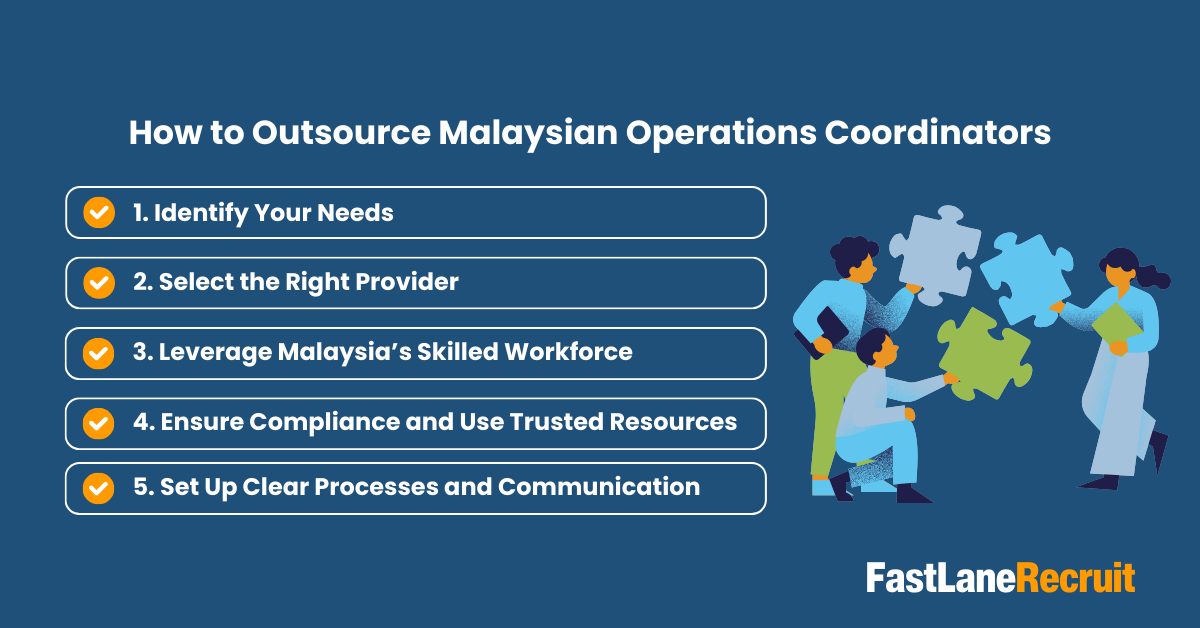
Outsourcing operations coordinators to Malaysia can help your business run more smoothly, improve efficiency, and tap into skilled professionals without the complexities of building a local team from scratch. Here’s how to approach it effectively:
1. Identify Your Needs
Start by defining what tasks you want outsourced coordinators to handle. Common responsibilities include:
- Managing workflows and project timelines
- Coordinating internal teams and external partners
- Monitoring performance and reporting
- Supporting compliance and documentation
Understanding the scope of work helps you choose the right providers and ensures a clear alignment of expectations.
2. Select the Right Provider
Look for outsourcing partners or service providers in Malaysia who have proven experience in operations coordination. Key criteria include:
- Track record with global teams or similar industries
- Access to advanced tools for task tracking, reporting, and communication
- Flexibility to scale your team up or down based on business needs
Tip: Consider providers that offer ready-to-deploy coordinators, so you can start quickly without spending months on hiring and training.
3. Leverage Malaysia’s Skilled Workforce
Malaysian coordinators bring several advantages:
- Strong English proficiency for clear communication with global teams
- Experience with international business standards and working across regions
- Cultural awareness to bridge gaps between Asia-Pacific and Western markets
This combination ensures your outsourced team can integrate seamlessly with your in-house operations.
4. Ensure Compliance and Use Trusted Resources
Malaysia’s business-friendly environment supports smooth operations. Coordinators can work effectively while adhering to local regulations, supported by official resources such as the Malaysia Investment Development Authority (MIDA) and the Ministry of Human Resources Malaysia.
These agencies provide guidance on employment practices, compliance, and investment incentives, helping your business stay compliant and avoid unnecessary risks.
5. Set Up Clear Processes and Communication
To get the most out of outsourced Malaysian coordinators:
- Establish roles, responsibilities, and reporting cycles
- Use collaboration tools like Slack, Microsoft Teams, or project management platforms
- Schedule regular check-ins to monitor progress and address issues quickly
Treat your outsourced team as an extension of your company, not just a service provider. A collaborative approach ensures alignment with your goals and smooth daily operations.
Example:
A tech company expanding into Southeast Asia outsourced its operations coordination to a Malaysian provider. The coordinators managed vendor communication, tracked project milestones, and prepared weekly performance reports. This allowed the in-house team to focus on strategy and product development while maintaining efficient and compliant operations across the region.
Also Read: Corporate Services Officer Salary Guide 2026
When an EOR Model Is a Better Alternative
While outsourcing operations coordination works well for many short- to mid-term projects, there are situations where businesses need long-term control, deeper integration, and certainty around compliance. In these cases, an Employer of Record (EOR) model can be a more effective solution.
1. Full Dedication to Your Business
With an EOR, the operations coordinator is hired to work exclusively for your company, rather than being part of a shared outsourcing pool. This ensures your team has consistent support, builds institutional knowledge, and becomes fully aligned with your business processes and culture.
Example: A company expanding into Malaysia might use an EOR to hire a dedicated operations coordinator who understands the company’s internal workflows and can manage local vendors while adhering to the company’s global standards.
2. Direct Control and Performance Oversight
Unlike traditional outsourcing, where tasks are managed by the service provider, an EOR allows you to directly assign tasks, set priorities, and monitor performance. You maintain clear oversight of the coordinator’s work while benefiting from local employment management handled by the EOR.
Example: Your Malaysian operations coordinator can report directly to your regional manager, ensuring seamless alignment between in-house teams and local operations, without the communication delays that sometimes happen with a third-party outsourcing provider.
3. Local Compliance and Payroll Management
An EOR takes care of employment, payroll, and legal compliance in the host country. This is particularly useful in markets like Malaysia, where labor laws, tax regulations, and social security contributions can be complex.
How it helps your business:
- You avoid the risk of non-compliance or fines.
- Local HR, payroll, and benefits are professionally managed.
- You gain the flexibility of hiring employees in new markets without setting up a local legal entity.
Example: A global company using an EOR in Malaysia can hire coordinators immediately, while the EOR handles payroll, statutory benefits, and compliance reporting, letting the company focus on operations rather than administrative complexities.
Also Read: Recruiting Coordinator Salary Guide 2026
When to Choose an EOR Over Outsourcing
Consider using an EOR if your business:
- Needs long-term support in a foreign market
- Requires the coordinator to be fully integrated with your team
- Wants direct oversight of day-to-day operations
- Seeks local compliance and payroll management without establishing a local company
In short, the EOR model combines the flexibility of outsourcing with the control and integration of an in-house employee, making it an ideal solution for businesses looking to expand sustainably in Malaysia or other international markets.
FastLaneRecruit’s EOR Solution for Operations Coordinators
FastLaneRecruit offers a compliant EOR (Employer of Record) Service that allows companies to hire operations coordinators in Malaysia without setting up a local entity.
This approach provides:
- Dedicated operations coordinators
- Full compliance with local labour laws
- Transparent employment and payroll management
- Long-term team stability
For companies that want the benefits of local talent without the risks of traditional outsourcing, FastLaneRecruit’s EOR service offers a balanced, scalable alternative.
Conclusion
Outsourcing operations coordination can deliver significant strategic value when done thoughtfully. It improves efficiency, supports growth, and allows businesses to focus on what matters most.
However, outsourcing is not one-size-fits-all. For businesses seeking deeper integration and long-term control, an EOR model may provide a stronger foundation.
Whether you choose outsourcing or an EOR approach, the key is selecting a solution that aligns with your operational goals and growth plans.
Ready to Build a Stronger Operations Team?
If you’re considering outsourcing operations coordination in Malaysia or exploring a more structured alternative, FastLaneRecruit’s EOR service can help you move forward with confidence.
Speak with FastLaneRecruit today to hire operations coordinators in Malaysia for your global operations.