A Practical Guide for Global Businesses
As businesses grow across borders, one challenge remains constant: managing large volumes of accurate, reliable data. From customer records and transaction logs to CRM updates and reporting, data entry plays a critical role in day-to-day operations.
For many global companies, building a dedicated offshore data entry team in Malaysia has become a practical and sustainable way to support growth, maintain data quality, and improve operational efficiency without adding complexity to local hiring.
This guide walks you through how to build and manage a Malaysia-based data entry team, what to expect at each stage, and how an Employer of Record (EOR) model can simplify the entire process.
Content Outline
Key Summary
Data Accuracy is Critical
Offshore data entry teams ensure consistent, accurate information across CRM, ERP, and other systems, reducing errors and supporting better business decisions.
Malaysia Offers Skilled Talent
With strong English proficiency, a structured education system, and a detail-oriented workforce, Malaysia provides a reliable base for global data operations.
Secure and Compliant Operations
Dedicated teams follow data security protocols and internal policies, ensuring sensitive information is handled responsibly and legally.
Step-by-Step Team Building
Successful offshore teams require clear role definitions, hiring models (like EOR), structured recruitment, onboarding, and ongoing performance management.
Integration with Internal Workflows
Malaysia-based teams work as an extension of in-house staff, supporting daily operations, system updates, and reporting to free up higher-value activities.
Best Practices Ensure Long-Term Success
Document workflows, use shared dashboards, schedule overlapping hours, include offshore staff in the company culture, and partner with local employment experts.
EOR Model Simplifies Global Hiring
Using an Employer of Record allows businesses to legally employ Malaysian talent, manage payroll and compliance, and maintain operational control without setting up a local entity.
Why Data Entry Teams Matter for Scalable Operations
Every growing business relies on accurate data to operate smoothly. Customer records, invoices, product information, reports, and system updates all depend on data being entered correctly and on time. This is where dedicated data entry teams play an important role.
Data entry professionals help ensure that business information is:
- Accurate and consistently maintained – They carefully input and check data to reduce errors and keep records reliable over time.
- Updated across multiple systems – Many businesses use more than one platform, such as CRMs, accounting software, or internal databases. Data entry teams help keep information aligned across all systems.
- Secure and compliant with internal policies – Trained teams follow established procedures to protect sensitive information and meet company data standards.
When data is managed well, teams can make confident decisions, complete tasks faster, and deliver better service to customers. Reports are more reliable, processes run smoothly, and small issues are identified before they become bigger problems.
On the other hand, when data is inconsistent or inaccurate, errors can quickly spread across systems. This can lead to delays, rework, and confusion that slows down daily operations.
For this reason, many organizations choose to support their growth by building specialized data entry teams. These teams work as an extension of internal staff, follow the same workflows, and help businesses scale their operations while maintaining data quality and operational consistency.
Also Read: Recruiting Coordinator Salary Guide 2026
Why Malaysia Is a Strong Location for Offshore Data Entry Teams
Malaysia has steadily built a strong reputation as a reliable location for global business operations. Many international companies choose Malaysia to support administrative, shared services, and back-office functions because the country offers a balanced combination of skilled talent, digital readiness, and a supportive business environment.
For data entry teams in particular, Malaysia provides the right foundation for accuracy-driven, process-oriented work that integrates well with global operations.
Key Reasons Companies Choose Malaysia
| Factor | Why It Matters |
| English proficiency | Malaysian professionals are comfortable working in English, which supports clear communication with global teams, accurate documentation, and smooth collaboration across borders. |
| Strong education system | Malaysia’s education system produces graduates who are structured, detail-oriented, and familiar with standardized processes, qualities that are essential for data-focused roles. |
| Mature digital infrastructure | Reliable internet connectivity and widespread use of cloud-based tools allow data entry teams to work securely and efficiently in modern digital environments. |
| Business-friendly policies | Malaysia actively supports foreign investment and global employment, making it easier for international companies to build and manage overseas teams. |
| Time-zone flexibility | Malaysia’s time zone aligns well with Asia-Pacific markets and allows partial overlap with European and U.S. working hours, enabling timely communication and faster turnaround times. |
Beyond these practical advantages, Malaysia has also invested heavily in developing its digital economy and workforce capabilities.
According to the Malaysia Digital Economy Corporation (MDEC), the country continues to attract multinational shared service centers due to its skilled talent pool, digital infrastructure, and readiness to support global business needs.
(Source: mdec.my)
Data from the Department of Statistics Malaysia (DOSM) further shows consistent growth in business services and administrative roles, highlighting a stable and sustainable pipeline of professionals suited for long-term operational support.
(Source: dosm.gov.my)
Together, these factors make Malaysia a dependable and forward-looking choice for organizations looking to build offshore data entry teams that can scale alongside their business.
What a Malaysia-Based Data Entry Team Can Support
A dedicated data entry team based in Malaysia can support many of the routine but essential tasks that keep business operations running smoothly. These tasks often require a high level of accuracy, consistency, and attention to detail, especially when handled at scale.
Common areas a Malaysia-based data entry team can support include:
- Data input, validation, and cleansing
Teams accurately enter information from multiple sources, review data for errors or duplicates, and ensure records remain clean and reliable over time. - CRM and ERP system updates
They keep customer, supplier, and operational data up to date across systems, helping teams work with current and consistent information. - Invoice and transaction processing
Data entry professionals record financial transactions, update billing details, and support reconciliation processes by ensuring data is entered correctly and on schedule. - Document digitisation and record management
Physical or unstructured documents are converted into digital formats, indexed properly, and stored in an organized way that supports easy retrieval and audits. - Product, inventory, or catalog data maintenance
Teams manage product descriptions, pricing details, stock information, and catalog updates to ensure accuracy across sales and inventory platforms.
By taking ownership of these execution-focused tasks, Malaysia-based data entry teams help reduce manual workload for internal staff. This allows in-house teams to spend more time on higher-value initiatives such as data analysis, process improvement, strategic planning, and customer engagement while maintaining consistent data quality across the organization.
How to Build an Offshore Data Entry Team in Malaysia (Step by Step)
Building a high-performing offshore data entry team in Malaysia requires careful planning, clear processes, and ongoing support. Here’s a practical step-by-step guide to help your business succeed:
Step 1: Define the Role Clearly
Before hiring, it’s essential to know exactly what you need. Start by outlining:
- Daily responsibilities – Specify tasks like entering customer data, updating product records, processing invoices, or maintaining CRM systems.
- Tools and systems used – Identify which software, platforms, or internal systems the team will use (e.g., Salesforce, SAP, Excel, or custom applications).
- Accuracy and turnaround expectations – Define the quality standards, error thresholds, and turnaround times for each task.
- Reporting structure – Clarify who the team reports to, how work progress is monitored, and how feedback will be shared.
Clear role definition ensures that both your offshore team and in-house staff are aligned from day one. It reduces confusion, improves efficiency, and helps measure performance effectively.
Also Read: Employment Laws and Compliance for Hiring Recruitment Teams in Malaysia
Step 2: Choose the Right Hiring Model
Once the role is defined, you need to decide how to employ your offshore team. Most companies consider three approaches:
| Model | Key Considerations |
| Setting up a local entity | Gives full control but requires registering a legal entity, understanding Malaysian labor laws, handling payroll, and managing HR infrastructure. |
| Working with third-party vendors | Often faster to start, but you may have limited influence over team selection, processes, and long-term continuity. |
| Employer of Record (EOR) | Allows you to directly hire talent in Malaysia while a local partner handles payroll, compliance, contracts, taxes, and statutory requirements. You retain operational control without the legal and administrative burden of a local entity. |
For most global businesses, the EOR model strikes the best balance between compliance, flexibility, and team oversight.
Step 3: Source and Screen Talent
Finding the right people is critical. A Malaysia-based data entry team should have:
- Strong attention to detail – Data accuracy is non-negotiable.
- Experience with relevant platforms – Familiarity with your CRM, ERP, or data tools ensures faster onboarding.
- Structured process knowledge – Professionals should understand standard operating procedures and workflow requirements.
- Clear written communication skills – Good communication ensures smooth collaboration with global teams.
A structured screening process helps maintain quality and trust. This may include:
- Skills assessments or test projects
- Background verification
- Reference checks
Thorough vetting ensures you hire reliable, capable professionals who can handle sensitive data responsibly.
Step 4: Onboard Securely and Thoughtfully
Proper onboarding ensures your offshore team operates like an integrated part of your business. Key steps include:
- System access controls – Ensure team members have secure, role-based access to software and sensitive data.
- Data security training – Provide clear guidance on privacy, compliance, and safe handling of confidential information.
- Documentation and SOPs – Share standard operating procedures, guidelines, and workflow documentation.
- Performance metrics – Define KPIs to measure accuracy, efficiency, and productivity.
Effective onboarding reduces mistakes, accelerates productivity, and builds a strong foundation for long-term collaboration.
Step 5: Provide Ongoing Support and Feedback
A high-performing offshore team requires continuous guidance and engagement:
- Regular check-ins – Weekly or bi-weekly meetings help track progress and address issues quickly.
- Transparent KPIs – Clear metrics let the team know what success looks like and where improvements are needed.
- Process improvements over time – Encourage team members to suggest ways to streamline workflows.
- Growth opportunities – Offer training and skill development to retain talent and increase engagement.
Consistent support and feedback not only maintain quality but also foster loyalty, reliability, and long-term stability for your offshore operation.
Also Read: How to Hire Recruiting Coordinators in Malaysia
Step 6 (Optional): Scale and Optimize
Once your team is running smoothly, you can expand operations by:
- Adding specialized roles (e.g., data analysts or reporting specialists)
- Automating repetitive tasks with software tools
- Integrating with additional internal departments
Scaling thoughtfully ensures your offshore team grows with your business without sacrificing quality or compliance.
Example: Supporting a Global Business with a Malaysia-Based Data Entry Team
Scenario
A fast-growing e-commerce company faced challenges managing its increasing volume of product listings, order records, and supplier data across multiple systems. The internal team was stretched thin, and errors in product details and order information were slowing down operations and affecting customer experience. The company needed a reliable solution to maintain data accuracy, improve efficiency, and support growth.
Solution
The company decided to build a dedicated data entry team in Malaysia. Here’s how the team was structured to deliver results:
- Adhered to internal SOPs – The offshore team followed the company’s standard operating procedures to ensure consistency and alignment with the in-house team.
- Used secure cloud-based tools – All data was handled through secure cloud platforms, allowing seamless collaboration and real-time updates without compromising confidentiality.
- Provided daily data accuracy reports – Regular reporting allowed the management team to track performance, spot potential errors early, and maintain high-quality standards.
- Integrated with internal workflows – The Malaysia-based team became a true extension of the business, coordinating with customer service, marketing, and operations departments to support overall efficiency.
Outcome
By leveraging a Malaysia-based data entry team, the company achieved:
- Faster data updates – Product information, inventory levels, and supplier details were consistently updated across all systems, enabling quicker responses to customer orders.
- Fewer operational errors – Attention to detail and structured workflows reduced mistakes, ensuring smoother day-to-day operations.
- Improved internal productivity – In-house staff could focus on higher-value tasks such as strategic planning, marketing initiatives, and customer engagement rather than manual data management.
- Scalable operations – As the business continued to grow, the offshore team expanded accordingly, providing flexibility without the costs and overhead of local hiring.
This example demonstrates how Malaysia-based data entry teams can act as a reliable, high-quality extension of a global business, helping companies maintain operational excellence while supporting growth.
Also Read: Malaysia’s Advantage for Building Offshore Recruitment Teams
Best Practices for Long-Term Success with a Malaysia-Based Data Entry Team
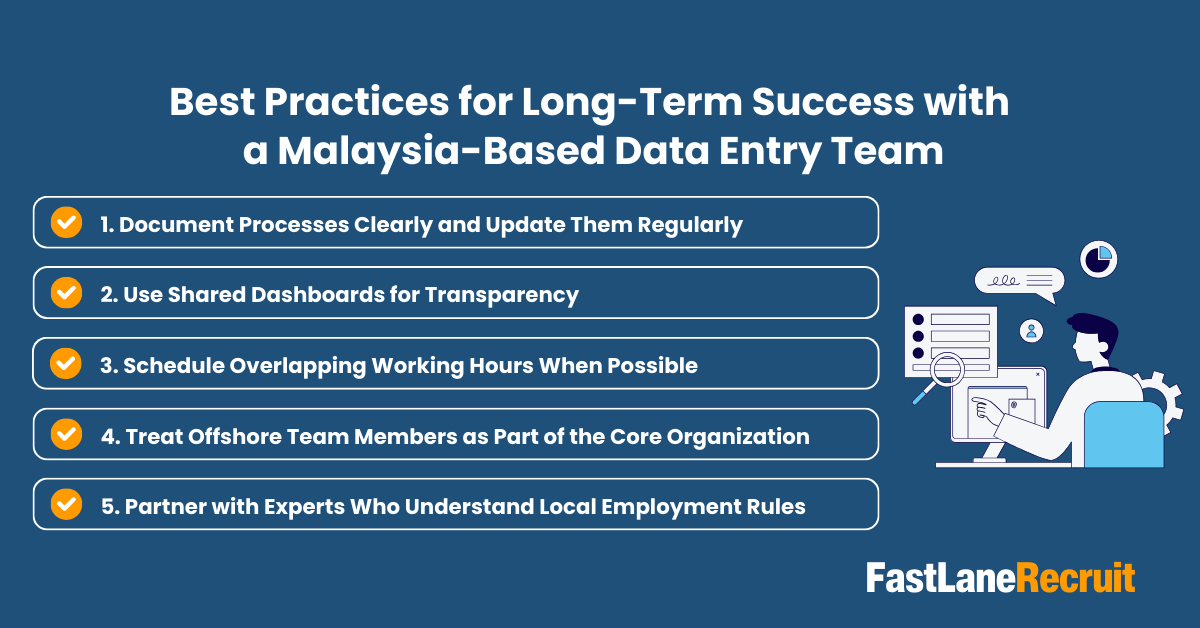
Building an offshore data entry team is just the start. Long-term success depends on creating structured processes, fostering collaboration, and maintaining strong relationships. Here are best practices to ensure your offshore team delivers consistent results over time:
1. Document Processes Clearly and Update Them Regularly
Clear documentation ensures everyone knows exactly how tasks should be completed. This includes standard operating procedures (SOPs), system instructions, and quality guidelines. Regularly reviewing and updating these documents ensures your offshore team stays aligned with evolving business processes and reduces errors.
Tip: Use cloud-based tools like Google Workspace, Confluence, or Notion to maintain accessible and up-to-date process manuals.
2. Use Shared Dashboards for Transparency
Shared dashboards allow managers and team members to track progress, monitor performance metrics, and spot issues early. Transparency helps build accountability and makes it easier to measure productivity, accuracy, and turnaround times.
Tip: Tools like Asana, Monday.com, or Tableau can help visualize KPIs and workflow status across distributed teams.
3. Schedule Overlapping Working Hours When Possible
Time-zone differences can create delays in communication and workflow. Scheduling overlapping hours between your in-house team and offshore staff ensures real-time collaboration, quicker approvals, and faster problem resolution.
Tip: Even one or two hours of overlap daily can make a significant difference in maintaining workflow continuity and team engagement.
4. Treat Offshore Team Members as Part of the Core Organization
To get the most from your offshore team, integrate them into your company culture. Include them in meetings, updates, and recognition programs. Treating them as full team members fosters engagement, loyalty, and a sense of ownership over the work they perform.
Tip: Host virtual team-building activities or cross-office training sessions to strengthen connections between local and offshore teams.
Also Read: How Outsourcing Recruitment Coordination Streamlines Global Hiring
5. Partner with Experts Who Understand Local Employment Rules
Compliance with local labor laws, payroll regulations, and statutory requirements is crucial when building a team in another country. Partnering with a trusted Employer of Record (EOR) or local HR expert ensures you stay compliant, avoid legal risks, and can scale your team efficiently.
Tip: Work with partners who also provide onboarding support, payroll management, and HR administration, so you can focus on operations rather than administrative hurdles.
Following these best practices will help your Malaysia-based data entry team operate efficiently, maintain data quality, and scale seamlessly as your business grows. By combining clear processes, strong communication, and thoughtful team integration, offshore teams can become a strategic extension of your organization.
Why Consider an EOR Model for Malaysia?
Hiring talent internationally can be complicated. Every country has its own labor laws, tax requirements, and compliance standards. For businesses looking to expand operations to Malaysia, managing these responsibilities in-house can be time-consuming, risky, and resource-intensive.
An Employer of Record (EOR) provides a practical solution by acting as the legal employer of your offshore team while you maintain operational control. Key benefits include:
- Employ talent legally without setting up a local entity – You can hire skilled Malaysian professionals without registering a separate company in Malaysia, saving time and administrative costs.
- Stay compliant with Malaysian labor regulations – The EOR ensures all employment contracts, payroll, benefits, and statutory obligations follow Malaysian labor laws.
- Manage payroll, contracts, and statutory benefits – From salaries to social security contributions, the EOR handles all administrative and compliance tasks.
- Reduce administrative complexity – You avoid the burden of HR administration, reporting, and ongoing legal compliance, allowing your team to focus on business growth.
According to the World Bank, having a compliant employment framework is critical for sustainable international operations. Partnering with an EOR helps businesses navigate local regulations safely while scaling efficiently.
Also Read: The Ultimate Playbook for Building and Integrating Offshore Teams (Singapore Edition)
How FastLaneRecruit Supports Global Teams in Malaysia
FastLaneRecruit specializes in helping businesses build and manage offshore teams in Malaysia through its EOR services. With FastLaneRecruit, companies gain:
- Compliant employment structures – All legal, statutory, and HR obligations are handled in accordance with Malaysian regulations.
- End-to-end HR and payroll management – Payroll, benefits, contracts, and administrative tasks are taken care of, giving you one point of contact for all employment-related matters.
- Support for onboarding and scaling – FastLaneRecruit ensures your team integrates smoothly, and the service scales with your business needs.
- Peace of mind when expanding internationally – You can hire talent confidently without worrying about compliance or operational risks.
By choosing an EOR model, businesses gain direct access to skilled Malaysian data entry clerks while retaining control over day-to-day operations. Unlike relying on third-party vendors, you can manage workflow, maintain quality, and scale teams on your terms, all while staying fully compliant.
This approach is particularly effective for data entry operations, where precision, reliability, and process consistency are essential for business success.
Conclusion
Building an offshore data entry team in Malaysia is not just about operational support; it’s about creating a reliable, scalable foundation for global growth.
With the right structure, clear processes, and a compliant employment model, businesses can maintain data accuracy, improve efficiency, and stay focused on what matters most.
Looking for a Smarter Way to Build Your Malaysia Data Entry Team?
If you’re exploring alternatives to traditional outsourcing and want a more flexible, compliant approach, FastLaneRecruit’s Employer of Record service can help you hire and manage Malaysian data entry professionals with confidence.
Talk to FastLaneRecruit today to hire offshore data entry clerks in Malaysia and see how EOR can support your global operations without the complexity of setting up locally.