
Hiring Data Entry Clerks in Malaysia goes beyond recruiting talent; it requires strict adherence to payroll regulations, statutory compliance, and employment laws. Ensuring compliance protects your business, boosts employee trust, and minimizes legal risks. This guide covers everything you need to know to hire Data Entry Clerks efficiently while staying fully compliant with Malaysian law.
Content Outline
Key Summary
Importance of Payroll and Compliance
Proper payroll and statutory compliance protect your business, reduce legal risks, and build trust with employees.
Statutory Contributions
Employers must make mandatory contributions to EPF, SOCSO, and EIS for all Data Entry Clerks, including foreign hires.
Employment Contracts
Contracts should clearly outline job responsibilities, salary, benefits, working hours, probation, and termination conditions.
Fair Compensation and Overtime
Ensure salaries meet Malaysia’s minimum wage laws and overtime is correctly calculated for additional working hours.
Tax Compliance
Employers are responsible for monthly income tax deductions via IRBM and providing Form EA for annual employee tax filing.
Hiring Foreign Clerks
Foreign hires require proper work permits, visa documentation, and adherence to statutory payroll and benefits obligations.
Using an Employer of Record (EOR)
Partnering with FastLaneRecruit simplifies payroll, contracts, HR onboarding, and compliance, allowing businesses to hire confidently.
Why Payroll and Compliance Matter for Data Entry Clerks
Data entry clerks are essential to any business because they manage large volumes of data accurately and efficiently, from customer records and financial documents to inventory or CRM systems. Even though the role may seem straightforward, hiring and managing data entry clerks comes with important legal and financial responsibilities. Failing to comply with Malaysia’s employment laws can lead to fines, penalties, or employee disputes. Here’s why payroll and compliance matter:
1. Statutory Contributions
Employers in Malaysia must make mandatory contributions to several statutory funds for their employees:
- EPF (Employees Provident Fund): A retirement savings plan that both employers and employees contribute to.
- SOCSO (Social Security Organization): Provides coverage for workplace injuries or disabilities.
- EIS (Employment Insurance System): Offers financial assistance to employees who lose their jobs due to retrenchment.
These contributions are legally required, and missing payments can result in fines or legal action. For data entry clerks, even though the role is entry-level, these contributions are still compulsory.
Also Read: Recruiting Coordinator Salary Guide 2026
2. Employment Contracts
Any employment longer than one month must include a written employment contract. This contract should clearly outline:
- Job responsibilities and duties
- Working hours and schedules
- Salary, benefits, and overtime rules
- Probationary periods and termination conditions
A proper contract protects both the employer and the employee, ensuring expectations are clear and reducing the risk of disputes.
3. Fair Compensation
Malaysia has minimum wage laws and rules about overtime pay. Employers must ensure that:
- Salaries meet or exceed the legal minimum wage
- Overtime is properly calculated and paid according to the law
- Benefits, such as leave and health insurance (if provided), are fairly administered
Even for data entry clerks, fair compensation is not just a legal requirement—it also helps attract and retain reliable employees who can perform their work accurately and efficiently.
4. Tax Compliance
Employers are responsible for deducting income tax from employees’ salaries and submitting it to the Inland Revenue Board of Malaysia (IRBM) each month. This includes providing employees with their Form EA at the end of the year for tax filing purposes. Mistakes or delays in tax deductions can create legal issues for your business.
How FastLaneRecruit Helps
Navigating all these obligations can be complex, especially if you’re hiring multiple data entry clerks or expanding your team. FastLaneRecruit simplifies the process by:
- Managing payroll and statutory contributions automatically
- Ensuring employment contracts are legally compliant
- Handling tax deductions and reporting
- Reducing administrative work so you can focus on growing your business
By working with FastLaneRecruit, employers can hire data entry clerks confidently, knowing that payroll, compliance, and statutory obligations are fully taken care of.
Also Read: Employment Laws and Compliance for Hiring Recruitment Teams in Malaysia
Payroll Obligations for Data Entry Clerks
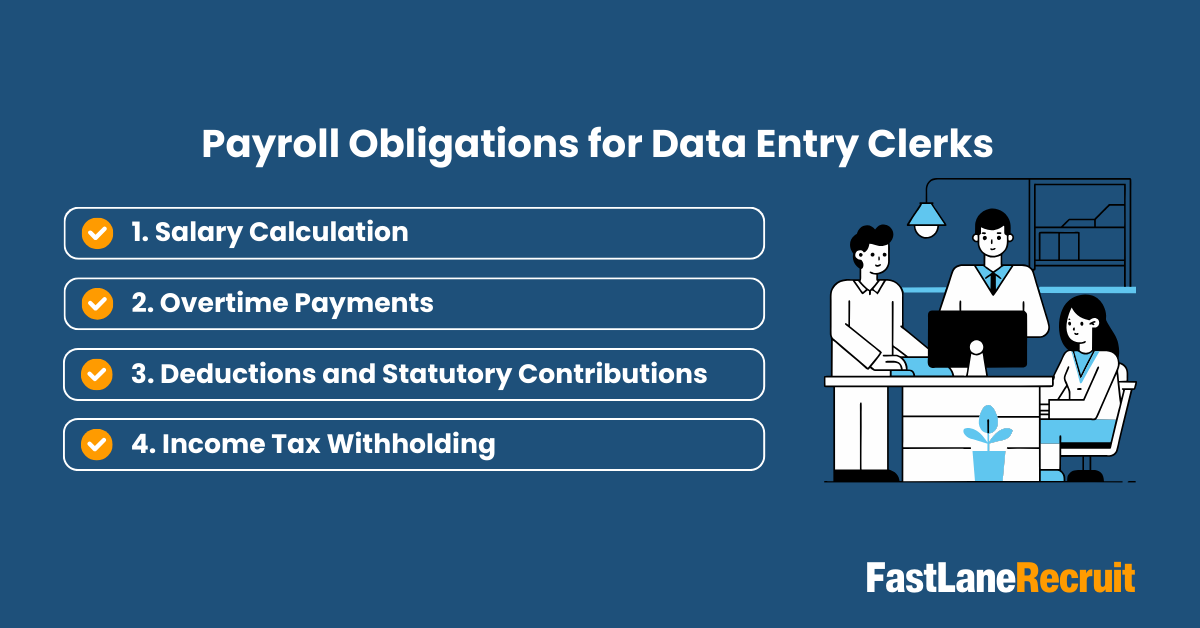
Proper payroll management is more than just paying your employees on time, it ensures legal compliance, employee satisfaction, and smooth business operations. For data entry clerks in Malaysia, employers must carefully manage salaries, overtime, statutory contributions, and taxes. Here’s a breakdown:
1. Salary Calculation
Data entry clerks can be paid either monthly or hourly, depending on your company’s structure.
- Monthly Salary Example: If a clerk earns RM2,000 per month, this must meet or exceed the minimum wage set by the Malaysian government.
- Hourly Wage Example: If a clerk works 40 hours per week at RM12 per hour, the monthly pay must still respect minimum wage rules.
Accurate salary calculation ensures fairness and helps avoid legal penalties.
2. Overtime Payments
The standard workweek in Malaysia is 40–48 hours, typically 8 hours per day, 5–6 days a week. Any additional hours must be compensated according to labor law.
Example:
- A data entry clerk works 45 hours in one week (5 hours overtime).
- Overtime pay is usually 1.5 times the hourly rate on weekdays and higher for weekends or public holidays.
- For a clerk earning RM12/hour, 5 hours overtime = RM12 × 1.5 × 5 = RM90 extra that week.
Properly calculating overtime shows employees they are valued and keeps your business compliant.
Also Read: How to Hire Recruiting Coordinators in Malaysia
3. Deductions and Statutory Contributions
Employers must manage mandatory contributions for all employees, including:
- EPF (Employees Provident Fund): Retirement savings plan. Both employer and employee contribute, e.g., 11% from employee, 13% from employer for a clerk earning RM2,000/month.
- SOCSO (Social Security Organization): Covers workplace injuries or accidents. Contribution is based on salary.
- EIS (Employment Insurance System): Provides assistance in case of retrenchment or unemployment.
Example: For a clerk earning RM2,000/month:
- EPF deduction: RM220 (employee) + RM260 (employer)
- SOCSO: ~RM18 (employee + employer)
- EIS: ~RM4 (employee + employer)
These deductions are legally required, and accurate processing avoids fines and ensures employee protection.
4. Income Tax Withholding
Employers are responsible for deducting monthly income tax (MTD) and remitting it to the Inland Revenue Board of Malaysia (IRBM). At the end of the year, employers must provide Form EA to employees for annual tax filing.
Example: If a data entry clerk’s taxable income is RM24,000/year, the employer calculates monthly deductions and remits them to IRBM, ensuring the employee’s taxes are covered.
How FastLaneRecruit Helps
Managing payroll can be time-consuming, especially for multiple employees. FastLaneRecruit simplifies the process by:
- Calculating salaries and overtime accurately
- Managing EPF, SOCSO, and EIS contributions
- Handling income tax deductions and Form EA issuance
- Ensuring full compliance with Malaysian labor laws
With FastLaneRecruit, HR teams can focus on business growth and employee engagement while leaving payroll and compliance in expert hands.
Also Read: Malaysia’s Advantage for Building Offshore Recruitment Teams
Statutory Compliance Requirements for Hiring Data Entry Clerks in Malaysia
When hiring data entry clerks in Malaysia, it’s essential for employers to adhere to statutory obligations under local labor laws. Compliance protects both the employee and the company, ensuring smooth operations and reducing the risk of legal disputes. Here’s what you need to know:
1. Employment Act 1955
The Employment Act 1955 is the primary law governing employment in Malaysia. It covers:
- Working hours: Standard is 8 hours per day, 40–48 hours per week.
- Leave entitlements: Paid annual leave, sick leave, and other types of leave.
- Termination procedures: Guidelines for notice periods, severance, and lawful termination.
- Employee rights: Ensures fair treatment, protection against discrimination, and workplace safety.
Example: If a data entry clerk works 9 hours a day for 5 days a week, any additional hours must be compensated as overtime under the Act.
2. Leave Entitlements
Employees are legally entitled to various types of leave, including:
- Annual Leave: Minimum 8–16 days per year depending on length of service.
- Sick Leave: Paid sick leave varies by service length (e.g., 14 days for 2 years of service).
- Maternity/Paternity Leave: Female employees typically receive 60–98 days of paid maternity leave; male employees may receive paternity leave according to company policy.
- Public Holidays: Employees are entitled to statutory holidays, and if a public holiday falls on a non-working day, some companies provide a replacement day off.
Example: A clerk who has worked for 2 years is entitled to 14 days of sick leave per year. If they fall sick, the company must honor this entitlement without penalty.
Also Read: How Outsourcing Recruitment Coordination Streamlines Global Hiring
3. Probation and Contracts
Most employers implement a probationary period of 3–6 months for new data entry clerks. During this time:
- Employers assess performance, attendance, and suitability for the role.
- Terms of employment, including work hours, benefits, and termination clauses, should be clearly stated in writing.
Example: A new hire on a 6-month probationary contract can be terminated with shorter notice if performance expectations are not met, as outlined in the contract.
4. Termination Procedures
Termination must comply with Malaysian labor laws:
- Notice Periods: Varies based on employment length (e.g., 4 weeks for employment over 2 years).
- Severance Pay: Required for retrenchment or redundancy situations.
- Lawful Termination: Termination cannot be discriminatory or arbitrary; misconduct must be documented and investigated properly.
Example: If a data entry clerk is retrenched due to downsizing after 5 years of service, the employer must provide the legally required notice and severance pay.
How FastLaneRecruit Helps
FastLaneRecruit simplifies statutory compliance by:
- Drafting employment contracts that fully comply with Malaysian labor laws
- Setting up probationary terms and clear termination procedures
- Ensuring leave entitlements, benefits, and payroll contributions are correctly managed
By leveraging FastLaneRecruit’s EOR, employers can reduce the risk of fines, legal disputes, or compliance errors, while focusing on growing their business and supporting employees effectively.
Employment Contracts for Data Entry Clerks in Malaysia
Having a well-drafted employment contract is essential when hiring data entry clerks in Malaysia. A contract sets clear expectations, protects both the employer and employee, and ensures compliance with Malaysian labor laws.
1. Types of Employment Contracts
Employers can choose different types of contracts depending on the nature of the role:
- Permanent or Full-Time Contracts:
This is the most common type of employment for data entry clerks. Permanent employees receive full statutory benefits, including EPF, SOCSO, annual leave, and public holidays.
Example: A full-time data entry clerk working 40 hours a week receives full leave entitlement and is covered for workplace accidents and retirement contributions. - Part-Time Contracts:
Part-time employees work fewer hours and may receive pro-rated benefits such as leave and contributions. This type of contract is ideal for flexible staffing needs.
Example: A part-time clerk working 20 hours per week might receive 50% of the annual leave entitlement of a full-time employee. - Probationary Contracts:
New hires often start with a 3–6 month probationary period to assess their suitability for the role. During probation, the employer can evaluate performance, attendance, and overall fit. Contracts should clearly state probation terms and conditions.
Example: A clerk on a 6-month probation can have performance reviews at the 3-month mark to ensure they are meeting expectations before confirming permanent employment.
Also Read: The Ultimate Playbook for Building and Integrating Offshore Teams (Singapore Edition)
2. Key Components of an Employment Contract
Every employment contract for a data entry clerk should clearly define the following:
- Job Responsibilities: Outline the clerk’s duties, such as entering data accurately, verifying records, and maintaining confidentiality.
- Working Hours and Shifts: Specify daily hours, weekly schedule, and any shift arrangements, including expectations for overtime.
- Salary, Benefits, and Overtime Rules: State the base salary, statutory contributions (EPF, SOCSO, EIS), and rules for overtime pay.
- Termination and Notice Period: Include terms for ending the employment, notice requirements, and any severance entitlements.
Example: If a data entry clerk is required to work beyond the standard 8-hour day, the contract should explicitly state that overtime will be compensated according to Malaysian labor laws.
3. How FastLaneRecruit Can Help
FastLaneRecruit provides:
- Drafting of customized contracts that comply with Malaysian labor laws
- Inclusion of probation, part-time, or full-time terms based on your staffing needs
- Clear documentation of employee rights, benefits, and employer obligations
By using FastLaneRecruit, businesses can ensure that every data entry clerk’s contract is legally sound, transparent, and tailored to your operational requirements, reducing the risk of disputes or compliance issues.
Hiring Foreign Data Entry Clerks in Malaysia
When hiring foreign data entry clerks in Malaysia, employers must navigate immigration regulations and labor compliance requirements. Failure to comply can result in fines, legal penalties, or visa issues for the employee.
1. Work Permits and Visa Requirements
The type of work permit or visa depends on the employee’s role, salary, and duration of employment:
- Employment Pass (EP):
Designed for professionals, executives, or managers earning above a certain salary threshold. Typically suitable for higher-skilled data entry roles or supervisory positions. - Temporary Employment Pass (PLKS):
For foreign clerks employed in manufacturing, services, or administrative support roles, including standard data entry positions. These are often shorter-term and tied to specific employers.
Example: A foreign data entry clerk hired on a PLKS to support a 6-month project must have the permit tied to that employer and job role.
2. Required Documentation
Employers must collect and submit several documents to the Malaysian Immigration Department:
- Valid Passport of the foreign employee
- Employment Contract detailing salary, working hours, and benefits
- Medical Examination Report confirming the employee is fit to work
- Security Clearance from the employee’s home country, if required
- Relevant Fees for permit processing
Example: Before a foreign clerk starts, the employer submits all documents to Immigration. Once approved, the clerk receives a work visa valid for the contract period.
3. Payroll and Statutory Compliance
Even for foreign employees, Malaysian law requires employers to:
- Contribute to EPF (if applicable), SOCSO, and EIS
- Deduct and remit income tax via the MTD system
- Maintain accurate payroll records and comply with employment contracts
Example: A foreign data entry clerk working 40 hours a week is entitled to overtime pay, leave, and other statutory benefits, just like a Malaysian employee, unless exempted by their visa category.
Using an Employer of Record (EOR) for Compliance
Hiring and managing Malaysian data entry clerks, especially when dealing with foreign hires, can be complex and time-consuming due to payroll obligations, statutory contributions, tax compliance, and immigration rules. Partnering with an Employer of Record (EOR) like FastLaneRecruit can simplify this process and reduce legal risk.
1. Payroll Management
An EOR handles all aspects of payroll for your Data Entry Clerks, ensuring accuracy and compliance:
- Calculates salaries, overtime, and pro-rated benefits for part-time or probationary employees
- Deducts and remits income tax via the MTD system
- Manages statutory contributions to EPF, SOCSO, and EIS
Example: If a data entry clerk works 45 hours in a week, FastLaneRecruit ensures overtime pay is calculated correctly, EPF/SOCSO contributions are deducted, and the clerk receives their net salary on time.
2. Tax Withholding and Reporting
Employers must comply with Malaysian tax laws for both local and foreign employees. An EOR:
- Handles monthly tax deductions for all employees
- Prepares and issues Form EA for annual tax filing
- Ensures compliance with all reporting requirements
Example: A foreign data entry clerk earning RM6,000/month has their income tax automatically calculated and remitted by FastLaneRecruit, removing any risk of penalties.
3. Legal Employment Contracts
FastLaneRecruit provides compliant, customized employment contracts that meet Malaysian labor law requirements:
- Clearly define job roles, responsibilities, salary, benefits, and working hours
- Include probation periods, termination clauses, and notice requirements
- Align with statutory leave entitlements and employment regulations
Example: A probationary contract for a new data entry clerk includes a 3-month assessment period, clear work hours, and provisions for overtime and leave, all fully compliant with the Employment Act 1955.
4. Onboarding and HR Support
Beyond payroll and compliance, FastLaneRecruit supports smooth onboarding and HR processes:
- Introduces new clerks to company policies, tools, and teams
- Provides guidance on HR procedures and employee relations
- Ensures that both local and foreign hires are properly integrated into the organization
Example: A newly hired data entry clerk receives a full onboarding plan, including system access, training schedules, and HR orientation, without burdening the internal team.
Why FastLaneRecruit?
By acting as your trusted EOR partner, FastLaneRecruit allows businesses to:
- Hire Data Entry Clerks locally or internationally
- Maintain full compliance with Malaysian labor laws
- Reduce administrative burden and legal risks
- Focus on growth, productivity, and core business operations
In short, partnering with an EOR like FastLaneRecruit ensures your hiring and employment processes are efficient, compliant, and worry-free, giving you peace of mind while building your team in Malaysia.
Conclusion
Hiring Data Entry Clerks in Malaysia requires more than recruitment; it demands meticulous attention to payroll, statutory compliance, contracts, and employee rights. By leveraging FastLaneRecruit, businesses can simplify payroll, reduce compliance risk, hire foreign or local talent seamlessly, and focus on growth.
Hire Data Entry Clerks in Malaysia with Ease
Finding skilled Data Entry Clerks in Malaysia doesn’t have to be complicated. With FastLaneRecruit, you can focus on growing your business while we handle the complexities of payroll, statutory compliance, work permits, and HR administration.
Gain access to qualified local and foreign talent, ensure full legal compliance, and streamline your hiring process from recruitment to onboarding. FastLaneRecruit makes it simple, efficient, and worry-free to expand your team in Malaysia.
Start building your high-performing data entry team today!