Malaysia vs Global Markets
Data Entry Clerks play a vital role in keeping business operations accurate, organized, and efficient. They manage data input, update records, maintain databases, and ensure information is correctly processed for payroll, finance, HR, and operations teams.
As businesses expand globally and rely more on digital systems, accurate data handling becomes even more critical. Understanding salary benchmarks across different countries helps companies hire competitively while managing payroll costs effectively.
This guide compares 2026 salary ranges for Data Entry Clerks in Malaysia, the United States, Singapore, Hong Kong, and Australia, helping you make informed hiring and budgeting decisions.
Content Outline
Key Summary
Malaysia Offers Cost-Efficient Talent
Data Entry Clerks in Malaysia deliver strong accuracy, system familiarity, and administrative support at a lower overall payroll cost compared to Western markets.
U.S. Salaries Reflect Higher Labor Costs
In the United States, Data Entry Clerk salaries are higher due to labor costs, compliance requirements, and cost of living.
Singapore’s Structured Pay Environment
Singapore offers stable and competitive pay for data administration roles, especially in regulated and multinational environments.
Hong Kong Shows Wide Salary Ranges
Salaries in Hong Kong vary depending on industry, company size, and data complexity.
Australia Balances Pay and Skills
Australia offers competitive wages reflecting demand for accuracy, compliance, and system-driven data roles.
Access Reliable Data Entry Talent
Hiring in Malaysia gives companies access to English-speaking professionals experienced in ERP systems, payroll data, HR records, and financial documentation.
Simplified Hiring via EOR
FastLaneRecruit’s Employer of Record (EOR) solution manages employment contracts, payroll, and statutory compliance while you retain full control of daily operations.
Data Entry Clerk Salary Breakdown by Country (2026)
Malaysia
| Level | Salary (MYR) | Salary (USD approx) |
| Entry (0–2 yrs) | 45,000–60,000 | 9,500–13,000 |
| Mid (3–5 yrs) | 60,000–80,000 | 13,000–17,500 |
| Senior (6+ yrs) | 80,000–100,000 | 17,500–22,000 |
Market Insight:
Malaysia offers one of the most cost-efficient markets for Data Entry Clerks while maintaining strong accuracy, system knowledge, and reliability.
United States
| Level | Salary (USD) |
| Entry (0–2 yrs) | 35,000–42,000 |
| Mid (3–5 yrs) | 42,000–50,000 |
| Senior (6+ yrs) | 50,000–58,000+ |
Market Insight:
U.S. salaries are higher due to labor regulations, higher minimum wages, and the demand for compliance-ready data handling.
Also Read: Recruiting Coordinator Salary Guide 2026
Singapore
| Level | Salary (SGD) | Salary (USD approx) |
| Entry (0–2 yrs) | 30,000–38,000 | 22,000–28,000 |
| Mid (3–5 yrs) | 38,000–48,000 | 28,000–35,000 |
| Senior (6+ yrs) | 48,000–58,000+ | 35,000–43,000+ |
Market Insight:
Singapore offers stable compensation, especially in finance, healthcare, and regulated industries where data accuracy is critical.
Hong Kong
| Level | Salary (HKD) | Salary (USD approx) |
| Entry (0–2 yrs) | 200,000–260,000 | 26,000–33,000 |
| Mid (3–5 yrs) | 260,000–320,000 | 33,000–41,000 |
| Senior (6+ yrs) | 320,000–380,000+ | 41,000–49,000+ |
Market Insight:
Hong Kong salaries vary widely based on sector, with higher pay in finance, logistics, and regulated industries.
Australia
| Level | Salary (AUD) | Salary (USD approx) |
| Entry (0–2 yrs) | 55,000–65,000 | 36,000–43,000 |
| Mid (3–5 yrs) | 65,000–75,000 | 43,000–50,000 |
| Senior (6+ yrs) | 75,000–85,000+ | 50,000–57,000+ |
Market Insight:
Australia pays competitively for data administration roles that support compliance, payroll, and enterprise systems.
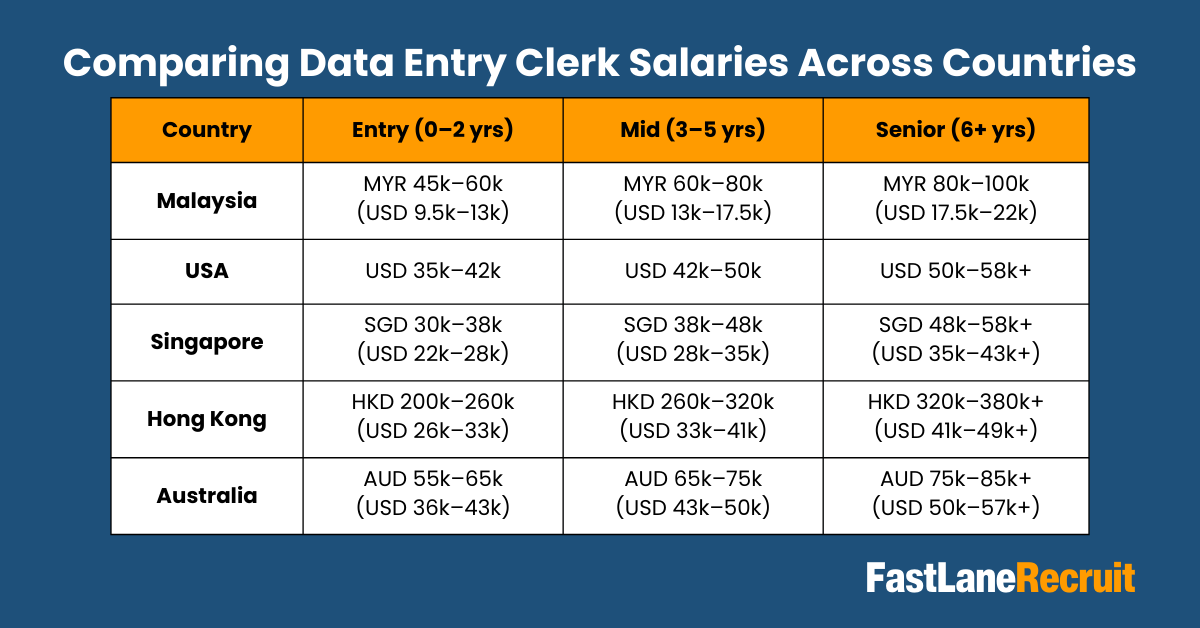
Comparing Data Entry Clerk Salaries Across Countries
| Country | Entry (0–2 yrs) | Mid (3–5 yrs) | Senior (6+ yrs) |
| Malaysia | MYR 45k–60k (USD 9.5k–13k) | MYR 60k–80k (USD 13k–17.5k) | MYR 80k–100k (USD 17.5k–22k) |
| USA | USD 35k–42k | USD 42k–50k | USD 50k–58k+ |
| Singapore | SGD 30k–38k (USD 22k–28k) | SGD 38k–48k (USD 28k–35k) | SGD 48k–58k+ (USD 35k–43k+) |
| Hong Kong | HKD 200k–260k (USD 26k–33k) | HKD 260k–320k (USD 33k–41k) | HKD 320k–380k+ (USD 41k–49k+) |
| Australia | AUD 55k–65k (USD 36k–43k) | AUD 65k–75k (USD 43k–50k) | AUD 75k–85k+ (USD 50k–57k+) |
Key Insight:
Malaysia remains the most payroll-efficient location for Data Entry Clerks while still delivering consistent quality and accuracy.
Why These Salaries Differ
Data Entry Clerk salaries can look very different across countries, even when the job title and core responsibilities appear similar. The differences usually come down to a mix of economic factors, business needs, and skill requirements. Understanding these drivers helps companies set fair, competitive pay while planning payroll budgets more effectively.
Also Read: Employment Laws and Compliance for Hiring Recruitment Teams in Malaysia
1. Cost of Living & Local Expenses
One of the biggest reasons salaries vary by country is the local cost of living. In markets such as the United States, Singapore, Australia, and Hong Kong, everyday expenses are significantly higher. Housing, healthcare, transportation, food, and utilities all cost more, so employers must offer higher wages to ensure employees can maintain a reasonable standard of living.
Malaysia, on the other hand, has a much lower cost of living. This allows companies to offer salaries that are competitive locally while still keeping overall payroll costs under control. Employees can afford housing, transportation, and daily expenses without the need for high wages.
Example:
A Data Entry Clerk earning USD 15,000 in Kuala Lumpur can enjoy a lifestyle similar to someone earning USD 35,000 in Singapore, simply because rent, food, and transportation costs are much lower in Malaysia.
2. Industry Demand & Data Volume
Salary levels are also influenced by the industry and the volume of data being handled. Data Entry Clerks working in sectors such as finance, healthcare, logistics, e-commerce, and payroll processing are often responsible for large volumes of sensitive and time-critical data. These roles demand a high level of accuracy, consistency, and speed.
When errors can impact payroll, financial reporting, compliance, or customer records, companies are willing to pay more for experienced clerks who can handle pressure and large workloads reliably.
Example:
A Data Entry Clerk managing payroll data for thousands of employees or processing high-value financial transactions will typically earn more than a clerk handling basic internal records or small data sets.
3. System Knowledge & Accuracy Skills
Not all Data Entry Clerks have the same technical skills. Clerks with experience using enterprise systems and specialized software are more valuable to employers. This includes familiarity with:
- ERP systems such as SAP or Oracle
- Payroll platforms and HR systems
- CRM tools and internal databases
- Compliance or audit-related reporting systems
These tools require training, attention to detail, and an understanding of how data flows across departments. Clerks who can work confidently within these systems help reduce errors, improve reporting accuracy, and support audits.
Example:
A clerk who can accurately manage data within SAP or payroll systems reduces the risk of payment errors, reporting issues, and audit findings. This added reliability often results in higher pay.
Also Read: How to Hire Recruiting Coordinators in Malaysia
4. Remote Work & Global Hiring
Remote work and global hiring strategies have changed how companies approach compensation. Businesses are no longer limited to hiring locally and can now build distributed teams across regions. This allows companies to hire skilled Data Entry Clerks in cost-efficient markets like Malaysia while still supporting global operations.
For employers, this means lower payroll costs without sacrificing data quality or turnaround time. For employees, it creates opportunities to work on international projects and gain exposure to global systems and standards.
Example:
A European company hires a Malaysian Data Entry Clerk to manage APAC payroll and employee records. The clerk delivers the same accuracy and system support as a local hire, but at a significantly lower payroll cost.
5. Compliance & Data Sensitivity
Countries with stricter data protection laws and regulatory requirements often pay higher salaries. When clerks handle personal data, payroll information, financial records, or healthcare data, the risk of errors or breaches is much higher. Employers value professionals who understand data confidentiality, access controls, and reporting obligations.
In highly regulated markets, companies pay more to ensure data is handled correctly and in line with local laws.
Example:
A Data Entry Clerk managing employee payroll data in a highly regulated market may earn more due to the responsibility of handling sensitive personal and financial information accurately and securely.
6. Retention & Career Growth
Salary is also a key tool for retaining experienced talent. Data Entry Clerks who understand internal systems, workflows, data structures, and compliance processes become more valuable over time. Replacing them can be costly and disruptive, especially in roles tied to payroll or reporting cycles.
To reduce turnover, companies often offer higher salaries, annual increments, or progression opportunities for experienced clerks who demonstrate reliability and consistency.
Example:
A senior clerk who has managed the same payroll and data systems for several years may receive higher pay to retain their knowledge and ensure business continuity.
Summary Insight
Salary differences across countries are driven by a combination of cost of living, industry demand, system complexity, compliance requirements, remote hiring strategies, and retention needs.
Malaysia stands out as a strategic hiring location, offering skilled Data Entry Clerks, strong accuracy, and system familiarity, all while keeping payroll costs efficient. This balance makes Malaysia an attractive choice for global companies seeking reliable data support without overextending their payroll budgets.
Also Read: Malaysia’s Advantage for Building Offshore Recruitment Teams
Why Outsource Data Entry Roles to Malaysia
Outsourcing Data Entry roles to Malaysia is not just about lowering costs. It’s a strategic decision that helps global companies improve accuracy, maintain compliance, and scale operations smoothly. Malaysia offers the right balance of skilled talent, stable infrastructure, and payroll efficiency, making it a preferred destination for data-driven support roles.
1. Lower Operational Costs with Reliable Accuracy
Malaysia provides access to well-trained Data Entry Clerks at lower overall payroll costs compared to Western and high-cost APAC markets. While salaries are more competitive, the quality of work remains high. Malaysian professionals are known for their attention to detail, consistency, and familiarity with structured data processes.
Many Data Entry Clerks in Malaysia have experience supporting payroll teams, finance departments, HR systems, and operational databases. This means companies can maintain data accuracy and reliability without overspending on payroll.
Example:
A company can hire two skilled Data Entry Clerks in Malaysia for the cost of one similar role in the U.S., increasing output and reducing workload bottlenecks while maintaining data quality.
2. Reduced Payroll & Compliance Risk
Hiring internationally often comes with risks related to employment laws, payroll processing, and statutory contributions. Malaysia has specific requirements such as EPF, SOCSO, EIS, and PCB, which must be handled accurately and on time.
FastLaneRecruit reduces this risk by managing:
- Compliant employment contracts under Malaysian labor laws
- Monthly payroll processing and salary disbursement
- Statutory contributions and tax deductions
- Ongoing compliance monitoring and reporting
This ensures your Data Entry Clerks are employed legally and compliantly from day one, reducing the risk of penalties, delays, or payroll errors.
Example:
A global company can onboard a Malaysian Data Entry Clerk without worrying about local payroll rules, as FastLaneRecruit handles all statutory obligations accurately.
3. Strategic Time Zone Coverage
Malaysia’s location makes it ideal for supporting regional and global operations. It offers full coverage for APAC markets and partial overlap with European working hours. This improves communication, speeds up data processing, and reduces turnaround times for urgent tasks.
This time zone advantage is especially useful for payroll processing, daily data updates, and end-of-month reporting cycles.
Example:
A European finance team can send data updates at the end of their workday and receive processed and validated data from the Malaysian team by the next morning.
4. EOR Simplifies Local Employment
Setting up a legal entity in a new country can be expensive and time-consuming. FastLaneRecruit’s Employer of Record (EOR) service removes this barrier.
As the legal employer in Malaysia, FastLaneRecruit handles:
- Employment contracts and onboarding
- Payroll, tax, and statutory contributions
- Compliance with local labor regulations
At the same time, your company retains full operational control. You manage daily tasks, workflows, performance, and reporting, while FastLaneRecruit manages the administrative and legal responsibilities.
Also Read: How Outsourcing Recruitment Coordination Streamlines Global Hiring
Example:
A startup expanding into APAC can hire a Malaysian Data Entry team immediately through EOR, without registering a local entity or building in-house payroll infrastructure.
5. English-Speaking Workforce
Malaysia has a strong English-speaking workforce, making collaboration with global teams smooth and efficient. Data Entry Clerks are comfortable working with English documentation, international systems, and global reporting standards.
This reduces misunderstandings, rework, and training time, especially when clerks support finance, payroll, HR, or operations teams across different countries.
Example:
A multinational company can assign Malaysian Data Entry Clerks to update global payroll records, HR databases, or CRM systems without language barriers or documentation issues.
6. Scalability for Growing Teams
Outsourcing to Malaysia makes it easy to scale your data operations as your business grows. Whether you need one Data Entry Clerk or a full offshore team, FastLaneRecruit’s flexible hiring model allows you to expand or adjust your workforce quickly.
This scalability is ideal for companies experiencing seasonal demand, rapid growth, or expansion into new markets.
Example:
An e-commerce company can start with a small Malaysian data team and scale up during peak sales periods without long-term hiring commitments or heavy administrative burden.
Summary Insight
Outsourcing Data Entry roles to Malaysia delivers a strong combination of accuracy, compliance, flexibility, and payroll efficiency. Companies gain access to reliable, English-speaking professionals while reducing operational risk and cost.
With FastLaneRecruit’s EOR support, businesses can hire quickly, stay compliant, and scale with confidence, making Malaysia a smart and sustainable choice for global data operations.
How to Hire Data Entry Clerks in Malaysia
Hiring Data Entry Clerks in Malaysia is straightforward when you follow a clear process and understand local hiring requirements. With the right approach, companies can build a reliable, accurate data support team while staying fully compliant with Malaysian employment laws.
1. Define Clear Responsibilities
Before hiring, it’s important to clearly outline what the Data Entry Clerk will be responsible for. Data entry roles can vary widely, so defining expectations early helps attract the right candidates and avoid confusion later.
Common responsibilities to include:
- Accurate data input into internal systems, spreadsheets, or databases
- Updating and maintaining records for payroll, HR, finance, or operations
- Performing validation checks to identify and correct data errors
- Generating routine reports and supporting audits or reviews
- Following data confidentiality and internal control procedures
Clearly defining responsibilities also helps differentiate between entry-level, mid-level, and senior roles. Entry-level clerks may focus on routine data input, while more experienced clerks handle complex datasets, validations, and cross-team coordination.
Tip: Clear job descriptions lead to better hires and reduce training time.
2. Choose the Right Hiring Model
Selecting the right hiring model depends on your business structure, timeline, and long-term plans in Malaysia.
| Hiring Model | Best For | How FastLaneRecruit Helps |
| Direct Hire | Companies with a Malaysian entity | Provides payroll processing, statutory contributions, and compliance support |
| Contract Hire | Short-term or project-based needs | Ensures compliant contracts, payments, and local regulations |
| Employer of Record (EOR) | Companies without a local entity | Acts as the legal employer and manages contracts, payroll, and compliance |
For many global companies, the EOR model is the fastest and safest option. It allows businesses to hire Data Entry Clerks in Malaysia without setting up a local entity, while still maintaining full operational control.
Example:
A global company can hire a Malaysian Data Entry Clerk within weeks using EOR, instead of spending months establishing a local entity.
Also Read: The Ultimate Playbook for Building and Integrating Offshore Teams (Singapore Edition)
3. Set Competitive Salaries
Offering competitive, market-aligned salaries is key to attracting reliable and detail-oriented Data Entry Clerks. While Malaysia offers cost efficiency compared to other markets, candidates still expect fair compensation based on their skills and experience.
When setting salaries, consider:
- Years of experience (entry, mid, or senior level)
- Type of data handled (payroll, finance, customer, or compliance data)
- Familiarity with systems such as ERP, payroll platforms, or CRM tools
- Accuracy, speed, and consistency of previous work
Paying slightly above the local average can help reduce turnover and attract candidates who value long-term stability.
Example:
A mid-level Data Entry Clerk with payroll system experience may command a higher salary than one handling basic administrative data, due to added responsibility and risk.
4. Ensure Compliance from Day One
Compliance is critical when hiring in Malaysia. Employment contracts, payroll processing, and statutory contributions must follow local labor laws from the first day of employment.
FastLaneRecruit ensures compliance by managing:
- Legally compliant employment contracts
- Monthly payroll processing and salary payments
- Statutory contributions such as EPF, SOCSO, EIS, and PCB
- Ongoing compliance monitoring and reporting
This removes the administrative burden from your internal team and reduces the risk of errors, penalties, or delays.
Example:
A company using EOR avoids mistakes related to payroll filings or statutory deductions, as FastLaneRecruit handles all local requirements accurately.
5. Support Onboarding & Scaling
Hiring doesn’t stop once the contract is signed. Effective onboarding helps new Data Entry Clerks become productive quickly and maintain high accuracy standards.
A strong onboarding process includes:
- Training on internal systems and workflows
- Clear data entry guidelines and quality checks
- Access to documentation and reporting templates
- Regular feedback during the first few months
As your business grows, your data needs will likely increase. FastLaneRecruit supports team scaling by making it easy to add new hires or adjust team size without disrupting payroll or compliance processes.
Example:
A growing company can start with one Data Entry Clerk in Malaysia and scale to a larger team as data volume increases, without changing its hiring structure.
Summary Insight
With clear role definitions, the right hiring model, competitive salaries, and compliance support, hiring Data Entry Clerks in Malaysia is efficient and low risk.
FastLaneRecruit’s EOR solution enables companies to hire quickly, stay compliant, and scale smoothly, making Malaysia an ideal location for building reliable, payroll-ready data teams.
Conclusion
Data Entry Clerk salaries in 2026 vary widely across global markets. Malaysia stands out as a cost-efficient destination offering skilled, reliable professionals, while countries like the U.S., Singapore, and Australia command higher wages due to labor and living costs.
Understanding these salary benchmarks helps companies plan payroll budgets and hiring strategies more effectively.
Ready to Hire Data Entry Talent with Confidence?
FastLaneRecruit’s Employer of Record (EOR) service makes it easy to hire Malaysian data entry clerks without setting up a local entity.
We handle:
- Fully compliant employment contracts
- Payroll and statutory contributions
- Ongoing compliance management
- Fast onboarding and team scaling
You keep full operational control while we manage the administrative complexity.
Your data operations team in Malaysia is ready.
Contact FastLaneRecruit today for a free consultation and start building your global data team with confidence.