Key Skills, Tools & Compliance Guide for Global Companies
Malaysia has become one of the best business hubs for payroll and HR operations. With a skilled, English-speaking workforce, strong statutory frameworks, and modern digital infrastructure, global companies increasingly engage Malaysian payroll specialists to support multi-country payroll, compliance, and HR operations.
This guide explains what Malaysian payroll specialists do, the skills and tools they must have, compliance requirements, hiring options, and how FastLaneRecruit helps global companies build compliant payroll teams in Malaysia.
Content Outline
Key Summary
Malaysia is a strategic payroll hub
Global companies hire Malaysian payroll specialists for a skilled, English-speaking workforce, clear labour laws, and reliable statutory compliance.
Payroll specialists handle core payroll functions
They manage salary calculations, tax deductions, EPF/SOCSO/EIS submissions, payslips, payroll reconciliation, and HRIS administration.
Essential skills for payroll specialists
Expertise in statutory compliance, Employment Act 1955, payroll software, PDPA data protection, reporting, and cross-border payroll is crucial.
Tools streamline payroll operations
Payroll systems, accounting software, statutory portals, HRIS platforms, and secure cloud storage ensure accuracy, compliance, and efficiency.
Multiple hiring models are available
Companies can choose direct local hiring, managed payroll services, hybrid teams, or an Employer of Record (EOR) depending on speed, compliance, and scale.
EOR simplifies offshore hiring
FastLaneRecruit’s EOR allows companies to hire Malaysian payroll specialists without entity setup, handling payroll, contracts, statutory filings, and HR administration.
Step-by-step hiring ensures success
Define payroll needs, source candidates, verify skills and compliance knowledge, draft contracts, onboard effectively, and monitor performance for smooth operations.
Why Global Companies Hire Payroll Specialists in Malaysia
Malaysia has become one of the best locations for companies managing regional and international payroll operations. It offers a strong mix of business stability, a well-educated workforce, and clear employment regulations that make payroll management more predictable and secure.
Most payroll and shared services teams are based in Kuala Lumpur and Selangor, where you’ll find experienced professionals who are familiar with regional payroll processing, tax reporting, and compliance requirements. Many Malaysian payroll specialists are fluent in English and trained in global HR and finance practices, making collaboration with international teams smooth and efficient.
What makes Malaysia especially reliable for payroll operations is its structured legal and statutory framework. Payroll activities are guided by government authorities that clearly define employer responsibilities, contribution rates, reporting deadlines, and employee protections. This gives companies confidence that their payroll processes can remain compliant and transparent.
Key Government Authorities That Regulate Payroll in Malaysia
| Authority | What They Regulate |
| Inland Revenue Board of Malaysia (LHDN) | Manages income tax, Monthly Tax Deduction (PCB/MTD), and annual tax reporting |
| Employees Provident Fund (KWSP / EPF) | Oversees retirement savings contributions for employers and employees |
| Social Security Organisation (SOCSO) | Covers employment injury and invalidity protection |
| Employment Insurance System (EIS) | Provides unemployment and job-seeking support |
| Department of Labour (JTK) | Enforces the Employment Act 1955 and workplace regulations |
| Personal Data Protection Department | Ensures payroll and employee data follow PDPA requirements |
These bodies publish clear rules on contribution rates, deadlines, employee entitlements, and employer obligations. Payroll specialists in Malaysia are trained to follow these requirements closely, helping global companies reduce compliance risks and maintain consistent payroll standards.
Together, these clear regulations and experienced payroll professionals make Malaysia a dependable location for companies that want to build compliant, scalable payroll operations in Asia.
What Does a Payroll Specialist Do in Malaysia?
A payroll specialist in Malaysia plays a key role in making sure every employee is paid correctly, on time, and in line with local labour laws. Beyond just processing salaries, they manage tax deductions, statutory contributions, reporting, and payroll records, helping companies stay compliant while building trust with their workforce.
For global companies, Malaysian payroll specialists often act as the bridge between HR, finance, and government authorities. They ensure that payroll data is accurate, government submissions are completed on time, and employees receive clear and compliant payslips every month.
Core Responsibilities of a Malaysian Payroll Specialist
| Responsibility | What It Means |
| Salary and Allowance Calculations | Calculates monthly basic salary, overtime, bonuses, commissions, and allowances based on employment contracts and company policies. |
| Monthly Tax Deduction (PCB/MTD) Processing | Applies the correct income tax deductions for each employee and prepares submissions to the Inland Revenue Board of Malaysia (LHDN). |
| EPF, SOCSO and EIS Submissions | Calculates and submits employer and employee contributions to statutory bodies for retirement, social security, and unemployment protection. |
| Payslip Generation and Reporting | Issues clear and compliant payslips and prepares payroll summaries for HR and finance teams. |
| Payroll Reconciliation and Audits | Reviews payroll records to ensure figures are accurate, resolves discrepancies, and supports internal or external audits. |
| Year-End EA Forms Preparation | Prepares annual income statements (EA forms) required for employees’ personal tax filing. |
| Leave, Overtime and Benefit Processing | Tracks leave entitlements, overtime hours, and benefit claims to ensure correct payroll calculations. |
| HRIS and Payroll System Administration | Manages payroll software and HR systems, keeps employee records updated, and maintains secure payroll databases. |
In short, payroll specialists in Malaysia ensure that payroll operations run smoothly, statutory obligations are met, and both employers and employees can rely on a transparent and compliant payroll process every month.
Also Read: Building a High-Performing Offshore HR and Payroll Management Team in Malaysia (Singapore Edition)
Key Skills Malaysian Payroll Specialists Must Have
Payroll specialists in Malaysia play an important role in protecting both the company and its employees. Their skills ensure salaries are paid correctly, government requirements are met, and sensitive information is handled responsibly. Below are the key skill areas that global companies should look for when hiring payroll professionals in Malaysia.
| Skill Area | Why It Matters |
| Malaysian Statutory Compliance | Payroll specialists must clearly understand how to calculate and submit EPF, SOCSO, EIS and monthly tax deductions (PCB/MTD). They need to follow submission deadlines, contribution rates, and government procedures set by LHDN, KWSP and SOCSO. This prevents late penalties, incorrect filings, and employee dissatisfaction. |
| Employment Act 1955 Knowledge | The Employment Act defines work hours, overtime, public holidays, leave entitlements, notice periods and termination benefits. Payroll specialists must apply these rules correctly when calculating overtime, leave encashment, bonuses, and final salary payments. This protects employers from disputes and compliance issues. |
| Payroll Software Proficiency | Modern payroll is system-driven. Payroll specialists should be confident using payroll and HR systems to automate calculations, generate payslips, manage leave, and produce statutory reports. System proficiency reduces manual work, improves payroll accuracy, and shortens payroll processing time each month. |
| Data Protection (PDPA) Awareness | Payroll involves personal data such as identification numbers, salary details, and bank information. Payroll specialists must understand PDPA rules to ensure data is securely stored, shared only with authorised parties, and protected against misuse. This builds employee trust and safeguards company reputation. |
| Reporting and Reconciliation Skills | Payroll specialists prepare payroll summaries, statutory reports, and monthly reconciliations for finance teams. They must be able to review figures, identify discrepancies, and correct errors before submission. These skills support audits, year-end reporting, and accurate financial planning. |
| Cross-Border Payroll Understanding | Many companies run regional payroll operations from Malaysia. Payroll specialists who understand expatriate payroll, multi-country payroll structures, and regional reporting standards can support cross-border teams. This helps companies manage overseas employees and expansion plans smoothly. |
Together, these skills help Malaysian payroll specialists deliver consistent, compliant, and reliable payroll services while supporting regional and global business growth.
Tools Payroll Specialists in Malaysia Commonly Use
Modern payroll operations rely heavily on digital tools to ensure accuracy, security, and timely submissions. Payroll specialists in Malaysia use a combination of payroll software, government portals, and HR systems to manage employee pay and statutory obligations smoothly.
Payroll Systems
Payroll systems are the core tools used to process salaries, allowances, overtime, and statutory deductions. Common systems in Malaysia include SQL Payroll, Autopay, and other HRMS payroll platforms. These systems automate salary calculations, generate payslips, and prepare statutory contribution files for EPF, SOCSO, EIS, and tax submissions. By using payroll systems, specialists can reduce manual errors and complete payroll cycles more efficiently.
Also Read: Building a High-Performing Offshore HR and Payroll Management Team in Malaysia (Hong Kong Edition)
Accounting Software
Accounting software such as Xero, QuickBooks, and SAP is often used alongside payroll systems. Payroll specialists use these tools to post payroll journals, reconcile salary expenses, and prepare financial reports for finance teams. These systems help ensure payroll data matches accounting records and supports accurate financial reporting and audits.
Statutory Portals
Payroll specialists regularly work with Malaysian government portals such as the Inland Revenue Board (LHDN), Employees Provident Fund (KWSP), Social Security Organisation (SOCSO), and Employment Insurance System (EIS). These portals are used to submit monthly tax deductions, statutory contributions, and employee registration details. Familiarity with these portals is essential to ensure filings are accurate and submitted on time.
Human Resource Information Systems (HRIS)
HRIS platforms manage employee data, leave records, attendance tracking, and claims processing. Payroll specialists rely on HRIS data to calculate salaries correctly, especially for overtime, unpaid leave, and benefit claims. Integrated HRIS systems help maintain consistent employee records and improve coordination between HR and payroll teams.
Secure Cloud Storage
Payroll documents such as payslips, contracts, and statutory reports are often stored in secure cloud platforms. These systems support document retention, internal audits, and regulatory checks while ensuring sensitive employee data is protected. Secure cloud storage also allows authorised users to access payroll documents safely and efficiently when needed.
Together, these tools enable Malaysian payroll specialists to run compliant, accurate, and well-organised payroll operations for local and global companies.
Summary Table
| Tool Category | Examples |
| Payroll systems | SQL Payroll, Autopay, HRMS platforms |
| Accounting software | Xero, QuickBooks, SAP |
| Statutory portals | LHDN, KWSP, SOCSO, EIS |
| HRIS | Leave, attendance and claims systems |
| Secure cloud storage | Document retention & audits |
How Global Companies Hire Payroll Specialists in Malaysia
Global companies can hire payroll specialists in Malaysia using different approaches, depending on their business goals, timeline, and operational needs. Each option offers unique advantages and considerations for managing payroll efficiently and compliantly.
1. Direct Local Hiring
Best For: Companies planning a long-term presence in Malaysia with an established legal entity.
Direct local hiring involves registering a company in Malaysia (Sdn. Bhd.) and employing payroll specialists directly. This gives full control over payroll operations, team structure, and HR policies. It’s ideal for businesses planning sustained operations, as it allows access to government incentives, local benefits, and long-term talent development. However, it requires significant upfront investment in company setup, legal compliance, and HR administration.
2. Managed Payroll Services
Best For: Businesses with regional operations seeking professional support for payroll management.
Managed payroll services involve outsourcing all or part of payroll processing to a specialized service provider. Payroll specialists in these teams handle salary calculations, statutory submissions, payslips, and reporting, often for multiple countries in the region. This approach is beneficial for companies that need consistent, professional payroll support without expanding in-house teams. Managed services also ensure compliance with local regulations while leveraging automation and expert knowledge.
Also Read: Building a High-Performing Offshore HR and Payroll Management Team in Malaysia (Australia Edition)
3. Employer of Record (EOR)
Best For: Companies looking to hire quickly in Malaysia without registering a local entity.
An Employer of Record (EOR) acts as the legal employer of your workforce, while you manage day-to-day operations and team performance. Payroll specialists employed through an EOR handle all compliance, statutory filings, benefits administration, and tax obligations. This option allows companies to onboard talent quickly, reduce administrative burden, and scale teams efficiently without navigating complex legal registration processes. It is especially useful for companies testing the Malaysian market or expanding remote and hybrid teams.
4. Hybrid or Regional Support Teams
Best For: Organizations that require flexibility and cross-border payroll expertise.
Some companies adopt a hybrid approach, where core payroll operations remain in-house, but specialized tasks, such as statutory filings, tax compliance, or multi-country payroll, are delegated to offshore specialists. This setup allows businesses to maintain control over sensitive processes while benefiting from regional expertise and automated tools, providing scalability as the workforce grows.
Each of these engagement models gives global companies the flexibility to hire Malaysian payroll specialists in a way that fits their growth strategy, compliance needs, and operational goals. Whether through direct hiring, managed services, or an EOR, the focus remains on accurate, timely, and compliant payroll operations.
Example: Expanding Payroll Operations into Malaysia
When global companies enter the Malaysian market, managing payroll and compliance can quickly become complex. Engaging Malaysian payroll specialists through the right hiring model helps simplify operations, reduce risk, and ensure employees are paid accurately and on time.
Case Study:
A US fintech firm planning to expand into Southeast Asia wanted to hire a local team in Malaysia quickly. Rather than establishing a legal entity immediately, which can take months, the company engaged Malaysian payroll specialists through an Employer of Record (EOR) partner.
The EOR handled all legal, administrative, and compliance responsibilities, including:
- Drafting employment contracts aligned with the Employment Act 1955
- Managing payroll calculations, payslips, and statutory contributions (EPF, SOCSO, EIS)
- Submitting taxes and monthly PCB deductions to the Inland Revenue Board (LHDN)
- Ensuring PDPA-compliant handling of sensitive employee data
Meanwhile, the fintech firm focused on core business activities such as product development, market research, and client acquisition. By leveraging the EOR model, the company was able to hire fast, stay fully compliant, and scale operations efficiently without setting up a Malaysian entity immediately.
Also Read: How Outsourcing HR Operations Can Streamline Business Efficiency
In-House Hiring vs. Employer of Record (EOR)
To decide the best approach for hiring Malaysian payroll specialists, companies should consider the differences between in-house hiring and using an EOR.
| Factor | In-House Hiring | EOR |
| Entity Setup | Required – Must register a local company (Sdn. Bhd.) before hiring employees. | Not required – The EOR acts as the legal employer of record. |
| Payroll Compliance | Self-managed – The company is responsible for statutory submissions, deductions, and legal compliance. | Managed by EOR – The EOR ensures all payroll, tax, and statutory requirements are fulfilled. |
| Speed to Hire | Slower – Entity setup, recruitment, and onboarding take time. | Faster – EOR allows immediate hiring without waiting for legal registration. |
| Ongoing HR Administration | Internal – HR and finance teams manage payroll, leave, and benefits. | Included – EOR handles all administrative HR tasks. |
| Statutory Registrations | Internal – Must register employees for EPF, SOCSO, EIS, and taxes. | Included – EOR completes all statutory registrations and remittances. |
Key Takeaways:
- In-House Hiring is best for companies planning long-term operations in Malaysia with a legal entity and internal HR teams.
- EOR Hiring is ideal for companies expanding quickly, testing the market, or looking for a low-risk, compliant solution without the administrative burden.
By understanding these differences, businesses can make informed decisions that match their expansion goals, team size, and compliance requirements.
How to Hire Payroll Specialists in Malaysia: Step-by-Step Guide
Hiring the right Payroll Specialists in Malaysia requires careful planning, compliance awareness, and a clear understanding of your business needs. Whether you plan to hire in-house, via a managed payroll service, or through an Employer of Record (EOR) like FastLaneRecruit, following these steps ensures a smooth hiring process.
Step 1: Define Your Payroll Needs
Start by identifying the scope of work your payroll specialist will handle. Ask yourself:
- How many employees will they manage?
- Will they handle multi-country payroll or just Malaysia?
- Do you need them to manage statutory compliance (EPF, SOCSO, EIS, PCB) or focus only on payroll calculations?
- Are they required to work with HRIS and accounting systems?
Clearly defining the role helps you target candidates with the right skills and experience.
Step 2: Decide on the Hiring Model
Choose the hiring approach that best fits your business strategy:
- Direct Local Hiring: Ideal for long-term operations with a registered Malaysian entity.
- Managed Payroll Services: Best for companies that need professional payroll expertise across multiple regions.
- Employer of Record (EOR): Perfect for fast market entry without establishing a local entity.
Your choice will influence recruitment channels, contracts, and onboarding processes.
Step 3: Prepare Job Description and Requirements
Draft a clear and detailed job description highlighting:
- Core responsibilities (salary calculation, statutory submissions, payslip generation, payroll reconciliation)
- Required skills (Malaysian statutory compliance, Employment Act knowledge, payroll software proficiency, PDPA awareness)
- Experience level (junior, intermediate, senior)
- Any certifications or HRIS expertise (QuickBooks, Xero, SAP, Workday)
Well-prepared job descriptions attract qualified candidates and make screening easier.
Also Read: Why Malaysia Is Emerging as a Hub for HR Operations Analysts
Step 4: Source Candidates
Use multiple channels to find the best talent:
- Online job portals: JobStreet, LinkedIn, WOBB, Adnexio, Sling
- Recruitment agencies: They can shortlist candidates and conduct preliminary interviews.
- Professional networks: Industry groups, finance, and accounting associations.
Consider the candidate’s cultural fit, communication skills, and familiarity with Malaysian labor laws.
Step 5: Screen and Interview Candidates
Screen candidates for:
- Technical knowledge of payroll systems, statutory contributions, and compliance requirements
- Experience with payroll reporting, reconciliations, and year-end filings
- Attention to detail and problem-solving skills
- Ability to work with HR, finance, and leadership teams
Interviews can be conducted virtually or in-person. Some companies also include practical payroll exercises to assess candidate competency.
Step 6: Check References and Credentials
Verify previous employment, certifications, and professional references. Payroll specialists often handle sensitive data, so ensuring trustworthiness and credibility is critical.
Step 7: Draft a Compliant Employment Contract
Prepare a legally sound contract under the Employment Act 1955, including:
- Job responsibilities and reporting lines
- Salary structure, allowances, and benefits
- Statutory contributions (EPF, SOCSO, EIS) and tax deductions (PCB)
- Probationary period, leave entitlements, and notice period
If using an EOR, the provider will handle contract drafting and compliance automatically.
Step 8: Onboard the Payroll Specialist
Onboarding involves:
- Providing access to payroll systems and HRIS platforms
- Training on company-specific policies and reporting formats
- Setting up secure access to employee data and statutory portals
- Introducing them to HR, finance, and management teams
A smooth onboarding ensures the specialist can manage payroll accurately from day one.
Step 9: Monitor and Review Performance
Even after hiring, regular performance checks are essential:
- Review payroll reports and reconciliations monthly
- Ensure statutory submissions are accurate and timely
- Collect feedback from employees regarding payroll accuracy and timeliness
- Assess efficiency in using payroll systems and identifying process improvements
Continuous monitoring ensures consistent compliance, reduces errors, and supports business growth.
Also Read: How to Hire HR Operations Analysts in Malaysia
Step 10: Scale Payroll Operations as Needed
As your business grows, payroll specialists may take on additional responsibilities:
- Multi-country payroll management
- Advanced HRIS reporting
- Compliance audits and process improvements
- Integration with regional finance and HR teams
Hiring through an EOR allows you to scale without additional administrative overhead, while in-house teams may require additional hires or software upgrades.
This step-by-step approach helps global companies hire skilled payroll specialists in Malaysia efficiently, ensuring compliance, accuracy, and smooth payroll operations from the start.
Tips for Hiring Payroll Specialists in Malaysia
Hiring the right payroll specialist goes beyond technical skills; it requires ensuring compliance with Malaysian labour laws, payroll regulations, and data protection requirements. Here are key tips to guide your hiring process:
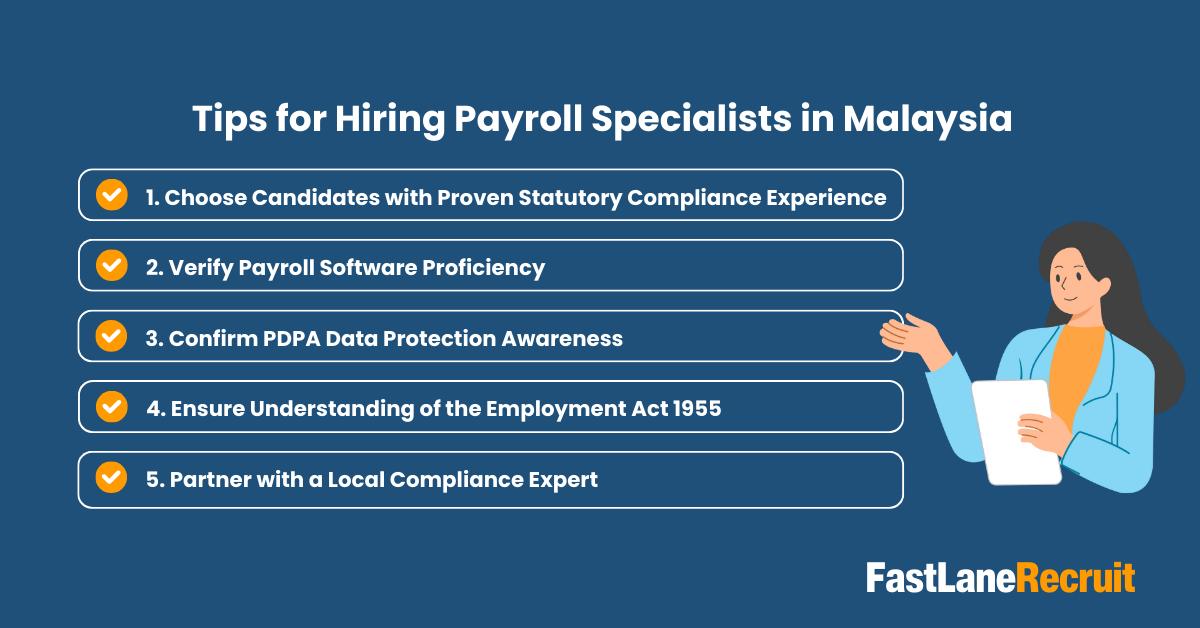
1. Choose Candidates with Proven Statutory Compliance Experience
Payroll specialists must be well-versed in EPF (KWSP), SOCSO, EIS, and PCB (monthly tax deduction) processes. Look for candidates who have hands-on experience submitting contributions accurately and on time. A strong track record in statutory compliance reduces errors, avoids penalties, and ensures your business stays aligned with Malaysian law.
Tip: Ask for examples of payroll compliance projects they’ve handled or any audits they successfully managed.
2. Verify Payroll Software Proficiency
Proficiency with payroll and HR software is essential for accuracy and efficiency. Common platforms in Malaysia include SQL Payroll, Autopay, Xero, QuickBooks, SAP, and local HRMS systems. Candidates should demonstrate experience managing payroll cycles, generating reports, and integrating statutory submissions into these systems.
Tip: Consider giving candidates a practical test or scenario to assess their software skills before hiring.
3. Confirm PDPA Data Protection Awareness
Payroll specialists handle highly sensitive employee data. Knowledge of the Personal Data Protection Act (PDPA 2010) is crucial to ensure employee information is protected and used appropriately. A candidate familiar with PDPA requirements will help your business maintain confidentiality, comply with legal obligations, and build trust with employees.
Tip: Include questions about data handling procedures and examples of how they ensure security in their previous roles.
4. Ensure Understanding of the Employment Act 1955
Malaysian payroll specialists must understand the Employment Act 1955, which governs working hours, overtime, leave entitlements, and employee rights. Awareness of this law ensures payroll calculations are accurate and aligned with statutory requirements, preventing disputes and potential legal issues.
Tip: Ask candidates to explain how they calculate overtime, annual leave, and statutory contributions according to the Act.
Also Read: Payroll and Compliance for HR Operations Teams in Malaysia
5. Partner with a Local Compliance Expert
Even with skilled payroll specialists, local regulations can be complex and subject to change. Partnering with a local compliance expert or EOR provider ensures your payroll operations stay up-to-date and compliant. These experts can also advise on best practices, handle statutory filings, and assist with multi-state or multi-country payroll setups.
Tip: Consider providers like FastLaneRecruit that offer EOR services, allowing you to hire skilled payroll specialists while ensuring compliance and efficiency without setting up a legal entity.
By following these tips, global companies can hire payroll specialists in Malaysia who are skilled, compliant, and ready to manage payroll accurately and efficiently, supporting both business growth and employee satisfaction.
Why Use FastLaneRecruit’s Employer of Record (EOR)?
Expanding your business into Malaysia and hiring skilled payroll specialists can be complex. Establishing a local entity, navigating statutory compliance, and managing HR administration require significant time and expertise. FastLaneRecruit’s Employer of Record (EOR) service simplifies this process, allowing global companies to hire and manage Malaysian payroll specialists efficiently, without setting up a local entity.
Here’s how FastLaneRecruit supports your business:
- Payroll processing
- EPF, SOCSO, EIS & tax compliance
- Employment contracts
- Statutory reporting
- HR administration
- Onboarding & offboarding
FastLaneRecruit handles the end-to-end payroll process for your Malaysian employees. This includes calculating salaries, allowances, overtime, and deductions accurately, ensuring employees are paid on time and in full compliance with local regulations. FastLaneRecruit ensures all contributions and filings are accurate and submitted on time, minimizing risk of non-compliance and penalties. Using FastLaneRecruit’s EOR allows you to hire Malaysian payroll specialists without the need for a local legal entity, saving time, cost, and administrative effort. This enables rapid market entry while maintaining full compliance with local employment and payroll regulations.
Partnering with FastLaneRecruit’s EOR service ensures that your Malaysian payroll operations are accurate, compliant, and efficient, while your teams can focus on growth and core business objectives. It’s a practical solution for global companies looking to engage local talent without the overhead of establishing a separate legal entity in Malaysia.
Also Read: HR Operations Analyst Salary Guide 2026
Conclusion
Malaysia offers one of Southeast Asia’s strongest payroll talent ecosystems. By engaging skilled payroll specialists, supported by compliant hiring models like FastLaneRecruit’s Employer of Record, global companies can scale confidently, maintain compliance, and focus on business growth.
Ready to Build Your Offshore Payroll Team in Malaysia?
Expanding your payroll operations into Malaysia doesn’t have to be complicated. With the right support, you can quickly establish a skilled offshore payroll team that integrates seamlessly with your in-house processes.
FastLaneRecruit makes it easy for global companies to hire and manage Malaysian payroll specialists without setting up a local entity. Our Employer of Record (EOR) services take care of all compliance, payroll processing, statutory contributions, employment contracts, and HR administration, ensuring your offshore team is fully supported and legally compliant.