A Guide for Global Employers
Expanding your business globally creates new growth opportunities, but payroll operations quickly become one of the most complex and risk-sensitive functions. Managing multi-country salaries, tax filings, statutory contributions, and labor law compliance across jurisdictions exposes companies to operational errors, regulatory penalties, and internal inefficiencies. This is why global employers are increasingly outsourcing payroll operations to specialist teams — not only to process salaries, but to build reliable, compliant payroll functions that can scale internationally.
In this guide, we’ll explore the benefits of payroll outsourcing, explain common challenges, and describe how solutions like FastLaneRecruit’s Employer of Record (EOR) service can simplify hiring and payroll for your international workforce. Global employers outsource payroll not only to improve efficiency, but to reduce operational risk — especially around approval workflows, audit trails, and consistent payroll controls across countries.
Content Outline
Key Summary
Payroll Is a Strategic Risk Area for Global Employers
Payroll errors, tax non-compliance, and late payments expose companies to financial penalties, legal issues, and employee dissatisfaction. Outsourcing payroll transforms payroll into a controlled, compliant operational function rather than a risky administrative task.
Outsourcing Payroll Improves Accuracy, Speed, and Compliance
Professional payroll outsourcing ensures accurate salary calculations, on-time payments, statutory filings, and full compliance with local tax and labor laws across every country you operate in.
Malaysia Is an Ideal Payroll Operations Hub
Malaysia offers a bilingual workforce, modern HR infrastructure, clear statutory frameworks (EPF, SOCSO, LHDN, PDPA), and strong time-zone alignment with APAC and Europe, making it a strategic location for centralized payroll operations.
EOR Models Enable Entity-Free Global Hiring
Employer of Record (EOR) solutions allow companies to legally hire payroll specialists in Malaysia without setting up a local entity, while maintaining full control over operations and eliminating Permanent Establishment risks.
Outsourced Payroll Enhances Employee Experience
Self-service portals, transparent payslips, accurate deductions, and on-time salaries build employee trust, improve retention, and reduce HR service workload.
Centralized Payroll Outsourcing Supports Scalable Growth
With centralized outsourcing and offshore payroll teams, companies can easily scale across countries, manage multi-currency payroll, and onboard new hires quickly while maintaining standardized payroll controls.
FastLaneRecruit EOR Enables Long-Term Payroll Capability
FastLaneRecruit allows companies to hire Malaysian payroll specialists, build compliant payroll operations, integrate payroll into HR/finance workflows, and scale across APAC, without local entity setup, compliance risk, or fragmented vendors.
What Is Payroll Outsourcing?
Payroll outsourcing refers to engaging a specialized provider to manage payroll execution, compliance, and reporting instead of handling these functions entirely in-house. Beyond salary processing, modern payroll outsourcing increasingly involves building dedicated payroll operations capability — including payroll specialists, compliance workflows, and secure payroll systems — to support multi-country teams. For many global employers, this means combining outsourced payroll operations with offshore payroll teams or Employer of Record (EOR) structures to ensure both execution accuracy and long-term scalability.
Outsourcing payroll helps businesses save time, reduce errors, stay compliant, and focus on their core operations, like growing the company or improving employee experience.
When you outsource payroll, providers typically ensure:
- Accurate and timely employee payments – Employees get paid the right amount on the scheduled pay date without delays or mistakes.
- Compliance with local tax and labor laws – The provider handles the rules for taxes, social security, and employment benefits in each country, avoiding fines or legal issues.
- Secure storage of payroll data – Sensitive employee information, like salaries and personal details, is stored safely using encryption and other security measures.
- Automation of repetitive payroll tasks – Manual calculations, reports, and filings are automated, reducing human errors and saving time.
Also Read: Building a High-Performing Offshore HR and Payroll Management Team in Malaysia (Singapore Edition)
Beyond Simple Payroll: What Providers Do
Modern payroll outsourcing isn’t just about calculating salaries. Trusted providers handle a wide range of tasks to make payroll smooth and worry-free. Here’s a closer look:
| Outsourced Payroll Function | What It Means | Example |
| Payroll account setup | Setting up employee profiles, salary structure, and deductions | Creating an employee record for Jane in Malaysia, including base salary, allowances, and EPF contributions |
| Payment method setup | Configuring how employees get paid, including local currency conversions | Paying employees in Malaysian Ringgit on the 25th of every month via bank transfer |
| Time tracking & leave management | Integrating attendance systems and calculating paid time off | Recording hours worked and automatically deducting leave days from Jane’s balance |
| Tax and social contributions | Calculating, withholding, filing, and paying taxes and statutory contributions | Filing EPF and SOCSO contributions on behalf of employees to stay compliant with Malaysia’s regulations |
| Reporting & documentation | Generating payroll reports, year-end statements, and maintaining compliance records | Preparing annual tax statements or audit-ready payroll reports for the finance department |
| Data security | Protecting sensitive payroll data using encryption, firewalls, and security standards | Using encrypted storage, access controls, and security best practices to reduce unauthorized access to sensitive payroll data. |
By outsourcing these functions, businesses can focus on growing the company and supporting their employees while leaving the complex and time-consuming payroll processes to experts.
Key Benefits of Outsourcing Payroll
When global employers build payroll operations through offshore specialist teams, they move beyond transactional payroll vendors. Through structures such as FastLaneRecruit’s Employer of Record (EOR) service, companies are able to legally hire Malaysian payroll specialists, establish compliant payroll workflows, and operate long-term payroll functions without setting up a local entity. This approach transforms payroll from an administrative burden into a controlled, scalable operational function.
Outsourcing payroll is not just about letting someone else handle calculations, it’s a strategic move that saves time, reduces risks, improves employee satisfaction, and supports business growth. Here’s a detailed look at the key benefits, explained with examples.
1. Compliance Across Jurisdictions
Managing payroll in multiple countries means juggling different tax codes, labor laws, and social security rules. Each country has its own requirements, and failing to comply can result in fines, penalties, or even legal trouble.
How outsourcing helps: Providers bring local expertise and make sure your payroll follows all rules, including:
- Inland Revenue Board of Malaysia (LHDN) – for personal income tax
- Employees Provident Fund (EPF) – mandatory retirement contributions
- Social Security Organisation (SOCSO) – workplace accident and injury coverage
- Department of Labour Malaysia (MOHR) – employment regulations
- Personal Data Protection Act (PDPA) – employee data protection
Example: A US-based company hires employees in Malaysia. Instead of trying to understand EPF, SOCSO, and LHDN rules, an outsourced provider calculates contributions automatically, files taxes on time, and ensures full compliance. The company avoids fines and keeps employees happy.
2. Saves Time and Reduces Errors
Payroll involves many repetitive and detail-heavy tasks:
- Calculating salaries and overtime
- Deducting taxes and benefits
- Filing statutory reports
- Maintaining records for audits
Doing all this manually is time-consuming and prone to errors.
How outsourcing helps: Automated systems reduce mistakes, calculate everything accurately, and generate reports quickly. Internal HR and finance teams can then focus on growth-oriented tasks, like recruiting, training, or strategy.
Example: A company with employees in five countries used to spend 10 hours per month processing payroll manually. After outsourcing, payroll is done in 2 hours, with automatic reporting and zero calculation errors.
3. Enhances Data Security
Payroll data is extremely sensitive, including salaries, bank account details, and personal information. If it’s mishandled, it could lead to fraud, identity theft, or data breaches.
How outsourcing helps: Reputable providers use enterprise-level security measures, such as:
- Encrypted servers for secure data storage
- Token-based authentication for login
- Regular security audits
- Secure document handling and retention policies
Example: Instead of storing payroll spreadsheets on a shared office computer, a company’s data is securely encrypted on the provider’s servers. Even if a laptop is lost or stolen, employee information remains safe.
4. Cost Efficiency
In-house payroll comes with hidden costs, including:
- Salaries for dedicated payroll staff
- Training and certifications
- Payroll software subscriptions
- Office space and equipment
How outsourcing helps: Businesses pay a predictable monthly fee for the service. They avoid hiring extra staff or investing in expensive software.
Example: A growing company needs payroll for 100 employees across multiple countries. Outsourcing costs less than hiring a payroll team in every country and avoids extra software licenses, saving tens of thousands annually.
5. Improved Employee Experience
Employees expect accurate and timely pay. Payroll mistakes or delays reduce trust, engagement, and retention.
How outsourcing helps: Providers offer self-service portals so employees can:
- View pay stubs and salary breakdowns
- Access tax documents
- Check leave balances and benefits
Example: An employee working remotely in Malaysia can log in at any time to see their salary details and submit reimbursement requests, even though the payroll is managed by a provider in another country. This improves trust and satisfaction.
Also Read: Building a High-Performing Offshore HR and Payroll Management Team in Malaysia (Hong Kong Edition)
6. Scalability and Flexibility
As companies expand, hire seasonal workers, or add contractors, payroll becomes more complex.
How outsourcing helps: Providers can quickly scale payroll services to match your workforce size and locations. They can handle:
- Onboarding new hires in multiple countries
- Payroll for temporary or seasonal staff
- Multi-currency payments for international employees
Example: A startup expands into Malaysia, Singapore, and Thailand. Instead of setting up separate payroll systems for each country, the outsourced provider handles all employees centrally, ensuring accurate pay and compliance.
7. Access to Expertise and Technology
Many small and medium businesses don’t have in-house experts for multi-country payroll. Outsourced providers bring specialized knowledge and modern payroll software.
How outsourcing helps:
- Expert teams understand local tax and labor rules
- Automation reduces errors and manual work
- Integration with HR, accounting, or ERP systems improves efficiency
Example: A company using an outsourced provider can generate an end-of-year tax report for all employees in Malaysia automatically, saving days of manual work.
In short: Outsourcing payroll transforms it from a complex, time-consuming, and risky task into a smooth, reliable, and scalable process. It ensures compliance, protects data, improves employee experience, and allows your team to focus on business growth.
Common Payroll Challenges
Managing payroll for a global workforce can be complicated. Companies face challenges ranging from local regulations to multi-currency payments. Here’s a closer look at the most common payroll challenges and how outsourcing can solve them:
| Challenge | How Outsourcing Solves It | Example |
| Complex Employment Laws & Tax Regulations | Local payroll experts ensure full compliance with labor laws, taxation, and statutory contributions. They stay updated with changes in legislation, so your business never misses a filing or contribution. | A company hiring employees in Malaysia doesn’t need to learn EPF, SOCSO, and LHDN regulations themselves. The outsourced provider calculates contributions and taxes automatically, avoiding fines or errors. |
| International Payments & Currency Exchange | Providers handle payroll in multiple currencies, convert amounts accurately, and manage banking logistics. They ensure employees are paid on time, regardless of location. | A business with staff in the US, Malaysia, and Singapore pays everyone on the same date. The provider converts salaries to MYR and SGD, handles local bank transfers, and accounts for transaction fees. |
| Data Privacy | Payroll providers use encryption, secure servers, and follow data protection laws such as PDPA or GDPR. This protects sensitive employee information from breaches and fraud. | Instead of storing payroll spreadsheets on office computers or emails, all payroll data is encrypted in a secure cloud system, accessible only to authorized personnel. |
| Permanent Establishment (PE) Risk | Using an outsourced payroll provider or EOR model allows companies to hire employees in foreign countries without setting up a legal entity. This mitigates tax and corporate obligations tied to establishing a local office. | A company wants to hire 10 employees in Malaysia. By using an EOR service, the provider becomes the legal employer, manages payroll, and handles statutory filings, avoiding costly registration and PE risks. |
| Resource Limitations | Outsourcing frees HR and finance teams from administrative payroll work, letting them focus on strategic priorities like employee engagement, hiring, and growth initiatives. | Instead of spending hours each month manually calculating salaries, the HR team can focus on recruiting new talent or improving employee experience while the payroll provider handles all calculations automatically. |
In FastLaneRecruit’s payroll and HR operations projects, these challenges consistently emerge when companies attempt to manage international payroll internally or across fragmented local vendors. Centralized payroll outsourcing combined with dedicated offshore payroll teams is typically the most stable long-term solution.
Real-World Examples
- Multi-Country Expansion:
A mid-sized tech firm expands into Malaysia, Singapore, and Thailand. Without outsourcing, HR would need to learn three sets of labor laws, tax codes, and banking systems. By outsourcing payroll, the company ensures compliance and on-time payments across all locations. - Contractor Payments:
A global business hires freelancers and contractors in multiple countries. Handling invoices, tax deductions, and currency conversions manually is prone to errors. Outsourced payroll providers automate payments, tax filings, and record-keeping, making the process seamless. - Seasonal Workforce:
A retail company hires temporary staff during the holiday season. Outsourced payroll scales automatically to handle fluctuations, so employees are paid accurately, and HR doesn’t get overwhelmed.
Payroll challenges grow with workforce size, geographical spread, and complexity of local regulations. Outsourcing provides expertise, automation, and compliance, turning these challenges into manageable, predictable processes.
Also Read: Building a High-Performing Offshore HR and Payroll Management Team in Malaysia (Australia Edition)
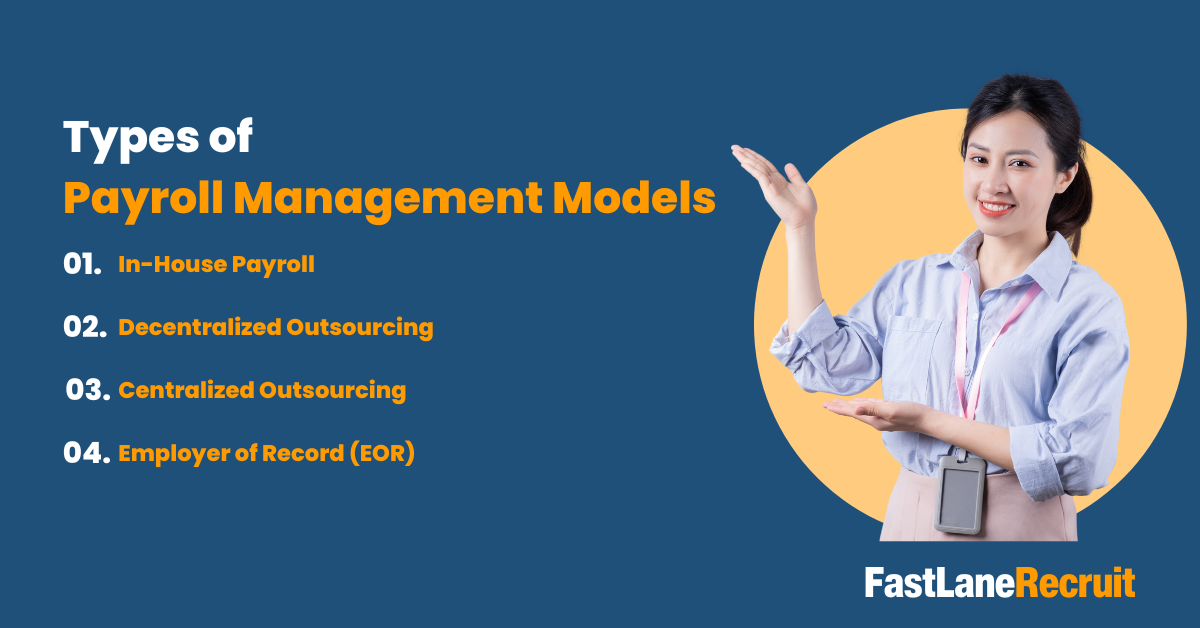
Types of Payroll Management Models
Global companies have several options for managing payroll. Each model has its own advantages and challenges, depending on your workforce size, locations, and business goals.
1. In-House Payroll
Description:
In-house payroll means your company manages payroll internally. HR or finance teams handle calculations, tax filings, benefits, and compliance themselves.
Pros:
- Full control over processes and employee data
- Direct oversight of payments and reporting
Cons:
- Time-consuming and labor-intensive
- High overhead costs (staff salaries, software, infrastructure)
- Risk of compliance errors if local laws aren’t fully understood
Example:
A US-based company hires employees in Malaysia but manages EPF, SOCSO, and LHDN filings manually. HR spends hours calculating salaries and deductions each month, and mistakes could result in fines.
2. Decentralized Outsourcing
Description:
Payroll is outsourced to local vendors in each country where the company operates. Each vendor manages payroll for its specific country.
Pros:
- Local expertise ensures compliance with country-specific labor laws
- Can handle small teams effectively
Cons:
- Fragmented payroll management
- Inconsistent processes across countries
- Higher coordination effort for global reporting
Example:
A company uses different payroll providers in Malaysia, Singapore, and Thailand. Each provider has its own system, making consolidated global reporting complicated and time-consuming.
3. Centralized Outsourcing
Description:
A single global payroll provider manages payroll across all countries. The provider handles compliance, reporting, and payments in a unified system.
Pros:
- Streamlined, consistent, and standardized payroll processes
- Reduced compliance risk
- Easier global reporting
Cons:
- Requires careful selection of an experienced and reliable provider
- Service fees may be higher than using local vendors
Example:
A tech company hires employees across 10 countries. Using a centralized global payroll provider, HR can generate consolidated reports for all employees, while payments, taxes, and benefits are handled automatically.
4. Employer of Record (EOR)
Description:
Under the Employer of Record (EOR) model, the provider becomes the legal employer in the target country while the company retains full operational control. In practice, this allows global employers to legally hire payroll specialists, build payroll operations teams, and run compliant payroll functions without establishing a local entity. The EOR manages payroll processing, statutory contributions, tax filings, contracts, and employment compliance, while the company integrates payroll staff directly into its internal finance or HR operations.
Pros:
- Eliminates Permanent Establishment (PE) risk
- Simplifies hiring in countries without a local entity
- Handles compliance, statutory contributions, and payroll
Cons:
- Service fee required
- Less direct control over legal employment
Example:
A US company wants to hire five employees in Malaysia but doesn’t have a local entity. Using an EOR, the provider becomes the official employer, manages EPF, SOCSO, and LHDN filings, and the company pays a monthly service fee while employees remain fully integrated into the team.
Outsourcing vs Building a Payroll Team
Many companies start by outsourcing payroll to software platforms or local payroll bureaus. While this approach may work for small teams, it often creates long-term limitations as companies expand internationally. Software vendors process payroll, but they do not build internal payroll capability. Local vendors typically operate country-by-country, which leads to fragmented reporting, inconsistent processes, and reduced operational control.
Increasingly, global employers are shifting toward building dedicated payroll operations teams through offshore hiring and Employer of Record (EOR) structures. This model allows companies to establish internal payroll capability — staffed by full-time payroll specialists — while outsourcing legal employment, statutory compliance, and regulatory administration.
Through partners like FastLaneRecruit, companies can recruit Malaysian payroll professionals, centralize payroll operations, and scale payroll functions across regions without setting up multiple foreign entities. This approach transforms payroll from a vendor-managed task into a controlled, scalable operational function. In practice, the most stable model is: build a payroll team for operational control, and use an Employer of Record for legal employment and statutory compliance.
How to Choose the Right Payroll Model
Choosing the right payroll model depends on your hiring footprint, compliance risk exposure, and whether you need entity-free hiring in new markets. Use the guide below to match your stage to the right structure.
- In-House Payroll: Best for companies operating in a single country with a small workforce and sufficient internal expertise.
- Decentralized Outsourcing: Works for businesses with a few employees in multiple countries but may lead to fragmented processes.
- Centralized Outsourcing: Ideal for companies with employees in multiple countries who want standardized, automated payroll with global visibility.
- EOR: Perfect for quick market entry, hiring remote employees, or companies expanding into countries where they don’t yet have a legal entity.
Scenario Example:
A startup plans to expand into Malaysia, Singapore, and the Philippines:
- In-house payroll: Would require learning three sets of local laws and managing three systems.
- Decentralized outsourcing: Requires three local vendors, complicating reporting.
- Centralized outsourcing: Provides standardized processes and unified reporting.
- EOR: Allows immediate hiring in Malaysia without a local entity, while the provider handles all compliance and payroll.
Also Read: How Outsourcing HR Operations Can Streamline Business Efficiency
When Should You Consider Outsourcing Payroll?
Payroll management may seem straightforward, but for global companies, it quickly becomes complex, time-consuming, and risky. Outsourcing can be the solution when your business faces certain challenges. Here’s when it makes sense to consider it:
1. Rapid International Expansion
Why it matters:
Expanding into new countries means handling multiple currencies, tax systems, labor laws, and compliance requirements simultaneously. Managing payroll internally in every country can quickly overwhelm HR and finance teams.
How outsourcing helps:
Global payroll providers or EOR services handle multi-country payroll seamlessly. They manage local compliance, statutory contributions, and payments, allowing your company to scale without delays or errors.
Example:
A SaaS company expands from Singapore to Malaysia, Thailand, and the Philippines. Instead of setting up separate payroll systems in each country, outsourcing allows them to onboard new employees immediately while ensuring accurate pay and local compliance.
2. Complex Multi-Country Payroll Regulations
Why it matters:
Each country has different labor laws, tax codes, social security contributions, and reporting requirements. Staying updated on regulations in multiple countries can be challenging and time-intensive.
How outsourcing helps:
Outsourced payroll providers bring local expertise to ensure compliance. They handle statutory filings, contributions, and legal requirements, reducing the risk of fines, penalties, or audits.
Example:
A company hires remote employees in Malaysia and Singapore. The provider ensures contributions to EPF and SOCSO in Malaysia and CPF in Singapore are calculated correctly and filed on time.
3. Recurrent Payroll Errors
Why it matters:
Payroll mistakes, like miscalculations, delayed payments, or incorrect tax deductions, can frustrate employees, damage trust, and even lead to legal consequences.
How outsourcing helps:
Providers use automated systems and expert staff to reduce errors. Payroll runs smoothly, accurately, and on time, improving employee satisfaction and preventing costly mistakes.
Example:
An HR team struggles with overtime calculations and tax filings for 50 employees across three countries. Outsourcing ensures all salaries, deductions, and statutory contributions are calculated accurately, avoiding penalties and employee complaints.
4. High Administrative Costs
Why it matters:
Managing payroll internally requires staffing, training, software subscriptions, and infrastructure. These hidden costs grow as your workforce expands.
How outsourcing helps:
Payroll providers charge a predictable fee, eliminating the need for additional staff or expensive software. This allows your business to allocate resources to growth-oriented initiatives.
Example:
Instead of hiring three payroll specialists for new international offices, a company uses an outsourced provider to manage all employees, saving tens of thousands in salaries, software, and training costs.
5. Limited In-House Expertise
Why it matters:
Internal teams may not have the specialized knowledge required to navigate multi-country payroll, tax regulations, or statutory compliance. Relying on undertrained staff increases risk.
How outsourcing helps:
Payroll experts handle all technical aspects, from statutory filings to tax deductions, ensuring accuracy and compliance. Your internal team can focus on strategic HR and finance initiatives.
Example:
A startup enters the Malaysian market. The HR team has no experience with EPF, SOCSO, or LHDN filings. An outsourced provider manages everything while guiding the company through local regulations.
6. Frequent Changes in Labor or Tax Laws
Why it matters:
Payroll regulations and labor laws change regularly. Companies must adapt quickly to avoid fines, penalties, or employee dissatisfaction.
How outsourcing helps:
Providers monitor legal and regulatory changes and update payroll systems automatically. Your business stays compliant without dedicating internal resources to constant research.
Example:
Malaysia updates its social security contribution rates. The outsourced payroll provider updates calculations automatically, ensuring employees are paid correctly and contributions are filed on time.
If your company is expanding internationally, struggling with compliance, experiencing payroll errors, or facing high administrative costs, it’s time to consider outsourcing payroll. With the right provider, you gain accuracy, efficiency, compliance, and peace of mind, letting your business focus on growth.
Also Read: Why Malaysia Is Emerging as a Hub for HR Operations Analysts
Checklist: Choosing the Right Payroll Solution
Selecting the right payroll provider is crucial for global businesses. The right partner ensures compliance, efficiency, and employee satisfaction while freeing internal teams to focus on growth. Use this checklist to evaluate payroll providers effectively:
1. Local Expertise in All Countries of Operation
Why it matters:
Payroll rules vary by country, including labor laws, statutory contributions, tax regulations, and employee benefits. A provider with local expertise ensures your payroll is handled correctly and legally in each country.
Example:
A company with employees in Malaysia, Singapore, and Thailand needs a provider who understands EPF and SOCSO in Malaysia, CPF in Singapore, and social security contributions in Thailand. This avoids costly mistakes and fines.
2. Compliance with Local Labor, Tax, and Data Protection Laws
Why it matters:
Non-compliance can result in penalties, legal issues, and damage to your company’s reputation. Providers must stay up-to-date with evolving laws in every region.
Example:
An outsourced payroll provider ensures income tax filings with the Inland Revenue Board of Malaysia (LHDN) are accurate and timely, while also maintaining PDPA-compliant data handling for all employees.
3. Scalable, Flexible Service Models
Why it matters:
Your business may grow, hire seasonal staff, or expand into new countries. Payroll providers should be able to scale services up or down without disrupting operations.
Example:
During a seasonal sales surge, a retail company hires temporary staff in Malaysia. The provider quickly adds these employees to the payroll system, calculates salaries and statutory contributions, and ensures timely payments.
4. Data Security Protocols and Certifications
Why it matters:
Payroll involves sensitive employee information, including personal details, bank accounts, and tax data. Providers must have strong cybersecurity measures and certifications like ISO 27001 or SOC2/3 to ensure data integrity.
Example:
All payroll data is stored on encrypted servers with multi-factor authentication. Regular audits confirm that no unauthorized access occurs, keeping employee data safe and compliant with regulations.
5. Integrated Payroll Automation and Reporting Tools
Why it matters:
Automation reduces errors, saves time, and provides real-time reporting for HR and finance teams. Integrated platforms also connect payroll with attendance, leave management, and accounting systems.
Example:
A global tech firm uses a payroll provider with automated salary calculations, tax filing, and consolidated reporting across three countries. HR can generate a report showing total payroll costs in local currencies in minutes instead of days.
Also Read: How to Hire HR Operations Analysts in Malaysia
6. Employee Self-Service Options
Why it matters:
Self-service portals give employees access to payslips, tax documents, leave balances, and benefits information at any time. This reduces administrative queries and improves employee satisfaction.
Example:
Employees in Malaysia can log in to view their pay stubs, download income tax forms, or update banking information directly, without contacting HR for every request.
7. Transparent Pricing and Predictable Fees
Why it matters:
Payroll outsourcing should be cost-efficient and predictable, avoiding hidden charges that can inflate budgets. Clear pricing models allow better financial planning for your business.
Example:
A provider offers a flat monthly fee per employee, including payroll, statutory filings, and reporting. This ensures there are no surprise costs as the workforce grows.
Key Takeaway:
When choosing a payroll provider, focus on compliance, expertise, automation, security, and scalability. Using this checklist ensures that your provider can support your global workforce efficiently while giving employees a reliable, seamless payroll experience.
Malaysia as a Strategic Payroll Hub
Malaysia has become a strategic payroll operations hub for global employers building offshore payroll teams. Global employers can use FastLaneRecruit to establish Malaysia-based payroll operations covering payroll processing, statutory compliance, reporting, and regional coordination. The country’s skilled bilingual workforce, established labor framework, and advanced HR infrastructure make Malaysia well-suited for long-term payroll capability development, not just transactional payroll outsourcing.
1. Strong Bilingual Workforce
Malaysia has a highly skilled, bilingual workforce fluent in English and Malay, with many professionals also proficient in Mandarin and Tamil. This makes communication seamless for global employers and ensures smooth collaboration across countries.
Example:
A US-based company hires Malaysian finance and HR staff through an EOR. Employees can communicate effectively with headquarters, handle payroll queries from regional offices, and work across international teams without language barriers.
2. Advanced HR and Payroll Infrastructure
Malaysia offers robust payroll and HR infrastructure, including:
- Modern HRIS systems and cloud-based payroll platforms
- Integration with attendance and leave management systems
- Secure payroll software compliant with international standards
Example:
A European company expanding in APAC uses Malaysia as a central payroll hub. The provider integrates employee attendance, leave, and salary data into one platform, automating payroll calculations and statutory filings across the region.
3. Clear Labor Laws and Statutory Contributions
Malaysia has well-established labor laws, statutory contributions, and payroll regulations, which make compliance straightforward:
- Employees Provident Fund (EPF) – retirement savings contributions
- Social Security Organisation (SOCSO) – workplace accident and injury coverage
- Inland Revenue Board of Malaysia (LHDN) – income tax filing
- Department of Labour Malaysia (MOHR) – employment regulations
- Personal Data Protection Act (PDPA) – data protection compliance
Example:
A company hiring multiple employees in Malaysia can rely on an EOR provider to calculate EPF, SOCSO, and tax contributions automatically, ensuring compliance without needing local legal expertise.
4. Time Zone Advantage for Regional Coordination
Malaysia’s GMT+8 time zone aligns well with key APAC markets such as Singapore, Hong Kong, and the Philippines. It also overlaps partially with European working hours, making coordination with global headquarters easier.
Example:
A UK-based company uses a Malaysian payroll hub to manage employees in APAC. The time zone alignment allows real-time reporting, payroll approvals, and problem-solving without delays, improving efficiency across offices.
Also Read: Payroll and Compliance for HR Operations Teams in Malaysia
5. Strategic Example: Using Malaysia as a Payroll Hub via EOR
Global companies can hire Malaysian staff through an EOR service, centralize payroll management, and remain fully compliant without creating a local entity.
Scenario:
A US startup wants to expand its sales and support team in APAC:
- Employees are hired in Malaysia via an EOR provider
- The EOR handles payroll, statutory contributions (EPF, SOCSO), tax filings, and compliance
- The company can manage payroll centrally from its headquarters, paying employees in local currency
- No need to register a legal entity in Malaysia, saving time and reducing PE risk
This setup allows the company to expand rapidly, stay compliant, and scale operations efficiently, making Malaysia a strategic choice for payroll outsourcing.
Key Takeaway:
With a skilled bilingual workforce, strong payroll infrastructure, clear labor laws, and favorable time zones, Malaysia is an ideal APAC hub for companies looking to centralize payroll operations. Using an EOR solution makes it even easier for global employers to hire, pay, and remain compliant without the complexities of establishing a local entity.
| When FastLaneRecruit is the right fit? You want to hire Malaysian payroll specialists without setting up a local entity You need statutory compliance support (EPF, SOCSO, LHDN) handled correctly You want payroll operations integrated into your finance/HR workflows You need scalable hiring for APAC without fragmented local vendors |
FastLaneRecruit EOR: A Smarter Way to Outsource Payroll Specialists
Managing international payroll is not only an administrative challenge — it is an operational control issue. FastLaneRecruit’s Employer of Record (EOR) service enables global companies to legally hire Malaysian payroll specialists, establish compliant payroll operations, and scale international payroll functions without setting up a local entity. Rather than simply outsourcing payroll processing, FastLaneRecruit supports companies in building structured payroll teams, integrating them into internal finance or HR departments, and maintaining full compliance across Malaysian statutory and labor requirements.
Why Choose FastLaneRecruit EOR for Hiring Malaysian Payroll Specialists
- Compliance Assurance: Stay fully compliant with Malaysian labor laws, tax regulations, and statutory contributions.
- Operational Efficiency: Reduce administrative workload for HR and finance teams.
- Employee Satisfaction: Accurate, timely pay and accessible self-service portals improve trust and retention.
- Scalable Solution: Easily expand your workforce in Malaysia or other APAC countries without additional legal entities or infrastructure.
Example Scenario:
A US fintech company wants to expand its APAC payroll team with specialists in Malaysia. Using FastLaneRecruit EOR, the company:
- Hires employees legally without registering a local entity.
- Pays salaries in Malaysian Ringgit, handles EPF, SOCSO, and tax filings.
- Integrates payroll with their existing finance software for smooth reporting.
- Onboards employees rapidly, reducing time-to-productivity.
This approach reduces risk, saves time, and ensures a seamless experience for both the employer and employees.
Key Takeaway:
FastLaneRecruit’s EOR service is a smarter, compliant, and scalable solution for companies looking to hire payroll specialists in Malaysia. By acting as the legal employer, managing payroll, and ensuring regulatory compliance, FastLaneRecruit allows global employers to focus on growth while providing a reliable, transparent payroll experience for their employees.
Learn more about FastLaneRecruit EOR and start expanding your global payroll team effortlessly.
Also Read: HR Operations Analyst Salary Guide 2026
Conclusion
Outsourcing payroll is no longer simply about reducing administrative workload. For global companies, it is increasingly about building reliable payroll operations, maintaining compliance control, and enabling international expansion without structural friction. By combining payroll outsourcing with offshore payroll teams and Employer of Record solutions, companies can establish scalable payroll functions that support long-term growth. Through FastLaneRecruit, global employers gain access to Malaysian payroll specialists, compliant employment structures, and operational payroll support — enabling them to expand internationally with speed, stability, and confidence.
Ready to Simplify Global Hiring and Payroll?
FastLaneRecruit’s EOR helps you hire Malaysian payroll specialists and run compliant payroll operations without setting up a local entity. You get structured onboarding, statutory compliance support, and reliable monthly payroll execution — so your internal teams can stay focused on growth.