
Payroll, Tax, and Compliance Explained
Hiring a DevOps engineers is a strategic move for companies looking to build scalable, secure, and cost-efficient infrastructure supported by strong local technical talent. But getting payroll, taxation, and compliance right is critical; errors can lead to fines, back payments, or reputational risk.
In this guide, we will walk you through the essentials: employer obligations, payroll mechanics, tax requirements, and compliance tips when employing a DevOps engineer in Malaysia, especially if you’re sourcing globally or using an Employer of Record (EOR) structure. At the end, you’ll see how FastLaneRecruit’s EOR service can simplify this process for you.
Content Outline
Key Summary
Payroll and Compliance Are Non-Negotiable
Hiring DevOps engineers in Malaysia isn’t just about offering a salary, it’s about ensuring legal compliance. Employers must handle EPF, SOCSO, EIS, and MTD deductions correctly to avoid penalties, protect their reputation, and build employee trust.
Core Laws Define Employer Responsibilities
Malaysia’s Employment Act 1955 and related regulations (EPF, SOCSO, LHDN, and EIS) form the foundation of payroll compliance. Understanding their scope ensures fair treatment of employees and safeguards against audit risks.
Proper Payroll Setup Ensures Smooth Operations
Employers must register with all statutory bodies, configure payroll correctly, and process monthly pay runs and filings on time. Using payroll automation or outsourcing can help prevent costly administrative errors.
Statutory Contributions Increase Total Hiring Cost
Beyond gross salary, employers must budget for additional costs like EPF (12–13%), SOCSO, and EIS contributions. A DevOps engineer earning RM15,000 may cost over RM17,000 monthly when statutory payments are included.
Compliance Mistakes Can Be Costly
Late payments, misclassified bonuses, and poor record-keeping can lead to fines, audits, or reputational damage. Companies should maintain digital payroll records, subscribe to legislative updates, and perform annual payroll audits.
EOR Services Simplify Cross-Border Hiring
For companies without a local Malaysian entity, partnering with a trusted Employer of Record (EOR) like FastLaneRecruit ensures seamless onboarding, full legal compliance, and transparent cost control — without the burden of setting up a local entity. The EOR handles contracts, payroll, tax filings, and employee benefits, allowing companies to hire quickly and legally.
FastLaneRecruit’s EOR Advantage
FastLaneRecruit provides full-service employment compliance from payroll registration and filings to benefit administration while offering faster onboarding, local expertise, and transparent cost structures. It’s the ideal choice for scaling DevOps teams in Malaysia.
Strategic Takeaway for Employers
Compliance is more than just a legal checkbox. It’s a trust multiplier, risk mitigator, and brand reputation protector — especially critical when hiring top-tier DevOps talent. Whether through in-house teams or an EOR, establishing robust payroll and compliance processes ensures smooth operations and long-term success in Malaysia.
Why Payroll & Compliance Matter When Hiring DevOps Engineers
Hiring a DevOps engineer is more than just filling a technical role; it’s a long-term investment in your company’s infrastructure, security, and agility. However, many global companies overlook one crucial part of this process: payroll and compliance. Whether you’re hiring locally or managing a remote team through an Employer of Record (EOR), understanding how Malaysia’s payroll system works is vital to staying compliant and building a trustworthy employer reputation.
Let’s break down why this matters:
1. High Expectations, High Stakes
DevOps engineers are highly skilled professionals who often command competitive compensation packages that may include bonuses, performance-based incentives, or stock options. Each of these payment types can have different implications for tax and statutory contributions under Malaysian law.
If employers miscalculate these deductions or fail to submit mandatory contributions on time, it can lead to serious issues such as underpayment, employee disputes, or even audits from authorities like the Lembaga Hasil Dalam Negeri (LHDN) or Employees Provident Fund (EPF).
In simple terms: one small payroll mistake can create big legal and financial problems.
Also Read: Top Professional SEO Services in the US
2. Cross-Border Complexity
If your company is headquartered outside Malaysia but hiring locally, payroll compliance becomes even more complex. You’re still legally required to adhere to Malaysian labor and tax laws — including contributions to EPF, SOCSO, EIS, and the Monthly Tax Deduction (MTD/PCB) system.
Many foreign employers assume that outsourcing or remote hiring means these responsibilities don’t apply, but that’s a misconception. The Malaysian government mandates that all employees working in Malaysia, regardless of the employer’s location, must be covered under local social protection and tax systems.
To navigate this, global companies often rely on a trusted Employer of Record (EOR) partner who handles all statutory deductions and ensures your business stays compliant without setting up a local entity.
3. Employee Trust and Retention
In today’s job market, employee experience goes far beyond salaries or perks. Developers, especially experienced DevOps professionals, value transparency and reliability. They expect clear payslips, accurate tax reporting, and confidence that their contributions to EPF or SOCSO are being properly remitted.
If an employee notices inconsistencies or delays in salary payments or deductions, it can quickly erode trust and motivation. In the tech industry, where competition for talent is fierce, that loss of confidence could mean losing your best engineers to competitors who offer better structure and transparency.
Proper payroll management isn’t just about compliance, it’s also about maintaining strong employer branding and long-term retention.
4. Regulatory Risk and Penalties
Malaysia enforces strict penalties for late or incorrect payroll submissions. For example:
- The EPF can impose 6% interest per annum for late payments.
- Under the Employees’ Social Security Act, SOCSO violations may result in fines of up to RM5,000 or imprisonment.
- LHDN may also impose penalties for incorrect income tax deductions or failure to file required forms such as Form E or EA.
These penalties don’t just affect finances, they can damage your company’s credibility and make it harder to attract top tech talent or secure business partnerships in Malaysia.
Before you onboard your first DevOps engineer, it’s essential to have a clear payroll and compliance strategy. Understanding Malaysia’s employment regulations and tax systems upfront will save you time, money, and headaches later on.
If you don’t have a local HR or finance team, consider working with a reliable EOR partner like FastLaneRecruit, who can manage payroll, statutory contributions, and tax compliance seamlessly, so you can focus on building world-class DevOps teams with confidence.
Also Read: How to Successfully Outsource Data Engineering
Core Legislation & Scope: What Governs Payroll in Malaysia
1. Employment Act & Coverage
The Employment Act 1955 (EA) is the cornerstone of Malaysian labor law. It outlines the basic employment terms and conditions, ensuring that employees receive fair treatment and protection at work.
The EA governs important aspects such as:
- Working hours and overtime pay
- Public holidays, rest days, and annual leave entitlements
- Maternity, sick, and hospitalization leave
- Procedures for termination and severance payments
However, the Act has income-based coverage limits:
- Employees earning above RM4,000 per month are excluded from certain protections (for example, overtime pay for work on rest days or public holidays).
- Despite this, many employers extend similar benefits contractually to maintain fairness and competitiveness.
Additionally:
- The EA only applies to Peninsular Malaysia, while Sabah and Sarawak are governed by their respective Labour Ordinances, which have similar but not identical provisions.
- The government is also considering ways to expand protection to gig and platform workers who meet certain employment-like conditions, such as working under supervision or fixed hours.
2. Other Key Statutes & Authorities
In addition to the Employment Act, employers must comply with several other laws and agencies responsible for managing payroll-related obligations. Each plays a specific role in ensuring employees are fairly compensated and protected:
- Lembaga Hasil Dalam Negeri (LHDN / IRBM) – Malaysia’s Inland Revenue Board oversees income tax.
Employers must register with LHDN and deduct employees’ income tax monthly under the Monthly Tax Deduction (MTD) or Potongan Cukai Bulanan (PCB) system. - Employees Provident Fund (EPF / KWSP) – A mandatory retirement savings scheme where both employers and employees contribute a percentage of monthly wages.
Employers are responsible for registering their staff, calculating the correct contributions, and remitting payments on time. - Social Security Organisation (SOCSO / PERKESO) – Provides social protection to employees in cases of workplace injury, disability, or death.
Contributions are mandatory for most employees and calculated based on salary tiers. - Employment Insurance System (EIS) – Managed by SOCSO, the EIS provides financial assistance and re-employment support to employees who lose their jobs involuntarily. Both employer and employee contribute a small monthly percentage.
- Human Resources Development Fund (HRDF / HRD Corp) – Applicable to employers in specific sectors such as services, manufacturing, and mining.
Companies with 10 or more employees are required to contribute 1% of their monthly payroll toward a training levy that funds employee upskilling programs.
3. Why This Matters
Before a company can legally process salaries in Malaysia, it must register with all relevant statutory bodies (LHDN, EPF, SOCSO, and if applicable, HRDF).
These registrations form the foundation for compliant payroll operations, ensuring employees receive the right benefits and that employers avoid penalties, audits, or reputational risk.
Understanding these laws is not just an HR formality, it’s part of building a responsible, trustworthy, and sustainable presence in Malaysia’s business landscape.
Also Read: Data Engineering Salary Guide 2025
Payroll Setup: From Registration to Pay Run
Hiring a DevOps engineer in Malaysia requires more than just offering a salary, you must ensure your company is properly registered, compliant, and ready to process payroll each month.
Below is a step-by-step overview of how payroll setup works in practice.
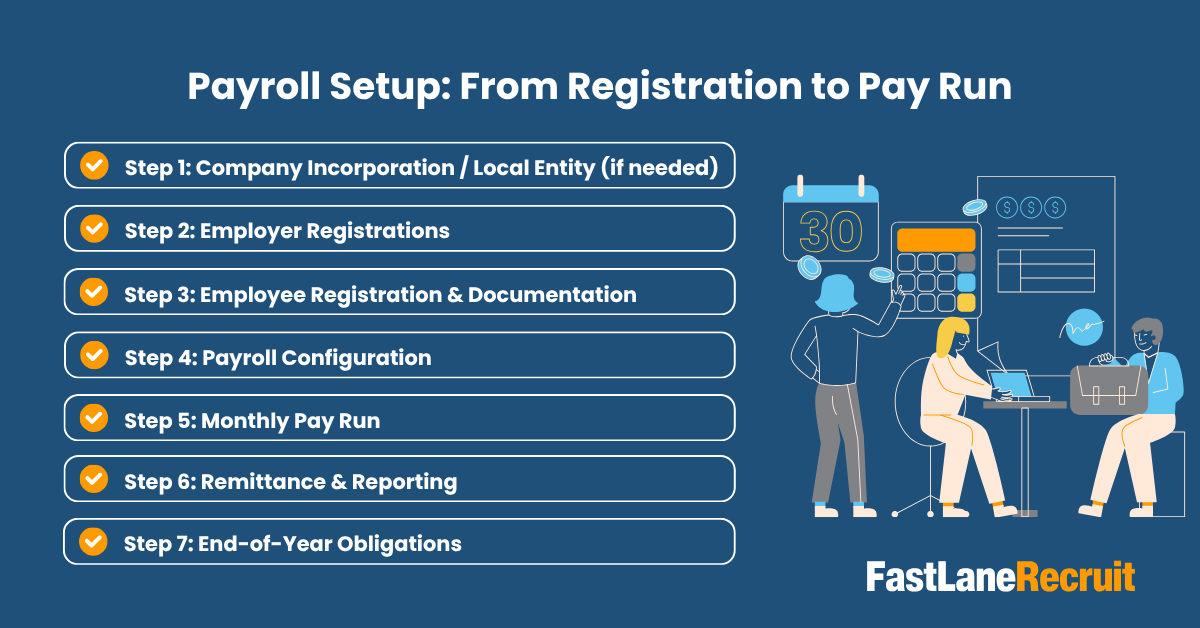
Step 1: Company Incorporation / Local Entity (if needed)
If your company does not yet have a registered business in Malaysia, you’ll need to establish one or partner with an Employer of Record (EOR) such as FastLaneRecruit.
An EOR allows you to legally hire and pay employees in Malaysia without setting up your own entity, saving time and cost.
Tip: An EOR is ideal for companies exploring Malaysia as a new talent hub — enabling rapid market entry, lean operations, and zero entity setup.
Step 2: Employer Registrations
Once you’re set up as an employer, you must register with Malaysia’s statutory authorities:
- LHDN (Inland Revenue Board) – for income tax (get Employer “E” number)
- EPF (Employees Provident Fund) – for retirement contributions
- SOCSO (Social Security Organisation) – for employment injury and disability protection
- EIS (Employment Insurance System) – for unemployment benefits
Each agency provides an online portal for registration and monthly submissions:
Step 3: Employee Registration & Documentation
Before running payroll, collect and verify your employee’s details:
- Identification – Passport or MyKad
- Work authorization – Employment pass or work visa
- Bank details – For salary payments
- Tax declaration form (CP22) – To notify LHDN of new employment
- Employment contract – Stating salary, benefits, and working terms
Note: Starting 1 October 2025, non-Malaysian employees will also be required to contribute to EPF (2% employee, 2% employer).
Step 4: Payroll Configuration
Define all components that make up your employee’s pay:
- Basic salary
- Allowances (e.g. transport, phone, housing)
- Overtime
- Bonuses or commissions
Ensure all these are correctly categorized, as many items are subject to statutory contributions like EPF and SOCSO.
Step 5: Monthly Pay Run
Each month, calculate:
- Gross salary (total earnings)
- Statutory deductions (EPF, SOCSO, EIS, and income tax/PCB)
- Net pay (amount paid to employee after deductions)
Use LHDN’s Monthly Tax Deduction (MTD) schedule or upload data to the e-PCB system for accurate calculations.
Step 6: Remittance & Reporting
After processing payroll, submit all payments and reports on time:
- MTD (tax): Pay by the 15th of the current month
- EPF, SOCSO, EIS: Pay by the 15th of the following month
Late payments can incur interest or penalties, so it’s best to use payroll automation software or outsource to professionals to stay compliant.
Step 7: End-of-Year Obligations
Before the new tax year:
- Issue EA forms to employees by end of February
- Submit Form E to LHDN by 31 March
- Reconcile payroll data for accuracy
Failure to meet these obligations can result in audits, fines, or compliance reviews.
Pro tip: Automate reminders or use integrated payroll tools to never miss deadlines.
Statutory Contributions & Deductions in Practice
When paying a DevOps engineer, you’ll manage several mandatory deductions and employer contributions.
| Statutory Item | Who Contributes | Typical Rate | Purpose |
| EPF (Employees Provident Fund) | Employee: 11% Employer: 12–13% | Based on monthly wages | Employee retirement savings |
| SOCSO (Social Security) | Both employer & employee | Based on salary tiers (e.g. up to RM69.05 total) | Protection for work-related injury, disability, or death |
| EIS (Employment Insurance System) | Both employer & employee | ~0.2% each | Unemployment and re-employment support |
| MTD / PCB (Monthly Tax Deduction) | Employee only | Based on LHDN schedule | Monthly income tax deduction |
Example: DevOps Engineer Payroll Breakdown (RM 15,000/month)
| Component | Amount (RM) | Explanation |
| Gross Salary | 15,000 | Base monthly salary |
| Less: EPF (Employee, 11%) | –1,650 | Statutory employee retirement contribution (11% of RM15,000) |
| Less: SOCSO + EIS (Employee) | –41.65 | Based on the highest wage tier: SOCSO RM29.75 + EIS RM11.9 |
| Less: MTD / PCB (Tax) | –1,200 (approx.) | Estimated monthly tax deduction based on reliefs, rebates, and bonuses |
| Net Pay to Employee | ≈ 12,108.35 | Take-home salary after statutory deductions |
| Add: EPF (Employer, 13%) | +1,950 | Employer retirement contribution (13% of RM15,000) |
| Add: SOCSO + EIS (Employer) | +116.05 | SOCSO RM104.15 + EIS RM11.9 |
| Total Employer Cost | ≈ 17,066.05 | True total cost to the company |
Notes:
- SOCSO: For wages exceeding RM6,000, the employer’s contribution is capped at RM104.15 and the employee’s at RM29.75.
- EIS: For wages exceeding RM6,000, both employer and employee contribute RM11.9 and RM11.9, respectively.
- MTD/PCB: Varies based on individual tax profile; RM1,200 is a conservative estimate for this income bracket.
- Gross Salary+EPF (Employer)+SOCSO/EIS (Employer) = Total Employer Cost
- Learn more about SOCSO and EIS.
While a DevOps engineer’s salary may appear as RM 15,000 per month, the actual employer cost rises to around RM 17,000+ when statutory contributions are included.
This highlights why careful payroll budgeting and compliance are essential when hiring in Malaysia.
Also Read: Hiring Data Engineer in Malaysia
Key Compliance Pitfalls & How to Avoid Them
Managing payroll for Malaysian employees, especially skilled professionals like DevOps engineers, requires precision and consistency. Even small compliance errors, such as a missed EPF payment or a misclassified allowance, can lead to financial penalties or damage to your company’s reputation. Below is an overview of common payroll compliance pitfalls, the risks they carry, and practical ways to avoid them.
| Common Mistake | Risk / Consequence | How to Avoid It (Mitigation Tip) |
| 1. Late remittance of EPF / SOCSO / MTD | Late submissions attract interest or fines — for example, the EPF charges 6% per annum on late payments, and SOCSO can impose fines of up to RM5,000 or imprisonment for repeated offences. | Automate reminders and payment schedules. Use reliable payroll software or outsource payroll to professionals who track statutory deadlines automatically. |
| 2. Misclassifying allowances and bonuses | Some payments that should be subject to EPF, SOCSO, or tax deductions are mistakenly excluded, causing underpayment of contributions and audit risks. | Review the EPF’s official definition of “wages” regularly to ensure all fixed and variable payments are correctly categorized. Train HR teams to identify contribution-eligible pay items. |
| 3. Poor record-keeping (manual or paper-based) | Missing payslips, receipts, or contribution records can create compliance gaps and difficulties during audits or employee disputes. | Shift to digital payroll systems with cloud-based data storage. Maintain secure electronic records for at least seven years as required under Malaysian tax law. |
| 4. Not staying updated with legislation changes | Payroll thresholds, contribution rates, and tax tables are periodically revised. Failing to apply updates can result in incorrect deductions or delayed filings. | Subscribe to official updates from LHDN, KWSP (EPF), and SOCSO. Regularly review announcements on malaysia.gov.my to stay informed. |
| 5. Overlooking non-Malaysian employee obligations | Starting October 2025, EPF contributions become mandatory for non-Malaysian workers. Failure to comply may result in penalties and employees losing retirement benefits. | Review your employee database early. Update payroll systems and contracts to include the new EPF contribution requirements for foreign hires. |
| 6. Failure to issue EA Forms / Form E on time | Late or missing filings can trigger fines, audits, and reputational risk. Employers must issue EA Forms by February and submit Form E by March 31 each year. | Integrate filing deadlines into your annual payroll calendar and set automated reminders. Payroll software can help generate and file these forms accurately and on time. |
Practical Recommendations
1. Create a Payroll Compliance Checklist
Maintain a checklist that includes all monthly, quarterly, and annual obligations such as EPF, SOCSO, EIS, and tax filing deadlines. Review it regularly and update it when legislation changes.
2. Conduct Internal Payroll Audits
Perform regular internal audits (at least once a year) to ensure accuracy across contributions, employee classifications, and tax deductions. This proactive step can help detect issues before an external audit occurs.
3. Implement Reliable Payroll Software
Adopt modern payroll systems like Talenox, Kakitangan, or Xero that automatically update tax and contribution rates and integrate with Malaysia’s statutory portals (LHDN, EPF, and SOCSO).
4. Outsource to a Professional Employer Organization (PEO)
If managing payroll internally creates administrative drag, consider leveraging FastLaneRecruit’s EOR service to ensure full statutory compliance while freeing your team to focus on core engineering objectives. An EOR manages payroll, tax filing, and compliance for your Malaysian team ensuring every pay run meets local legal requirements.
Also Read: Data Engineer Hiring Guide
Key Takeaway
Compliance isn’t just about avoiding penalties; it’s about building trust with your employees and protecting your business from unnecessary risk. By adopting structured payroll processes, using automation tools, and keeping up with legal updates, employers can ensure their operations in Malaysia remain fully compliant and efficient.
To simplify compliance and payroll management for your Malaysian hires, explore FastLaneRecruit’s EOR Services, your trusted partner for seamless cross-border employment and payroll compliance.
Recommendations & Best Practices for DevOps Recruitment Payroll
- Local market benchmarking: Use Malaysian DevOps salary benchmarks (e.g. from job portals) to define total compensation.
- Clarity in contract: Explicitly state what components are taxable, what are bonuses, and how deductions work.
- Transparent payslips: Provide payslips that clearly break down gross, statutory deductions, and net pay.
- Annual reviews & variable pay: Plan for performance bonuses or stock options, but include clear tax treatment.
- Grace periods & probation: Align with the Employment Act’s notice and probation rules.
- Audit readiness: Always maintain digital, auditable records for 7 years (or as required) in case of regulatory review.
- Stay updated: Legislation evolves. For example, EPF contributions for non-citizens will kick in 2025.
Outsourcing vs In-House vs EOR: What’s Best for DevOps Teams?
When expanding your DevOps team to Malaysia, one of the most critical decisions is how you’ll manage employment, payroll, and compliance. Global companies typically choose among three main approaches: setting up an in-house entity, outsourcing payroll to a local provider, or partnering with an Employer of Record (EOR).
Each model has its benefits and trade-offs. The best fit depends on your company’s stage of growth, headcount, and long-term strategy in Malaysia.
Also Read: Why Should You Hire Data Engineers in Malaysia?
1. Setting Up a Local Entity + In-House Payroll Team
How It Works:
You establish a legal entity in Malaysia and register with all relevant statutory bodies (LHDN, EPF, SOCSO, EIS). Your HR or finance team manages payroll, taxation, and compliance internally.
Pros:
- Full control over payroll processes and employee management
- Strong local presence and long-term business foundation
- Suitable for large-scale or permanent expansion
Cons:
- High administrative overhead (entity setup, tax filings, local director requirements)
- Requires continuous compliance monitoring and reporting
- Long onboarding timeline — not ideal for fast-growing DevOps teams
Recommendation:
This model works best for companies planning to hire more than 20 full-time employees in Malaysia and establish a permanent operational presence.
2. Outsourcing Payroll to a Local Payroll Provider or BPO
How It Works:
You maintain your Malaysian entity but delegate payroll operations, including payslips, statutory filings, and tax calculations to a local payroll service provider or Business Process Outsourcing (BPO) firm.
Pros:
- Reduces administrative workload
- Access to local payroll expertise and compliance specialists
- Keeps payroll data centralized with your own entity
Cons:
- Still requires you to handle local employment contracts and legal obligations
- Must ensure the provider integrates correctly with your HR and accounting systems
- Ultimate compliance liability remains with your company
Recommendation:
Ideal for mid-sized teams with an existing entity in Malaysia that need professional payroll processing without full HR outsourcing.
3. Using an Employer of Record (EOR) / Professional Employer Organization (PEO)
How It Works:
With an EOR model, your DevOps engineers are legally employed by a trusted local partner (like FastLaneRecruit) while you maintain day-to-day control of their work. The EOR manages all statutory and payroll compliance, from onboarding to offboarding, under Malaysian law.
Pros:
- No need to set up a Malaysian entity
- Full compliance with Malaysian labor, tax, and social security laws
- EOR handles payroll, EPF, SOCSO, EIS, and MTD deductions
- Simplified onboarding for foreign and local employees
- Fast market entry and flexible scaling
Cons:
- Slightly higher per-employee cost compared to in-house management, but far lower legal and operational risk
Example:
Global providers like RemotePeople highlight how EORs “handle all mandatory employment obligations, including EPF, SOCSO, EIS, and income tax withholding, on your behalf.”
However, the difference lies in local expertise and responsiveness. A global EOR may know compliance in theory, but a Malaysian-based provider like FastLaneRecruit offers hands-on support with real-time knowledge of local labor updates, digital filing systems, and on-ground employment norms.
Why FastLaneRecruit’s EOR Solution Stands Out
FastLaneRecruit specializes in helping global tech firms scale DevOps and IT teams in Malaysia without the complexity of local incorporation.
Here’s how FastLaneRecruit’s Employer of Record (EOR) service adds value:
| Feature | What FastLaneRecruit Offers |
| Local Compliance Assurance | Handles all EPF, SOCSO, EIS, and MTD filings on your behalf using official portals like KWSP i-Akaun, PERKESO ASSIST, and LHDN e-PCB. |
| Legal Employment & Payroll Management | Acts as the legal employer in Malaysia, managing contracts, payroll runs, and benefits while you manage the work deliverables. |
| Faster Hiring & Onboarding | Onboards your DevOps engineers in days, not months, without entity setup. |
| Cost Transparency | Provides a clear breakdown of gross salary, employer costs, and statutory contributions upfront. |
| Reduced Risk Exposure | FastLaneRecruit assumes responsibility for local compliance errors, reducing your company’s legal exposure. |
Tip: Evaluate EORs Beyond Just Pricing
When comparing EOR providers, always ask:
- How do they handle local audits or statutory investigations?
- Do they provide legal indemnity in case of payroll or tax errors?
- Are they integrated with Malaysia’s digital submission systems (LHDN, EPF, SOCSO)?
- Can they support multi-country scaling if you expand to Singapore or Hong Kong?
A reputable EOR like FastLaneRecruit should offer full transparency, indemnity coverage (within reasonable limits), and documented processes to protect your business from compliance risk.
Final Recommendation
For tech-driven businesses expanding into Malaysia, the EOR model offers the best balance of speed, compliance, and scalability. Instead of navigating entity setup, tax codes, and HR regulations, you can focus on what matters most, building and leading a high-performing DevOps team.
With FastLaneRecruit’s Employer of Record services, you can confidently hire and manage DevOps engineers in Malaysia while we handle every aspect of local employment compliance from onboarding to payroll, benefits, and statutory filings.
Start your Malaysia hiring journey today with FastLaneRecruit’s EOR service.
Simplify global expansion, stay compliant, and focus on your engineering goals, we’ll take care of the rest.
Conclusion
Successfully hiring a DevOps engineer in Malaysia goes far beyond simply agreeing on salary. You must understand the full compensation package, configure payroll correctly, register and remit statutory contributions, and maintain airtight compliance. Mistakes are expensive, financially and reputationally.
Build and Scale Your DevOps Team in Malaysia — Without the Compliance Headache
Whether you’re hiring your first DevOps engineer or scaling a distributed team, FastLaneRecruit’s EOR solution lets you focus on building technology, while we handle legal employment, payroll, tax, and compliance.
